
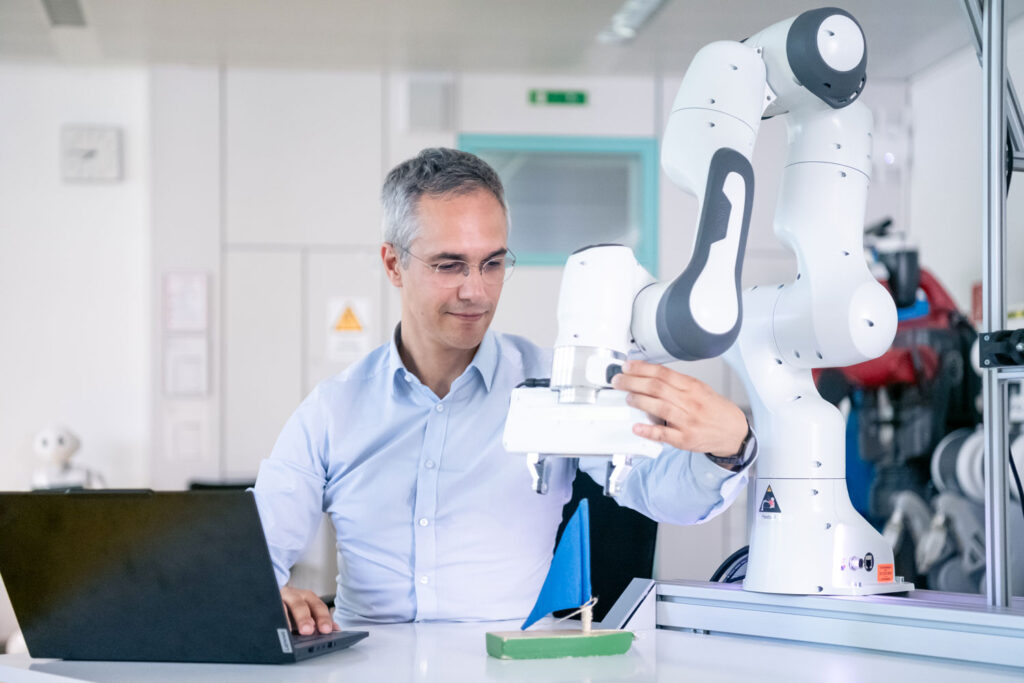
Robots that learn from people rather than only from prewritten programs are moving closer to practical use. Jens Kober, newly appointed Professor of Cognitive Robotics at the University of Stuttgart, is focusing on how users can guide and train robots directly. For manufacturing and other variable environments, that interaction is central to making robotic systems more adaptable.
Kober heads the new Department of Learning and Interactive Robots at the Institute for Artificial Intelligence at the University of Stuttgart. His work starts from a practical limitation: many robots are effective when a task is fixed, repetitive, and clearly defined. However, cognitive robots are expected to operate in changing surroundings.
That difference matters in applications ranging from household assistance and hospital logistics to greenhouse harvesting, construction work, supermarket shelf stocking, surgery support, and industrial manufacturing. In each case, the robot must do more than repeat a single programmed motion. It has to observe its environment, respond to changes, act independently when necessary, and work alongside people.
For production professionals, the most relevant point is not the list of possible applications itself, but the underlying challenge. Small production runs, changing products, and different task conditions make it unrealistic to prepare a robot in advance for every scenario. Kober’s research therefore focuses on learning methods that allow robots to be trained further in their actual area of use.
Human guidance becomes part of the robot workflow
Cognitive robots combine several technical elements, including sensor technology, speech recognition, control systems, AI methods, and human-machine interaction. Kober’s research is concerned with how these components can support learning beyond basic programming. The aim is not simply to add more stored instructions, but to enable the robot to improve its behavior through interaction with people.
This interaction can take different forms. Users may guide the robot through a keyboard, a touchscreen, or even physical contact. In each case, the data needed for further training is gathered directly from the exchange between human and machine. Kober describes this as involving people directly in the learning process, much like coaches guiding athletes or teachers guiding students.
That comparison is relevant because it shifts the role of the user. Instead of relying only on specialists to predefine every action, the person who understands the task can help shape how the robot performs it. In a production setting, that could be important where process knowledge is held by operators, technicians, or engineers working close to the application. The robot learns from those who know the requirements of the task.
Learning must work beyond one exact situation
A key technical challenge is generalization. Kober is not interested only in robots that can store new information and repeat it immediately. The larger goal is for cognitive robots to apply what they have learned to similar but not identical situations. This distinction is essential in environments where variation is normal rather than exceptional.
The press release gives several examples: every household is different, every supermarket product can present a new handling situation, every patient is individual, and every small production run in industrial manufacturing may bring its own requirements. These examples point to the same problem. A task may look similar from the outside, but the practical details change.
Programming every possible variation in advance is therefore seen by Kober as unrealistic. His approach is to make it possible for future users and human colleagues of intelligent machines to train the robots themselves. This is especially relevant where the operating environment cannot be reduced to one fixed sequence. The robot must be able to adapt without losing the structure and reliability needed for useful work.
For manufacturers, this raises a practical question: how easily can a robotic system be adjusted when the product, workpiece, or task changes? Kober’s work addresses that question from the learning side. If the robot can be taught by the people closest to the process, adaptation becomes less dependent on exhaustive preprogramming.
From algorithms to interaction in real applications
Kober’s previous work has focused mainly on developing and optimizing algorithms. At the University of Stuttgart, he now intends to place stronger emphasis on human-machine interaction. The shift is significant because algorithms alone do not determine whether a robot can be used effectively in a real working environment.
The stated goal is to bring research out of the laboratory and into practical applications. That requires attention to how people communicate with robots, how training data is collected during that interaction, and how the robot converts guidance into behavior that can be reused. For cognitive robotics, the interface between user and machine is therefore not an accessory. It is part of the learning system.
Stuttgart provides a setting where this work can span basic research and application-oriented development. According to Kober, the region combines university and non-university AI and robotics research institutions with an industrial sector willing to invest in robotics, AI, and machine learning. This environment gives his department a route to work across the full spectrum, from fundamental research to practical use cases.
For industry, the development to watch is not a single robot model or isolated application. It is the move toward systems that can be trained in context, by people who understand the task, and adjusted to conditions that cannot all be predicted in advance.