DMG MORI will use its Open House in Bielefeld from June 23 to 26, 2026, to show how turn-mill machining, automation, additive manufacturing, and digital functions are being combined into broader production strategies. The event focuses on practical process chains for manufacturers facing more complex parts, tighter accuracy requirements, and pressure to use machines more efficiently.
The Bielefeld site has a strong role within DMG MORI as a center for turn-mill technology and automation. During the open house, around 25 machines will be used to demonstrate production concepts based on the company’s Machining Transformation approach, known as MX. The program also includes seminars and workshops on current machining topics. DMQP partners will present peripheral equipment such as tools, tool presetting systems, and metrology solutions.
A central message of the event is that individual technologies are increasingly being considered as part of complete manufacturing chains. In this view, turning, milling, additive manufacturing, automation, digital functions, and lifecycle services are not separate topics. They are elements that need to work together. For users, the relevance lies in reducing setups, stabilizing processes, and making existing and new production capacity easier to use.
Complete machining reduces setups
Turn-mill centers are becoming more important as component geometries become more complex. DMG MORI will present models from the CTX TC and CLX TC series, which are designed for 6 sided complete machining. The practical benefit is clear: work that previously required at least two machines and several setups can be carried out in one working area.
This is achieved by combining turning, milling, and, where required, gear cutting and grinding in one machine concept. The result is not only fewer handling steps, but also a more consistent process. The part remains within one coordinated machining environment for more operations. Therefore, quality can be supported, transfer related variation can be reduced, and production planning can be simplified.
The CLX 450 TC is positioned as an entry level model for universal turning and milling. At the upper end of the portfolio, the CTX gamma 3000 TC is designed for workpiece lengths up to 3,000 mm. Solutions with a B axis and an optional lower turret are aimed at economical production turning, especially where flexibility and multi process capability are required within the same machine platform.
Automation for better machine utilization
Automation is presented in Bielefeld as a necessary part of making turnkey machining productive. Long machining cycles and stable quality require reliable loading and unloading, especially when machines are expected to run efficiently over extended periods. Automated handling also changes the use of skilled labor, giving staff more scope for work planning, process supervision, and quality control.
DMG MORI will show several automation approaches for different production situations. Bar feeders remain relevant for series production, where continuous material supply is important. For small and medium batches, flexible workpiece and pallet handling systems are more suitable because they allow different parts and jobs to be managed with less manual intervention.
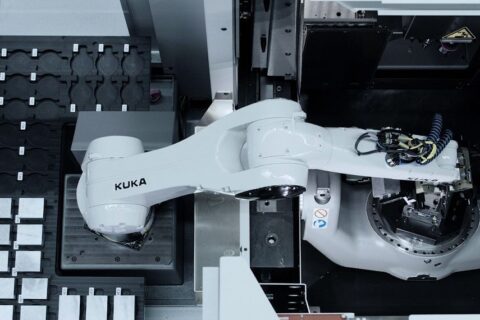
One focus is the third generation of Robo2Go, including the Robo2Go Milling 3. Generation version. The Robo2Go Max, with a payload of 210 kg, will also be shown live. For 5 axis simultaneous machining, the modular PH Cell 300 will be presented on a DMC 75 monoBLOCK. DMG MORI also points to retrofit solutions, allowing existing machines to be automated and integrated into updated production concepts rather than replaced outright.
Additive manufacturing linked to machining
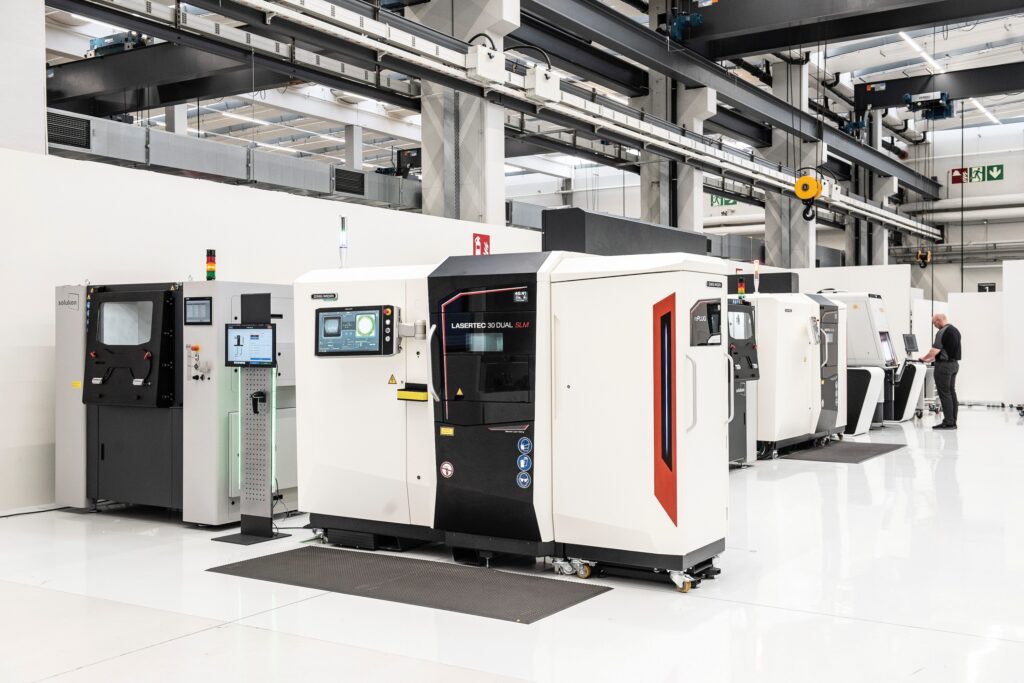
The open house will also include additive manufacturing process chains based on metal 3D printing in the powder bed on LASERTEC SLM machines, followed by post processing on universal machines such as the DMU 50 or DMU 65 monoBLOCK. The emphasis is not on additive manufacturing as a standalone route, but on combining it with machining where functional surfaces, threads, and bores must meet defined accuracy requirements.
This combination is relevant because additive manufacturing can create geometries that are difficult to produce conventionally, including cooling channels that closely follow the contours of tools. Machining then provides the final functional quality where it is required. In practice, the value lies in matching design freedom with reliable finishing, rather than treating printing and milling as separate production worlds.
DMG MORI supports this transition through its Additive Intelligence consulting unit. According to the company, the team helps users identify suitable components and develop the associated process. The process is first tested in the Bielefeld additive manufacturing facility before production is transferred to the customer’s site.
BX machines as an entry point to MX
The BX portfolio is presented as a lower threshold entry into the MX approach. Machines such as the CLX 550 TC for turning and milling and the DMX 60 U for 5 axis machining are positioned for daily production applications while allowing users to adopt selected elements of process integration, automation, and connectivity.
Even in their basic configuration, these machines are designed with process integrated and automated manufacturing in mind. Depending on the application, they can be combined with automation options and the CELOS X control platform. Digital functions such as DMG MORI technology cycles are also part of the wider MX environment.
For manufacturers, the relevance is not only the machine itself, but also the ability to build gradually toward more integrated production. A company may start with a machine suited to current parts and batch sizes, then add automation, digital connectivity, or application specific options as requirements grow. This makes the BX range part of the same discussion as larger turnkey systems, but at a more accessible level.
Lifecycle support and spare parts availability
Machine availability remains a practical concern throughout the lifecycle of a production system. DMG MORI will also address spare parts supply in Bielefeld, including the identification of suitable original spare parts, delivery times, and long term support for older machines.
The company links this with digital services and retrofit measures. For users, this matters because downtime affects planning reliability, delivery performance, and machine utilization. Retrofit options can also help existing equipment meet new production requirements, particularly when automation or updated service concepts are introduced.
Within the MX framework, DMG MORI groups its activities around process integration, automation, Digital Transformation, and Green Transformation. At the Bielefeld event, these themes are shown through machines, automation systems, additive process chains, and service concepts that are intended to function as connected production systems rather than isolated technologies.