
OPEN MIND’s hyperMILL 2026 release focuses on faster NC program creation and more reliable machining processes. The update extends NC code based simulation in hyperMILL VIRTUAL Machining to additional tool types and angle heads. It also adds functions for rest machining, turning preparation, turret configurations, and electrode path control.
For manufacturing companies using CAD/CAM software across milling, turning, mill-turning, and electrode production, the value of a release like this lies less in individual features than in how consistently programming, simulation, and collision checking are linked. Version 2026 addresses that connection in several areas where manual checks or additional programming work can affect process reliability.
A central change is the integration of angle heads into CAM programming and virtual machining. The release also extends support for 2D Hale machining, redesigns algorithms for rest material machining, and adds tools to enrich turning contours with manufacturing information. In practice, these functions are aimed at reducing manual preparation, improving the reliability of simulated machine behavior, and giving programmers more control over difficult machining situations before the NC program reaches the machine.
Angle heads become part of the programmed tool
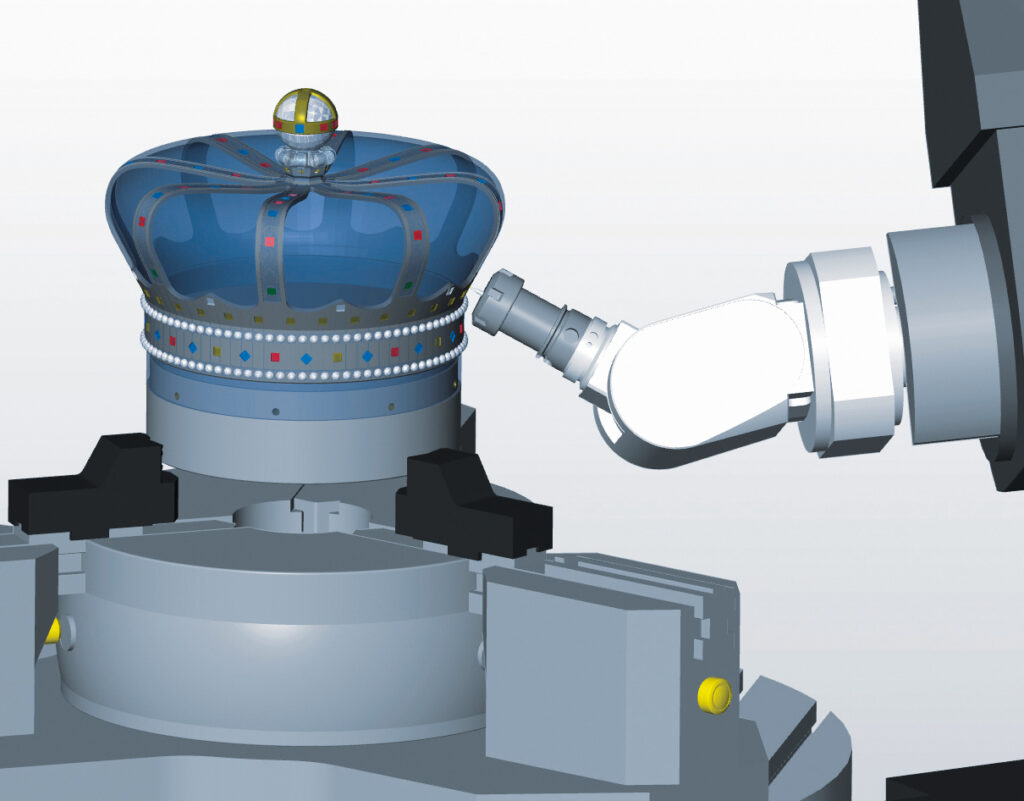
In hyperMILL 2026, angle heads can be integrated directly into CAM programming. The angle head is defined as part of the NC tool and configured in the hyperMILL TOOL Builder. Therefore, the virtual machine can include the angle head consistently during NC code generation, toolpath optimization, simulation, and collision checking.
That consistency is important because angle head machining often involves restricted access and movements that are difficult to verify reliably without a complete machine simulation. The software simulates critical phases such as approach and retraction, including angle head behavior. The hyperMILL VIRTUAL Machining Optimizer also automatically optimizes toolpaths for angle head machining.
Another practical addition is the option to approach via a curve. According to OPEN MIND, this enables safer access to areas of a component that are hard to reach. The function is initially available for Siemens SINUMERIK 840D and Heidenhain controls. For users working with these control systems, the update brings angle head programming closer to the same workflow used for other NC tools, with simulation and collision checking included throughout the process.
2D Hale machining
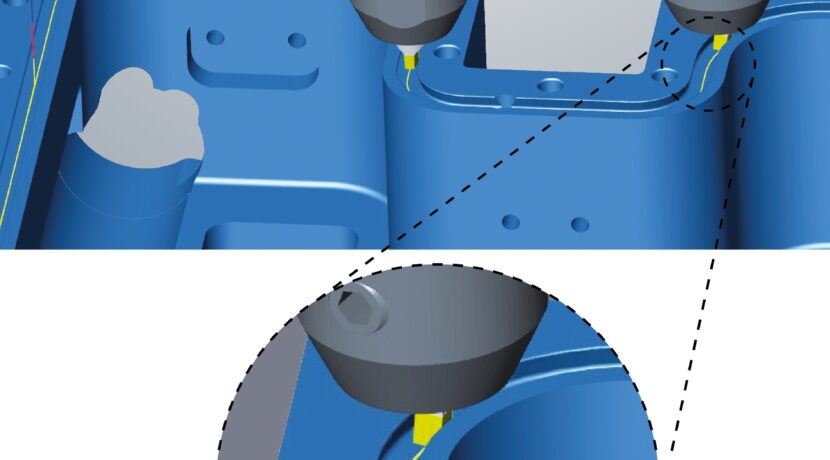
Version 2026 also supports 2D Hale machining, also known as contour planing, in both machining strategies and simulation. The process is intended for applications requiring scratch-free sealing surfaces, including battery manufacturing, the semiconductor industry, and mold and die work.
The software uses spindle axis functions as a trailing axis, so the tool is guided continuously perpendicular to the contour. This is relevant for surface quality because sealing surfaces often depend on controlled tool orientation and consistent contact behavior along the machined contour. By including the process in both strategy creation and simulation, hyperMILL 2026 allows programmers to check the planned motion before machining.
The update does not treat 2D Hale machining as an isolated tooling choice. It is part of the broader CAM and virtual machining environment, which means the same emphasis on programmed tool behavior and simulated machine movement applies. For users producing sealing surfaces, the practical benefit is a more structured way to prepare and verify contour planing operations within the CAM system.
Rest material machining
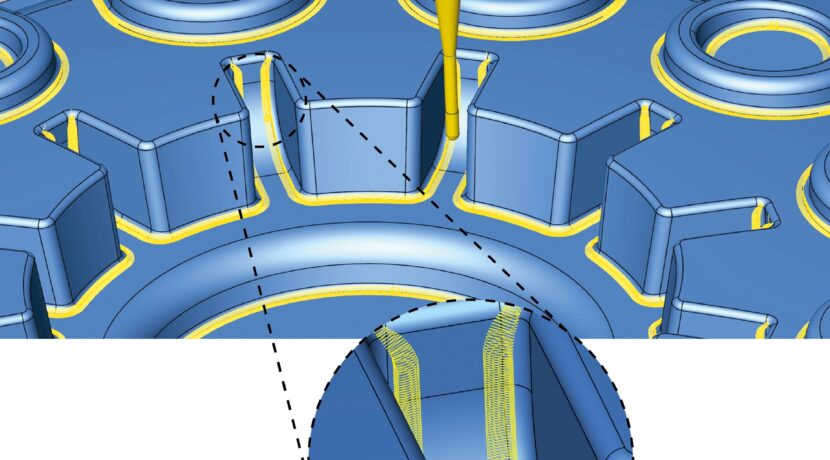
OPEN MIND has redesigned the calculation algorithms for rest material machining in the Z-level, Parallel, and Normal strategies. The aim is to make the processing of remaining material areas more reliable and efficient in both 3D and 5-axis machining.
Rest material areas are now detected with higher accuracy and machined more consistently. The system also takes feed specifications into account, resulting in more uniform toolpaths. This matters because rest machining often follows earlier roughing or finishing operations, where small remaining areas can be difficult to identify and machine without unnecessary air cuts, uneven engagement, or additional programming checks.
The release also automatically integrates a smooth overlap in steep, flat, and transitional areas during entry and exit movements. For 5-axis machining, users can set a new Minimum Clearance Angle. This option defines a minimum distance between the tool shank and the part, so machining is carried out with a specified clearance angle. The added control is especially relevant where tool orientation, part geometry, and remaining material have to be coordinated closely to avoid conflicts during machining.
Programming turned and mill-turned parts
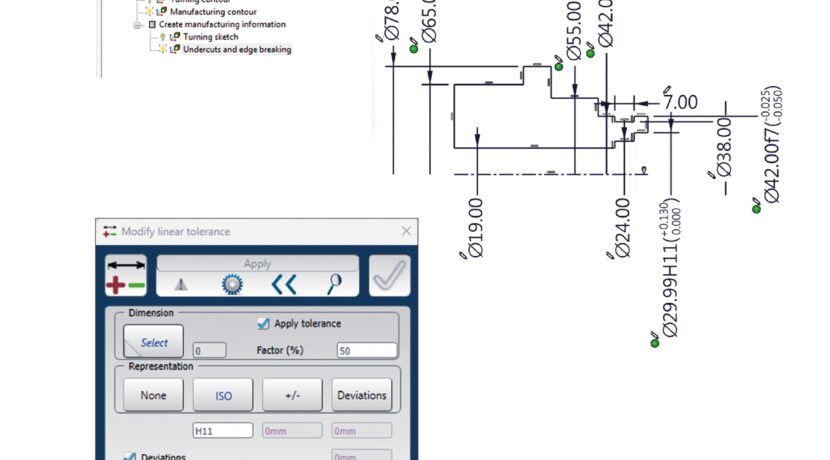
The release includes CAM Plan Turning, a function aimed at programming turned and mill-turned parts. OPEN MIND notes that turning programming often starts with geometries that do not include tolerances, fits, or other manufacturing information. Until now, this information had to be added manually, which takes time and can introduce errors.
CAM Plan Turning allows turning contours to be enriched with the relevant manufacturing information in a more consistent way. For programmers, this reduces the amount of manual data entry required before a contour can be used for machining. It also supports process reliability because the manufacturing information is linked to the turning contour rather than being recreated separately.
The hyperMILL TURNING Solutions have also been expanded with new complex turret-type machine configurations. These configurations are intended to improve collision checking. For mill-turned parts and machines with complex turret layouts, this is a relevant addition because reliable collision checking depends on the software representing the machine configuration closely enough to evaluate tool and component movement during the planned operation.
Electrode paths get more flexible movement control
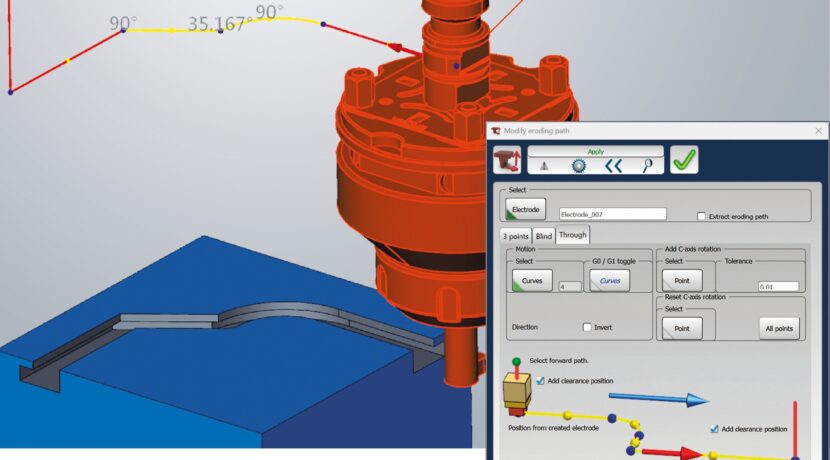
The hyperMILL Electrode module has also been updated. In version 2026, control of eroding paths has been improved, allowing more flexible use of feed and rapid movements. According to OPEN MIND, this makes it possible to optimize eroding paths and shorten machining times.
The change is focused on movement control rather than a new electrode workflow. By giving programmers more flexibility in how feed and rapid movements are used, the module can better adapt the eroding path to the intended operation. For companies using hyperMILL for electrode preparation, this adds another area where programming decisions can be refined inside the CAM environment before production.