
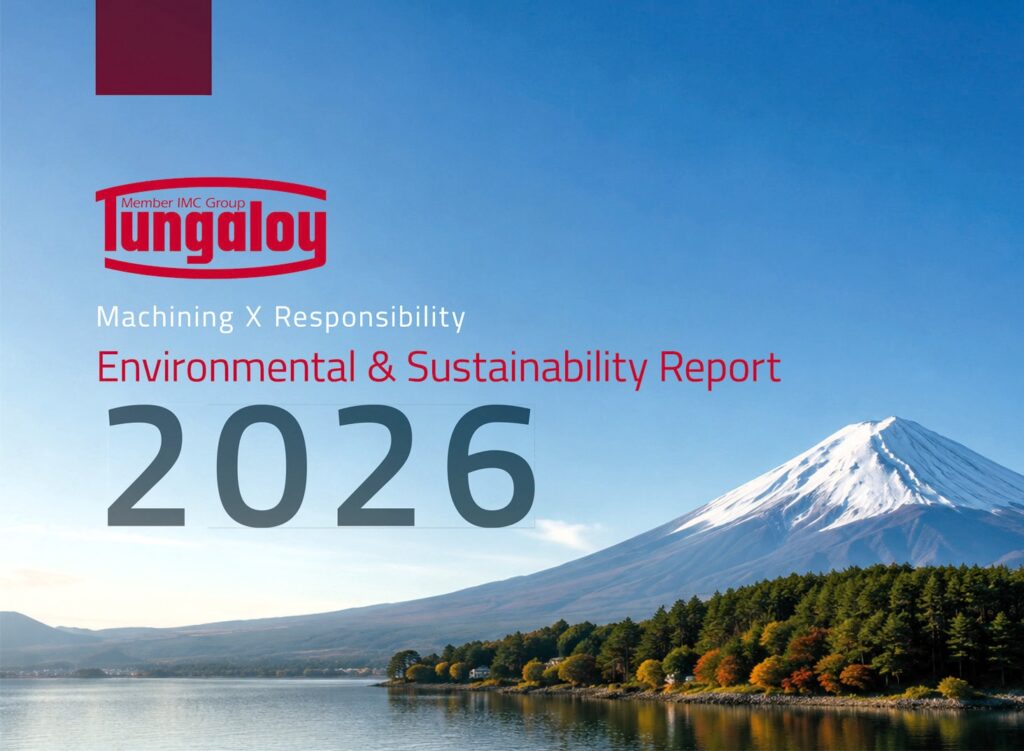
Tungaloy Corporation has published its 2026 Environmental & Sustainability Report. It outlines the company’s environmental performance and the sustainability initiatives completed in 2025. The report places product development, manufacturing operations and machining solutions within a broader effort to lower emissions, improve resource use and support responsible operations across the value chain. The report is based on Tungaloy’s “Think Green” philosophy. This approach links environmental responsibility to internal operations and to the tooling and machining solutions supplied to customers. Rather than treating sustainability as a separate activity, the company presents it as an engineering and manufacturing issue.
This includes energy use in production, the materials incorporated into cutting tools and the potential for machining processes to reduce consumption and waste. Tungaloy structures its reporting around three strategic pillars: Climate & Energy, Material & Product Efficiency, and Safe & Responsible Operations. Together, these areas cover improvements at the company’s own sites. They also address the role of machining technology in improving productivity and reducing resource requirements during use.
Climate and energy measures in manufacturing
Under its Climate & Energy pillar, Tungaloy identifies renewable energy, energy optimisation and operational improvements as key routes for reducing emissions. The report presents manufacturing operations as an important area for environmental action. In particular, it highlights opportunities to lower energy use through process changes and daily management. This focus on operational improvement is relevant to cutting-tool production. Material processing and manufacturing activities are central to the business. The published information does not provide individual performance figures. However, it identifies emissions reduction as a long-term objective. That objective is supported by practical measures involving energy sourcing and energy efficiency. By covering climate and energy alongside product and operational topics, Tungaloy connects its environmental work with how industrial products are designed and manufactured. The approach also reflects the fact that lower-emission manufacturing depends on more than one technology or initiative. Therefore, it requires attention to energy use, production conditions and the continuous improvement of operating practices.
Machining solutions and material efficiency
Material & Product Efficiency forms the second pillar of the report. Tungaloy links this area to machining solutions designed to improve productivity while reducing energy consumption, carbide use and material waste. For metalworking companies, these factors are closely connected. A more efficient process can influence both machining output and the resources required to achieve it. The report therefore places cutting-tool development within a wider discussion of resource efficiency. It specifically identifies carbide usage, energy and waste. This indicates that the company considers both the material content of tooling and its performance in machining applications. This focus extends beyond Tungaloy’s own manufacturing operations. The company states that its engineering work supports more sustainable manufacturing throughout the value chain. This includes machining solutions supplied to customers worldwide. In practical terms, the report presents productivity improvements as more than an output issue. They can also help reduce the energy and material inputs associated with machining.
Responsible operations and employee engagement
The third reporting pillar, Safe & Responsible Operations, covers environmental management, employee engagement and community initiatives. This part of the framework broadens the report beyond energy and materials. It places responsibility within the company’s manufacturing culture and organisational practices. Environmental management provides an operational structure for the other two pillars. Employee engagement indicates that sustainability initiatives are not limited to product development or corporate targets. Community initiatives are also included in the company’s responsible manufacturing approach. Tungaloy describes this overall direction as “Machining × Responsibility”. The 2026 report presents the concept as a combination of engineering innovation, responsible manufacturing and customer-focused solutions. Founded in 1934 and operating as part of the IMC Group, Tungaloy supplies cutting tools and industrial solutions to sectors including automotive, aerospace, energy and general engineering.
Read the full 2026 Environmental & Sustainability Report here.