
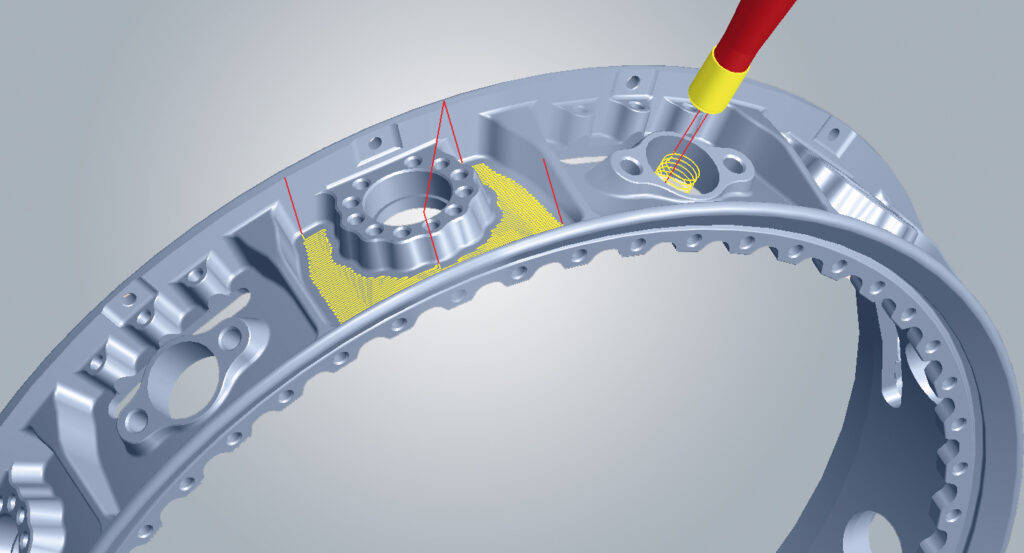
Aerospace manufacturers face demanding machining challenges. Complex geometries, difficult materials and strict quality requirements leave little room for error. With hyperMILL, OPEN MIND provides CAD/CAM technology for manufacturing processes designed to comply with AS9100 and EN9100 requirements. The software combines 5-axis machining, turning and milling strategies with NC code-based simulation to support process planning and reliable machining.
Weight is a critical factor in aerospace manufacturing. Components need to be as light as possible without compromising structural strength. This presents considerable challenges when machining engine parts, landing gear, structural assemblies and components for electric vertical take-off and landing (eVTOL) aircraft. The same applies to rocket components, from thrust frames and fasteners to fuel tanks.
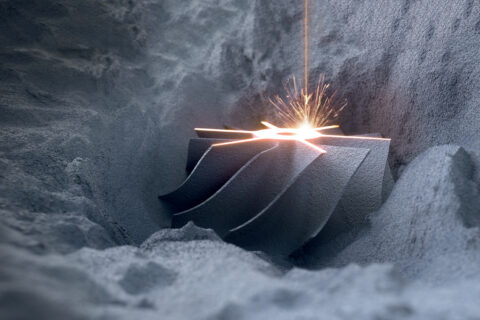
Producing these parts often means dealing with intricate geometries, tight dimensional tolerances and demanding surface-finish specifications. OPEN MIND addresses these requirements with its hyperMILL CAD/CAM suite, which combines advanced 5-axis machining technologies with turning and milling strategies. Dedicated solution packages are also available for complex components such as blisks and impellers.
However, machining performance is only part of the equation. Aerospace manufacturers must also work within strictly controlled production processes. hyperMILL supports manufacturing processes designed in accordance with EN9100, the European aerospace quality-management standard, and AS9100, its international counterpart. This makes the software relevant for manufacturers that need to combine advanced machining technology with clearly defined quality requirements.
Knowing what to expect before machining begins
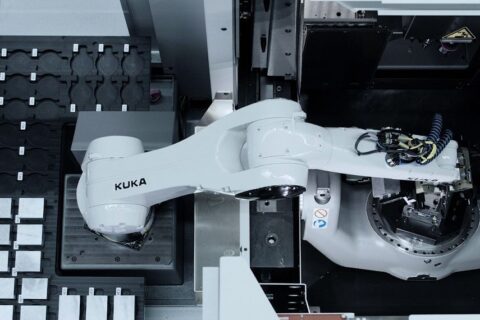
An error in an NC program can be expensive, particularly when machining high-value aerospace components that require many hours of machine time. Discovering a problem after machining has started can result in lost material, damaged tools and valuable production time going to waste. This is where hyperMILL VIRTUAL Machining comes into play. By simulating machining operations based on the actual NC code, the software helps identify potential problems before the program is executed on the machine. The objective is to make the virtual machining process correspond as closely as possible to what happens on the shop floor.
Denton Lewis, CAM Manager at aerospace contract manufacturer Western Precision Products, has experienced this in practice. According to Lewis, the company knew what to expect when the program reached the machine because the simulation accurately reflected the actual machining process.
This level of predictability is particularly valuable when producing components with complex surfaces and coordinated multi-axis movements. Blisks and impellers, for example, require carefully controlled toolpaths to machine areas that can be difficult to access. With CAD/CAM programming and virtual simulation working together, manufacturers can evaluate their machining operations before committing expensive material and machine capacity.
Material selection adds another layer of complexity. Titanium, Inconel, superalloys and fibre-reinforced composites are widely used in aerospace applications, but they can be challenging to machine. Cutting tools and machine tools are subjected to considerable loads, making process stability and tool wear important considerations. OPEN MIND has developed machining strategies intended to reduce wear while supporting safe and stable production.
From 150 kg of aluminium to a 10.5 kg component
Not every aerospace machining challenge is about difficult materials. Sometimes, the biggest task is simply removing enormous amounts of material while maintaining the accuracy and stability of the remaining structure.
Many lightweight aerospace components start as large solid blanks. Most of that material needs to be removed to create pockets, ribs and thin walls. The result may be a relatively light component, but getting there requires substantial machining time and carefully selected cutting strategies. hyperMILL addresses this challenge with High-Performance Cutting strategies designed for efficient material removal. One example comes from Shreeram Aerospace & Defence, which uses the software to manufacture aluminium antenna reflector panels.
The starting blanks weigh approximately 150 kg. By the time machining is complete, only 10.5 kg remains. The finished panels feature numerous pockets and walls measuring just two millimetres thick. Machining such thin structures requires particular attention to cutting forces, surface quality and component stability. Using hyperMILL, the company reports improving surface roughness from Ra 0.8 μm to Ra 0.4 μm, including in areas with two-millimetre pocket walls. At the same time, hyperMILL MAXX Machining helped reduce roughing time from 40 to 30 hours. That represents a substantial reduction in machining time for components requiring extensive material removal.
From the machine shop to orbit
Aerospace manufacturing continues to evolve as new materials, component designs and manufacturing methods emerge. OPEN MIND is working with research institutes to explore these developments and further adapt its machining technologies to the industry’s requirements.
The applications already extend well beyond conventional aircraft manufacturing. According to OPEN MIND, components programmed with hyperMILL are currently being used in satellites orbiting Earth. It is another example of how CAD/CAM technology supports the production of complex components, whether they are destined for an aircraft, a rocket or a satellite.