
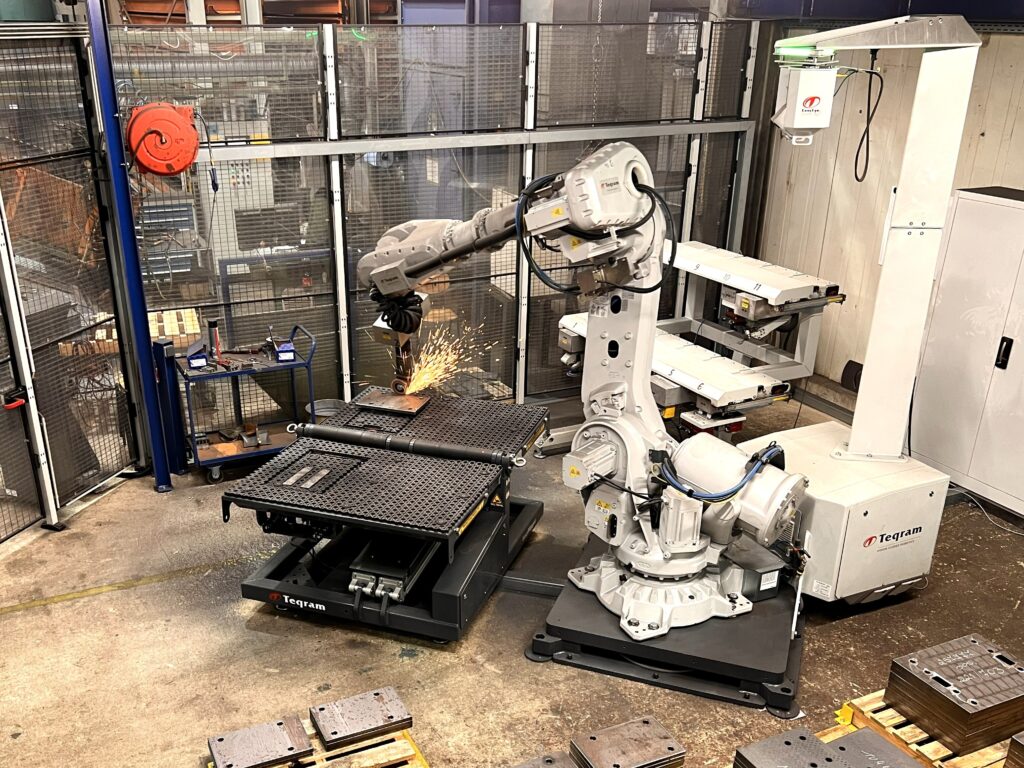
Peters Stahlbau has automated demanding P3 grinding work with Teqram’s EasyGrinder robot, known on the shop floor as Susi. The investment responds to rising finishing requirements in steel construction, where manual edge rounding, burr removal, and removal of the heat-affected zone place growing pressure on operators, process stability, and production time.
The company in Itterbeck, Germany, manufactures complex steel structures for industrial and commercial construction projects across Europe. Around 180 employees work on components that increasingly require a high level of surface preparation before further processing or coating. For projects with preparation grade P3, edges must be rounded to at least 2 mm, and the hardened heat-affected zone must be removed completely.
According to workshop manager Frank Evers, finishing requirements have increased significantly in recent years. That development has practical consequences on the shop floor. Manual grinding of large steel components is physically demanding, repetitive, and difficult to keep consistent during longer shifts. As volumes rise, small deviations can lead to rework, additional material use, and pressure on delivery schedules. Peters Stahlbau therefore looked for a way to make the process more reproducible without adding complexity to daily production.
P3 work demands stable grinding conditions
Preparation grade P3 leaves little room for variation in edge finishing. Removing cutting burrs, rounding edges to the required radius, and eliminating the heat-affected zone all depend on controlled contact between tool and workpiece. In manual work, that control relies heavily on operator strength, experience, and endurance. Over a shift, fatigue can influence force, angle, and dwell time, which makes consistent results harder to maintain.
This was one of the main reasons Peters Stahlbau moved toward robot-supported grinding. The EasyGrinder performs the operation with repeatable movements and does not lose force or concentration during multi-shift production. Evers describes the effect clearly: “Our EasyGrinder, affectionately called Susi, delivers consistent P3 quality and works without fatigue, even across multiple shifts.” For a steel construction company dealing with demanding surface preparation, that consistency is not only a quality issue. It also affects planning, because predictable cycle times make it easier to organize work around downstream steps.
Integration without robot programming
A decisive factor in the selection was the way the EasyGrinder fits into existing production. Peters Stahlbau chose the system because it does not require robot programming and can be operated directly by the machine operator. That matters in a steel construction environment, where batch sizes, component geometries, and project requirements can vary and where automation must support the workshop rather than create a separate specialist task.
The robot was brought into the process without a long start-up phase. Its acceptance on the shop floor is reflected in the nickname Susi, which suggests that operators see the system as part of the team rather than as a distant automation project. For practical implementation, this is important. A robot that is technically capable but difficult to use may remain underutilized. In this case, the emphasis is on intuitive operation and a workflow that allows grinding tasks to be transferred without disrupting the established production rhythm.
Lower tool consumption and less manual strain
The economic effect of automated grinding is not limited to labor time. Peters Stahlbau also reports a considerable reduction in grinding material and tool consumption. One specific example is disc use. As Evers notes, “The robot uses grinding discs completely down to the backing pad, a result that is difficult to achieve manually.” In manual grinding, declining force or changing handling conditions can lead to discs being replaced before their full usable life is reached.
The same process stability also helps extend the service life of standard angle grinders. More controlled use reduces unnecessary stress on the tool and creates a more predictable pattern of wear. For a workshop with recurring P3 work, these savings can become relevant alongside the more visible quality benefits.
Ergonomics is another major factor. Heavy grinding tasks place substantial physical strain on employees, especially when repeated over long periods or across shifts. By transferring a significant share of this work to the EasyGrinder, Peters Stahlbau reduces the burden on its workforce. In a market where skilled labor is difficult to find and retain, removing the most strenuous tasks from daily routines can help keep experienced employees focused on work where their judgment and craftsmanship add the most value.
Automation aimed at repeatable finishing quality
The project shows how robotics is entering areas of steel construction that have long depended on manual skill. Teqram develops robotic systems with integrated AI for tasks such as grinding, with an emphasis on simple integration and repeatable results. At Peters Stahlbau, the EasyGrinder is used for a clearly defined production challenge: making P3 grinding less dependent on physical endurance while improving process stability.
For fabricators facing similar requirements, the case highlights a practical direction for automation. The goal is not to replace the knowledge needed in steel construction, but to remove variability from demanding, repetitive finishing operations. When edge rounding, burr removal, and heat-affected-zone removal can be carried out with consistent quality and predictable consumption of grinding materials, the workshop gains more control over both output and working conditions.