
German machine tool manufacturer Spinner produces virtually all essential components for its machines itself. From spindles and turrets to electrical cabinets and automation solutions, everything is developed, manufactured and tested in-house. A visit to the company’s factory in Sauerlach shows how this approach results in high-quality machines that closely match the requirements of the Dutch market.
The German family-owned company Spinner was founded in 1949 as a small workshop for precision mechanical components. In the post-war years, machine tools were difficult to obtain, prompting the founders to build their own equipment. This pragmatic beginning led to a major shift in the 1960s, when Spinner developed into a fully-fledged machine tool manufacturer with a clear focus on turning and milling machines. Today, the second generation manages the company, which has grown into an international player employing around one thousand people. Approximately three hundred of them work in Germany, spread across two main locations.
Everything in-house
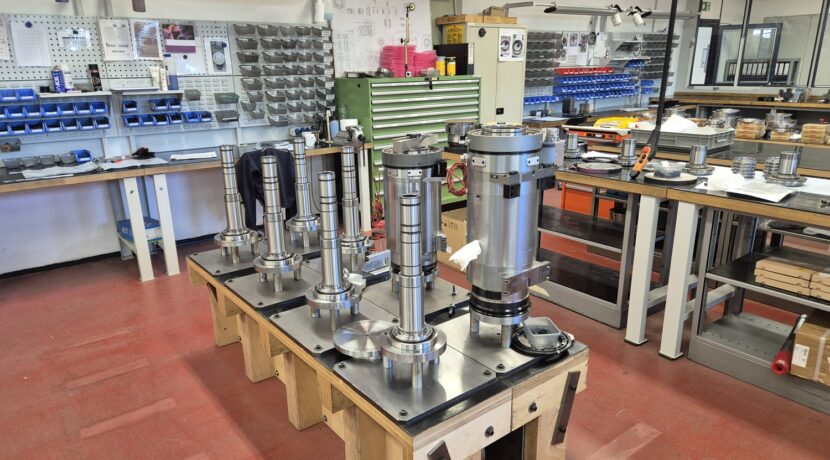
Despite its international growth, Spinner remains true to its origins as a family-owned company. Engineering, production and training are brought together under one roof, enabling the company to respond quickly and flexibly to changing market requirements. All essential components, from spindles and tool turrets to machine frames and electrical cabinets, are developed, manufactured and tested in-house. This allows Spinner to retain maximum control over quality, delivery reliability and technological development.
The internally manufactured spindle, for example, is tested for 24 hours and dynamically balanced before becoming the heart of each machine. Spinner’s internally developed turrets are another key component of its machine tools.
Production environment as a test bed
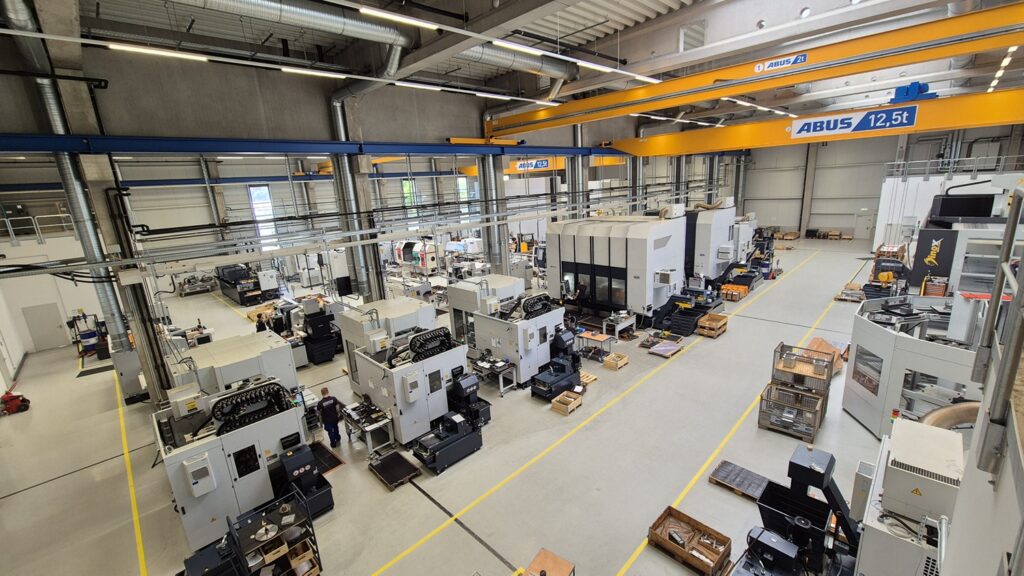
Two years ago, Spinner completely modernised its machining department. The climate-controlled production hall now houses forty modern CNC machines, most of which were manufactured by Spinner itself. The department produces virtually all components required for new Spinner machines. Grinding operations, which are essential for spindle components, are also carried out here. The grinding department has additional climate control to maintain a stable temperature, which is crucial for high-accuracy machining. Components are produced in small batches of thirty to fifty units.
Every three years, the machines used in production are replaced with new models. According to Robin Buchsein, Sales Manager at Spinner, this offers several advantages.
“By renewing our machine fleet on a regular basis, we are always working with the latest technology. This not only allows us to achieve high levels of accuracy and productivity, but also enables us to thoroughly test new functions, design modifications and innovations under actual production conditions before making them available to customers. This means that teething problems can be identified and resolved at an early stage. Using our own machines also provides direct feedback that strengthens product development. In this way, our machining department serves not only as a production facility, but also as a test environment for future innovations.”
Buchsein also points to another advantage: the relatively young used machines can be sold to customers looking for high-quality but more affordable alternatives.
From standard machines to turnkey systems
Spinner develops and manufactures a broad range of turning and milling machines for a wide variety of applications. The machines cover everything from very small components measured in millimetres to large workpieces several metres in length. This enables the company to serve both the precision engineering industry and heavier applications, including aerospace.
Around 95 percent of production consists of standard models, which are available at relatively short notice and suitable for a broad range of machining operations. The remaining five percent comprises turnkey solutions. These systems are designed and manufactured entirely to customer specifications, often for applications in which a single specific product is produced. Industries such as automotive, aerospace and medical technology make use of these customised systems.
Spinner develops these turnkey systems entirely in-house, including automation, in-process measurement, cleaning and sorting. This allows the complete production solution to be tailored to the customer’s specific requirements.
“Where machines used to remain in operation for decades, their service life today is around ten years. The use of automation means that machine tools are subjected to much heavier workloads in a shorter period of time. As a result, service requirements increase and machines are replaced sooner. Technological developments are also progressing increasingly quickly. Examples include multitasking, higher levels of accuracy, automation and new software developments. By keeping everything in-house, we remain closely involved in these developments and can respond flexibly to the market,” says Axel Spinner, Managing Director of Spinner.
Broad machine portfolio
During the tour of the factory and demonstration centre, several machines stood out as particularly relevant to the Dutch market.
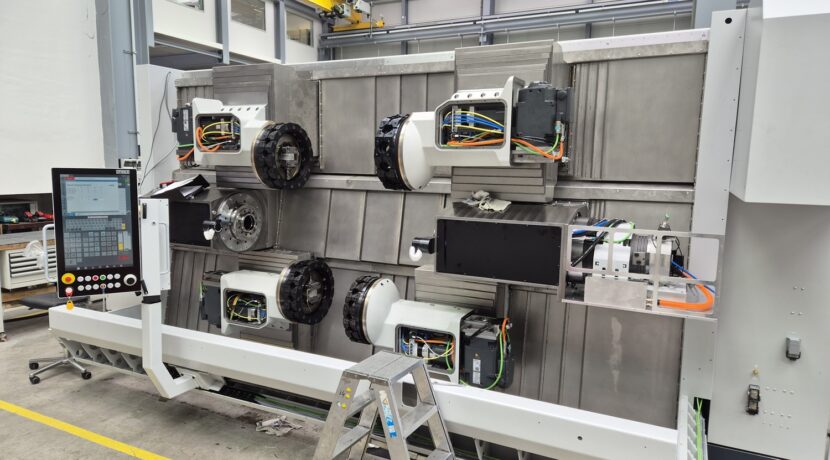
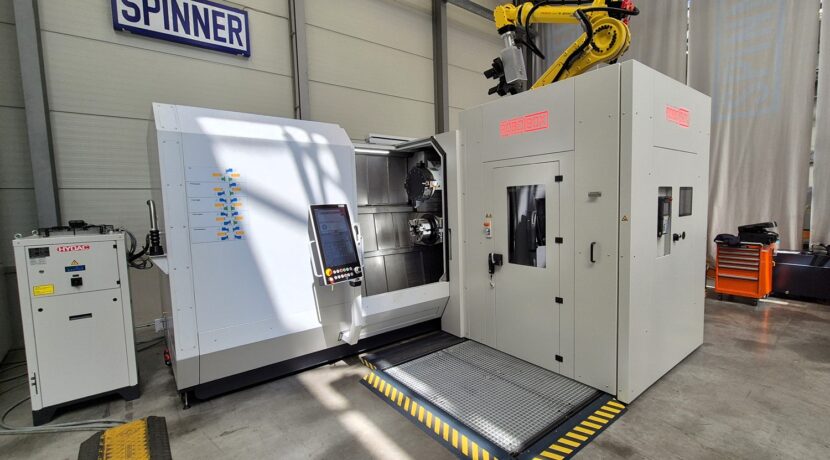
Upon entering the assembly hall, the TTS series immediately stood out because of its configuration with two spindles and four turrets. The turn-mill centre has been developed for machining complex turned parts and is available in configurations with two, three or even four turrets to achieve extremely short cycle times. This allows simultaneous machining on both sides of a workpiece and enables components to be completely machined in a single machine.
For applications requiring additional workpiece support, an adjustable steady rest can be fitted. It moves synchronously with the machining axes and can be positioned beneath the spindle without obstructing the working area.
The TTS series is available in several configurations. Turning lengths range from 600 mm to 1,850 mm, with turning diameters ranging from 250 mm to 585 mm. Spindle speeds range from 2,500 rpm to 7,000 rpm. Available bar capacities are 43 mm, 65 mm, 85 mm or 125 mm.
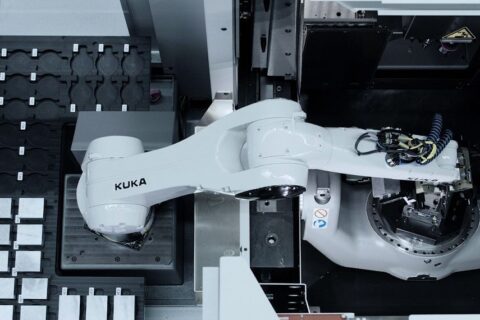
For further automation in addition to a bar feeder, the TTS series can also be combined with the Robobox, a robot cell that loads, cleans and sorts workpieces and can also eject rejected components.
High-accuracy turning
Another machine that attracted attention in Spinner’s demonstration centre was a turning machine from the Mikroturn series. Spinner developed the Mikroturn range for hard turning and conventional turning in the micrometre range.
The machine features a vertical bed, a turret with Y-axis, driven tools and high-speed main and sub-spindles, both with a maximum speed of 10,000 rpm. It also offers C-axis interpolation.
“The Mikroturn is an extremely accurate and stable machine and is used extensively in bearing production, for example. Because the Mikroturn can machine in the micrometre range, it is also well suited to applications in the optical, medical and semiconductor industries.”
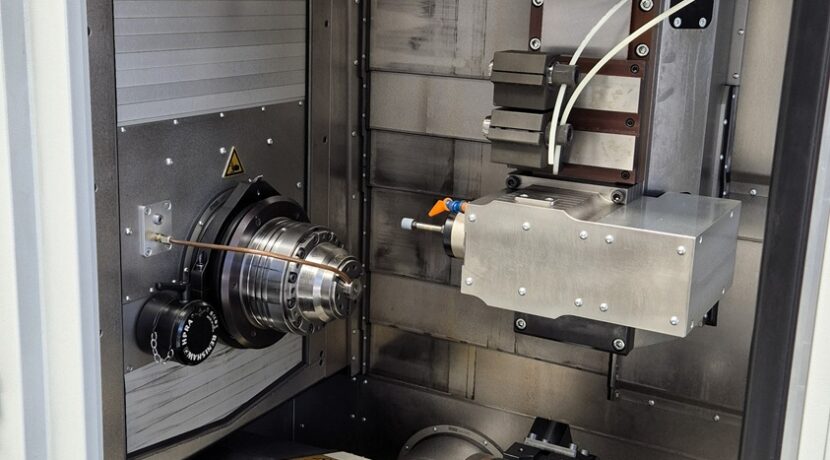
Spinner has several versions of the Mikroturn on display in its demonstration centre, including a model with grinding capability. The Mikroturn-Grind combines an ultraprecision hard-turning machine with a grinding machine.
The machine is equipped with three grinding spindles, allowing both internal and external grinding operations to be carried out directly in the same setup. This not only saves time, but also prevents inaccuracies caused by repeated clamping. The grinding units are mounted in the tool block and can be changed quickly depending on the application. Dressing of the grinding wheels and balancing of the spindles are performed fully automatically as part of the process.
Patented sealing concept
Spinner also offers an extensive portfolio of milling machines. Its VC series of vertical machining centres, for example, is designed for three-axis and five-axis milling. The range includes the compact VC850, the larger VC1150 and the versatile VC1650, available either as a five-axis machine or as a three-axis version for long workpieces.
On the five-axis version, the milling head is mounted eccentrically and can be positioned close to the workpiece. Automation solutions can be integrated as an option, including pallet-changing systems for loads ranging from fifty to five hundred kilograms. These characteristics make the VC series suitable for applications across a wide range of industries.
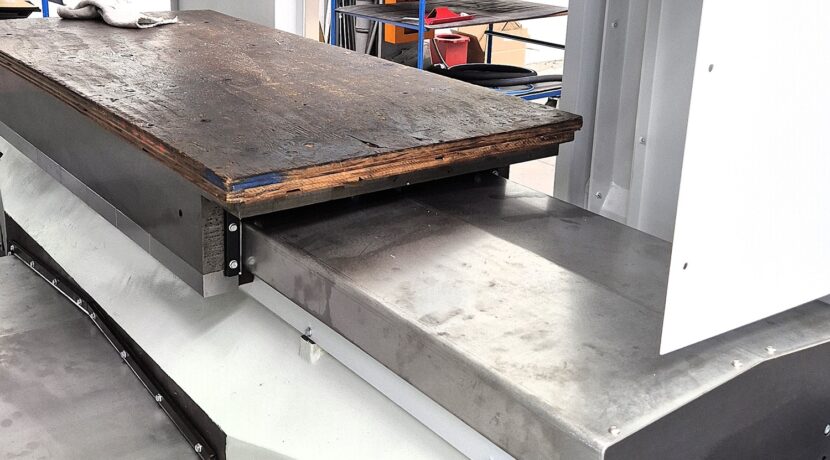
The tour of the assembly hall provided an opportunity to examine the machine construction in greater detail. One feature that immediately stands out is the sealing concept used for the moving table axes on the VC series. Whereas machine tools often use telescopic covers or bellows, Spinner has developed a different solution.
This sealing concept is patented and has the advantage of enabling a highly compact machine design while preventing chips from accumulating. The construction allows the overall machine footprint to remain relatively small. It also reduces the distance between the machine door and the table, allowing the operator to work close to the workpiece.
Factory-integrated automation
In recent years, Spinner has invested heavily in the development of automation solutions. The machine manufacturer now offers a broad range of pallet-loading and robot-loading solutions for its complete portfolio of machine tools.
“The advantage for the customer is that the machine tool and automation solution are fully coordinated. Once the cell is delivered, it is almost plug-and-play. If a malfunction occurs, the customer also has a single point of contact. We see that our customers regard this as a major advantage.”
Preview of EMO Hannover
Machining companies interested in seeing Spinner’s machines up close can visit the German manufacturer at EMO Hannover. Alongside a broad selection from its existing portfolio, Spinner will present a new addition: a larger version of the TTS multitasking machine.
The machine is equipped with two spindles and four turrets and has been developed for complete machining of larger, complex workpieces. Spinner will also demonstrate several automation solutions, including the Robobox.