
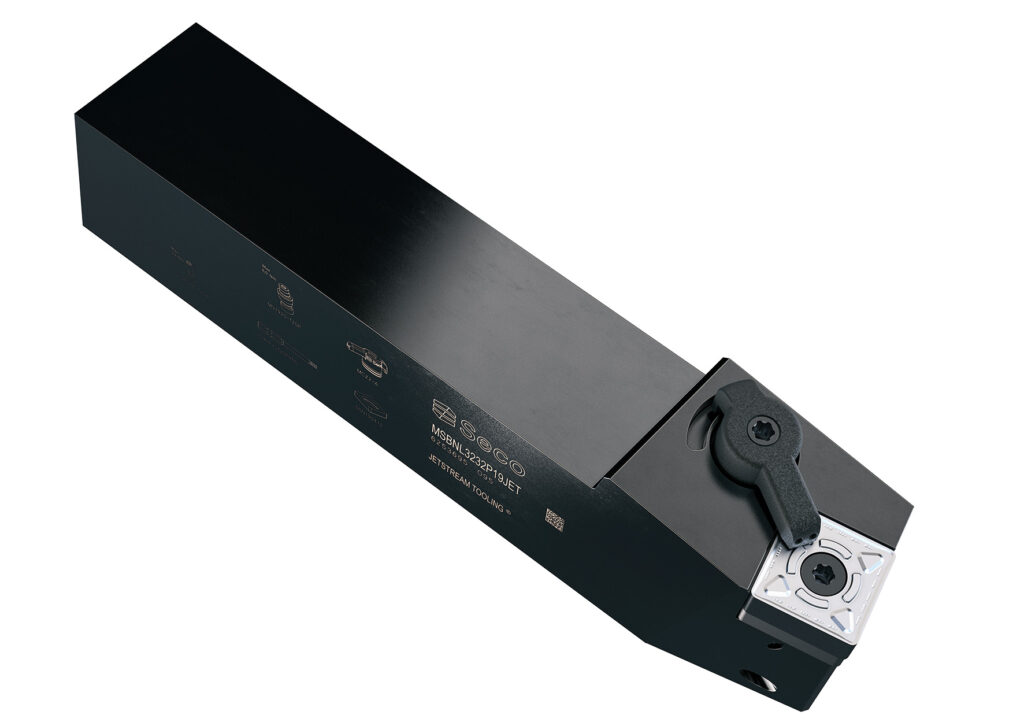
Seco has introduced Jetstream Tooling M-Clamp toolholders for large inserts, aimed at machining operations where coolant delivery, insert security and clamp wear directly affect process stability. The new holders combine high-pressure coolant, double clamping and 3D-printed clamps, with a clear focus on tool life, chip control and reducing interruptions in demanding materials.
The M-Clamp system is intended for applications where conventional clamp designs can struggle with heat, unstable chips and repeated wear around the cutting zone. Seco places the main technical emphasis on how coolant is delivered. Rather than treating coolant as a secondary aid, the holder is designed to direct high-pressure flow precisely where it has the greatest effect. In practice, that matters most in materials such as stainless steel and superalloys, where heat concentration and chip control often determine whether a process runs consistently or starts to drift.
According to Seco, the system combines coolant flow through a 3D-printed clamp with a secondary DUO JET outlet. That arrangement is intended to improve temperature control at the edge and keep cutting conditions more stable over time. The company states that this targeted cooling concept can extend tool life by at least 30%, while also improving chip control and surface finish.
Coolant delivery built into the clamp
A notable feature of the Jetstream M-Clamp design is the use of an additively manufactured clamp as part of the coolant path itself. By integrating coolant delivery directly through the clamp, Seco aims to bring the flow closer to the cutting action without exposing the clamp to unnecessary mechanical stress. The company says the clamp is positioned at a safe distance from the cutting edge, which helps it resist chip hammering, a common source of clamp wear and reduced stability.
That has practical implications beyond the clamp itself. When clamp wear is reduced, the holder can maintain more consistent insert location and support over a longer period. For production environments, this can translate into fewer clamp replacements and less unplanned downtime. It also reduces one of the recurring variables in long-running turning operations, especially where difficult materials generate aggressive chips and high thermal loads.
The 3D-printed clamp also opens the way to more application-specific designs. Seco highlights this as a route to customization, allowing the clamp geometry to be adapted to particular machining requirements in ways that are harder to achieve with traditional clamp production methods.
Double clamping for higher security
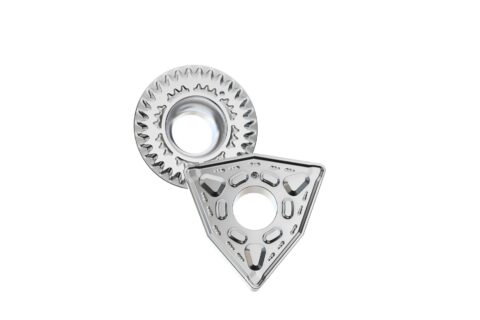
The second key element in the new system is insert retention. Seco states that the M-Clamp introduces double clamping security for both negative and round positive inserts. This combines a top clamp with a center-lock screw, with the goal of improving stability and rotational security under demanding cutting conditions.
Insert movement is a familiar issue in heavy or interrupted cuts, particularly when forces vary or chips interfere with the cutting zone. By adding a second securing mechanism, the holder is intended to reduce the risk of insert displacement and support more reliable operation. That is especially relevant for shops trying to maintain stable cutting data over longer runs, where even small shifts in insert position can affect tool life, surface quality and process confidence.
The design also addresses day-to-day handling. Seco says the holder includes a twist function and a shared key slot design to simplify insert indexing and speed up insert changes. In production terms, that means less time spent on routine tool handling and a lower likelihood of delays during changeovers. For operations running larger inserts in difficult materials, those savings can matter as much as the gains in tool life, because they affect spindle uptime directly.