GrindingHub 2026 closed in Stuttgart with around 11,000 visitors and 462 exhibitors, confirming the continued relevance of focused trade fairs for grinding technology. The event brought together machine builders, tool suppliers, automation specialists, software providers and users at a time when manufacturers are looking closely at productivity, efficiency, process stability and digital support in grinding operations.
The third edition of GrindingHub occupied three exhibition halls and was fully booked on the exhibitor side before the event opened. Companies from 28 countries presented products and systems across the grinding process chain, including machines, grinding tools, automation, measurement technology, software, digitalization, process peripherals and services.
For production companies, that breadth matters. Grinding performance is rarely determined by one component alone. Machine design, tool selection, measurement, data handling, automation and operator knowledge all influence cycle time, quality and cost. A trade fair dedicated to this field gives visitors the opportunity to compare these elements in one place and discuss specific production requirements with suppliers and technical specialists.
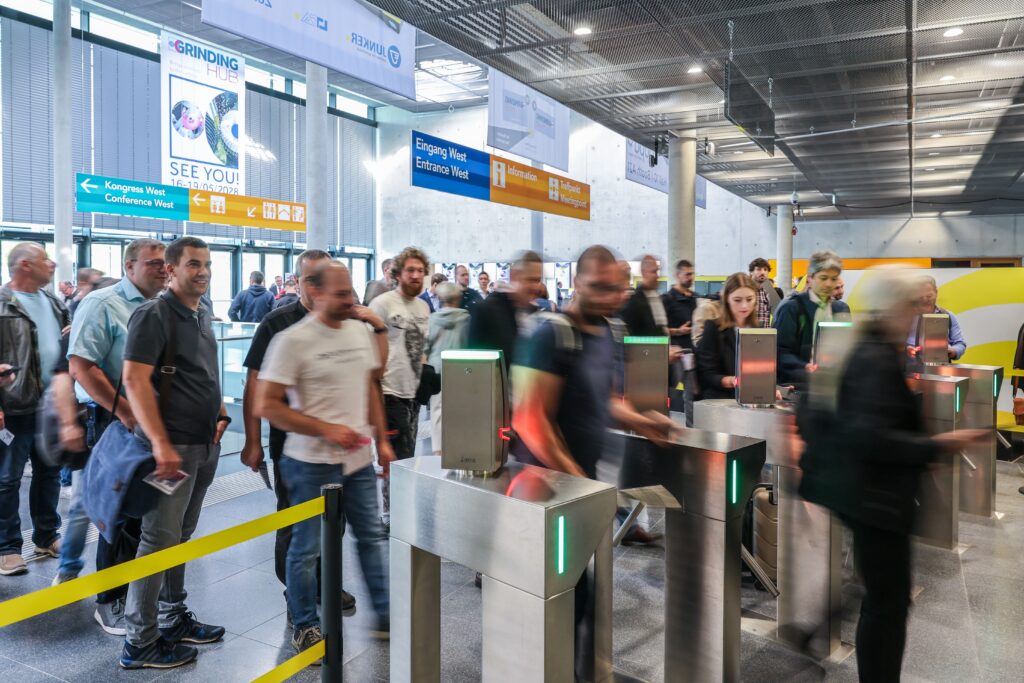
According to VDW, the German Machine Tool Builders’ Association and organizer of the event, visitors came from 59 countries. Switzerland, Italy, France, Austria and Turkey were among the strongest visitor countries outside Germany. International visitors accounted for 38 per cent of attendance.
Investment interest remains visible
The visitor profile points to a trade fair audience with direct influence on purchasing decisions. In the visitor survey, 82 per cent of respondents said they were involved in purchasing and procurement decisions. A further 37 per cent said they planned to invest within the next six months.
For exhibitors, this is a significant indicator. Grinding technology often involves capital-intensive decisions, where users assess not only machine capability but also process reliability, integration effort, tooling strategy and long-term operating costs. The high share of decision-makers at the event suggests that many visitors were not attending for general orientation alone, but to evaluate concrete options.
VDW Managing Director Dr. Markus Heering linked this to current investment priorities in the sector, noting that companies are making targeted investments in productivity, efficiency and sustainability. Within the context of the exhibition, those themes were visible across the process chain. Automation, measurement technology, software and digital applications were presented alongside grinding machines and tools, reflecting the growing need to stabilize processes and reduce manual intervention where possible.
The result is a more integrated view of grinding. Visitors were able to look beyond isolated machine specifications and discuss how individual systems fit into broader production environments, including quality control, data use and process monitoring.
Practical challenges shaped the supporting program
GrindingHub 2026 also placed strong emphasis on practical industrial questions through its supporting program. A new element was the Grinding Solution Forum, which focused on specific production challenges and possible solutions. Topics included process stability, quality, automation, data, digitalization, AI, cost-effectiveness and future developments in grinding technology.
This practical focus is relevant because many grinding applications are technically demanding and sensitive to variation. Tool condition, thermal behavior, machine dynamics, measurement strategy and process parameters can all affect the final result. For manufacturers, improving grinding performance is therefore not only a matter of buying new equipment. It also depends on understanding how machines, tools, software and measurement systems interact.
The forum created a setting for these discussions outside the exhibition stands. That distinction matters. While product presentations show what is available, application-oriented sessions can help users assess where a technology may solve a concrete problem in production, such as inconsistent quality, long setup times, rising cost pressure or limited process transparency.
The wider program also included the Grinder of the Year 2026 competition for young talent. Fabio Schoppet of K.-H. Müller Präzisionswerkzeuge GmbH won the competition and received a 3,000 euro education voucher. By linking technology topics with skills development, the event addressed another practical issue for the sector, the need for qualified people who understand the grinding process in detail.
Exhibits covered the full grinding environment
The exhibition itself brought together both established manufacturers and young technology companies. According to the organizer, exhibitors used the event to meet existing customers, make new contacts and start specific projects. Felipe Levin, Managing Director of Geibel & Holz GmbH, described the fair as an important platform for direct industry-specific dialogue with prospective customers, clients, partners and suppliers.
For users, the value of such a concentrated exhibition lies in the ability to compare technologies across adjacent fields. Grinding machines are central, but their performance increasingly depends on peripherals and digital systems. Measurement technology supports accuracy and repeatability. Automation can reduce handling time and improve consistency. Software and data applications can help make process behavior more transparent. Services and process support can influence how quickly a system reaches stable production after installation.
Several joint booths were also part of the event. Grinding Solution Park Industry, Grinding Solution Park Science, Grinding Pavilion Switzerland and the Startup Hub brought together industry, research, young companies and international partners in compact areas. This format made it easier for visitors to move between applied technology, research activity and emerging ideas.
The launch of the AI-powered chatbot Hubi added a digital layer to visitor navigation. The tool helped visitors find exhibitors, technologies and applications, supporting more targeted planning during the event. In a trade fair environment with hundreds of exhibitors, this kind of guidance can make it easier for users to focus on relevant suppliers and application areas.
GrindingHub format moves toward North America
The GrindingHub concept is now being extended beyond Europe. GrindingHub Americas is scheduled to take place from May 18 to 20, 2027, in Cincinnati, Ohio. According to Messe Stuttgart President Roland Bleinroth, an information session on the new event attracted strong interest from exhibitors, with a packed hall and positive response from participating companies.
The planned US event will be dedicated exclusively to grinding technology and related processes. For companies active in international markets, this creates another platform for technical exchange focused on grinding rather than broader manufacturing topics. The decision to launch the format in North America follows the strong exhibitor turnout and international visitor mix in Stuttgart.
GrindingHub in Stuttgart will continue on its two-year cycle. The next edition is planned for May 16 to 19, 2028. The event is organized by VDW in cooperation with Messe Stuttgart and with promotional support for the machine tools industry sector from Swissmem, the Swiss technology industry association.