
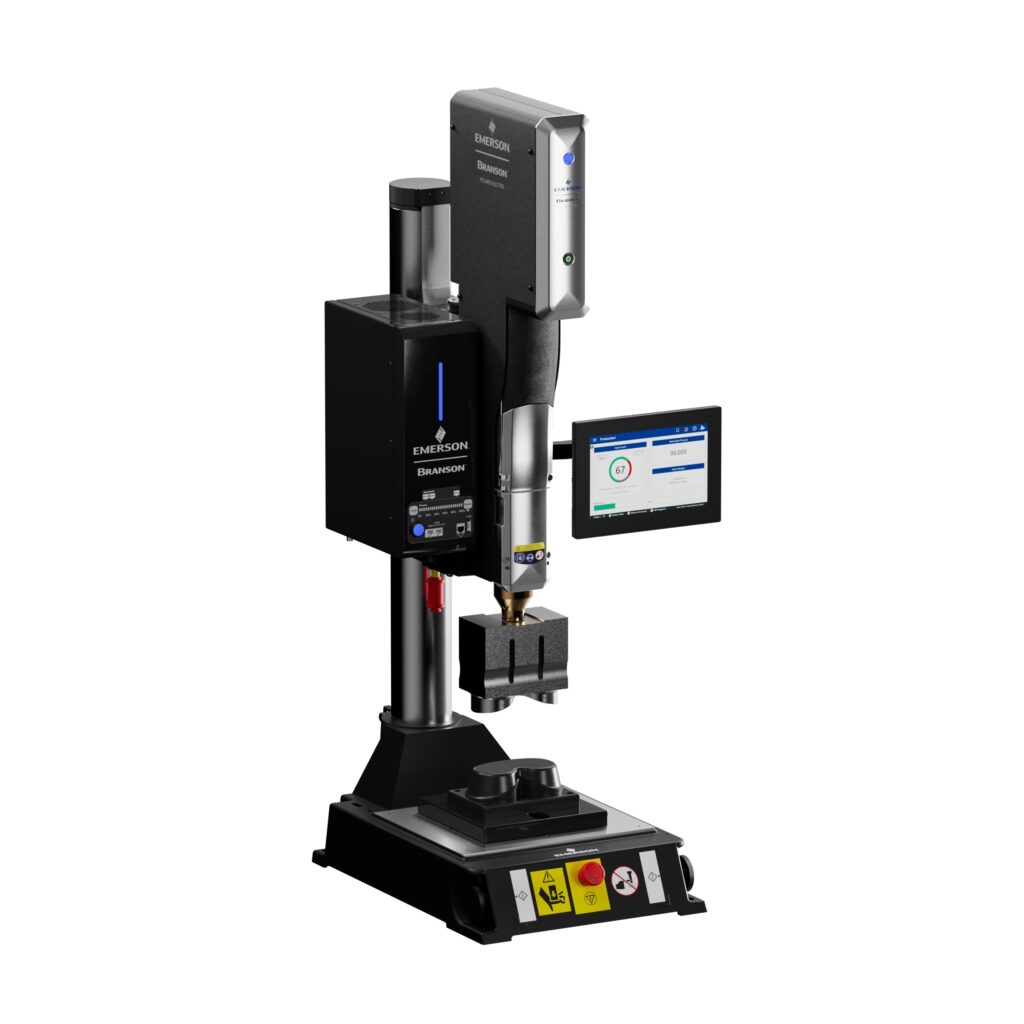
Emerson has introduced the Branson Polaris Ultrasonic Welding Platform, a modular system for joining plastics and other materials in applications ranging from packaging to medical devices. The platform is designed around configurable hardware, software, and connectivity, giving manufacturers a route from laboratory trials to automated production while keeping process control and data access central to the welding operation.
Manufacturers are under pressure to adapt production lines more often, whether because of changing product designs, regulatory requirements, sustainability targets, or higher throughput demands. Joining technology is part of that equation. A welding system that works well for one component or material combination may need to be adjusted, expanded, or integrated differently when production changes.
The Polaris platform addresses this by combining selectable power supplies, controllers, actuators, and software functionality. Instead of treating ultrasonic welding as a fixed machine concept, Emerson positions the system as a configurable platform that can be built around the application. According to the company, the same platform can support development work on a benchtop machine and later be scaled for use in a fully automated line.
This approach is relevant for sectors where product variety and process documentation are becoming more important. Emerson lists automotive parts, medical devices, consumer electronics, food packaging, appliances, bioplastics, and textiles among the target applications.
Configurable hardware for different welding tasks
The core of the Polaris platform is a set of power supplies, controllers, and actuators that can be combined according to the size and complexity of the application. For manufacturing engineers, this matters because the demands of a simple component differ significantly from those of a regulated product or a high volume automated cell.
In a development setting, a benchtop configuration can be used for trials, proof of concept work, and process definition. Once the welding process is defined, the same platform concept can be adapted for production by selecting the appropriate actuator, control level, and software capability. That can reduce the gap between process development and industrial implementation, especially where joining parameters need to be transferred into a larger production environment.
The platform also includes optional features intended to reduce system footprint, increase data storage, and support secure connectivity across enterprise networks. These are practical considerations in factories where floor space is limited and machines increasingly need to communicate with higher level systems. A compact, connected welding setup can be easier to integrate into existing automation than a standalone system with limited interface options.
Real time control and production data
Connectivity is a central part of the Polaris concept. The platform can connect to higher level systems, including programmable logic controllers, so that welding operations can be incorporated into automated production lines with greater visibility and control. For plants focused on overall equipment effectiveness, access to live process data can support faster response when conditions change.
Operators can use real time information to adjust control parameters and recipes during production. In practice, this can help maintain process stability when materials, parts, or production conditions vary. It also gives engineers a clearer view of machine performance, which is useful when investigating cycle time, reliability, or repeatability issues.
For regulated environments, the availability of performance data has an additional role. Emerson states that the data can support easier validation, which is especially relevant for products that require documented process control. In these cases, welding quality is not only a production issue but also part of compliance and traceability.
The platform is aimed at manufacturers that need ultrasonic welding to fit into a broader digital and automated production structure, rather than operate as an isolated joining process.
Support from development to production
Emerson says manufacturing engineers can select individual components themselves or work with the company’s specialists to configure a welding system for a specific application. This reflects a practical reality in ultrasonic welding: the joining method depends on the interaction between material, part design, tooling, actuator behavior, power delivery, and control strategy.
A configurable platform can help, but the final setup still has to match the product and production target. Technical support during selection, commissioning, and later operation can therefore influence how quickly a process reaches stable production. For companies moving from lab trials to automated lines, this lifecycle support may be as important as the hardware itself.
The Branson Polaris launch also shows how joining systems are being developed to meet changing factory requirements. Flexibility, secure connectivity, data storage, and real time control are becoming standard expectations in production equipment. For ultrasonic welding users, the practical question is no longer only whether a machine can make a weld, but whether it can be adapted, monitored, and integrated as manufacturing needs evolve.