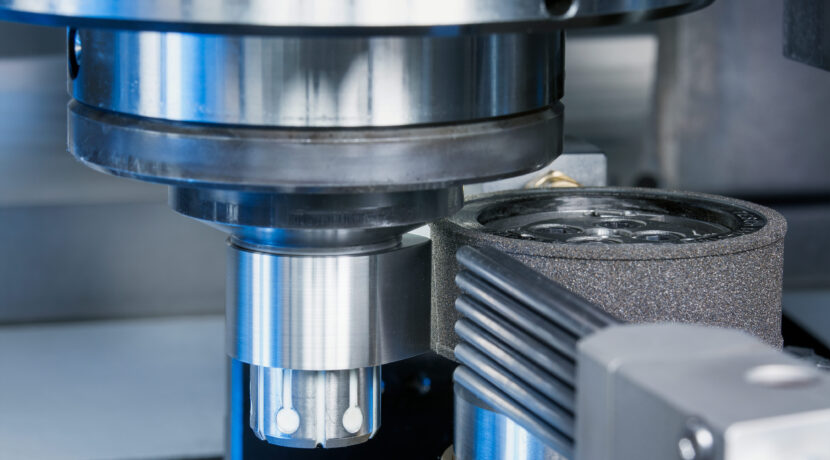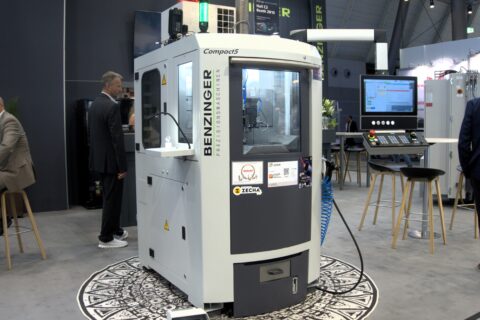

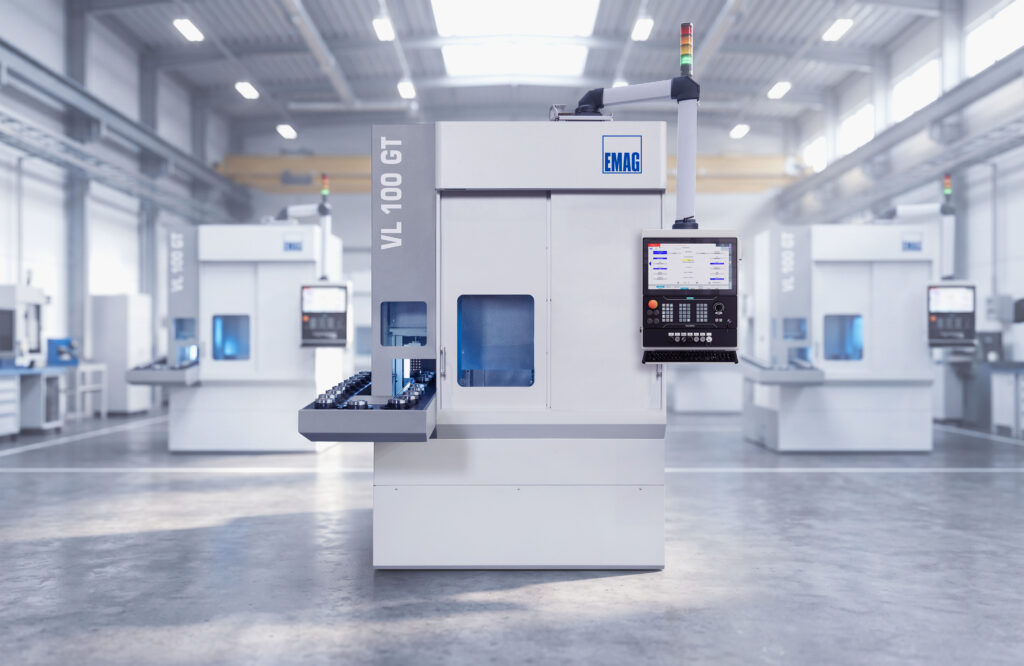
EMAG has introduced the VL 100 GT, a vertical turning and grinding center for hardened, chucked components up to 100 mm in diameter. The machine combines hard turning, internal grinding and external grinding in a single setup. For high-volume production of gears, sprockets and pump rings, this reduces reclamping operations. It also supports short cycle times and controlled surface quality.
The VL 100 GT is designed to finish small components after hardening. Dimensional accuracy, surface finish and positional tolerances must be maintained simultaneously. Its vertical layout and integrated pick-up automation support automated production cells with limited floor space. The machine requires approximately 9.6 square metres. It can be configured for different machining combinations, from internal grinding alone to complete machining with turning and both internal and external grinding. The workpiece spindle is positioned above the machining area. It takes parts directly from an integrated conveyor. Chips and grinding slurry fall downward under gravity. This limits their accumulation on the workpiece and guideways. As a result, the design is intended to reduce thermal interference, surface damage and cleaning requirements. The accessible work area also supports short setup times.
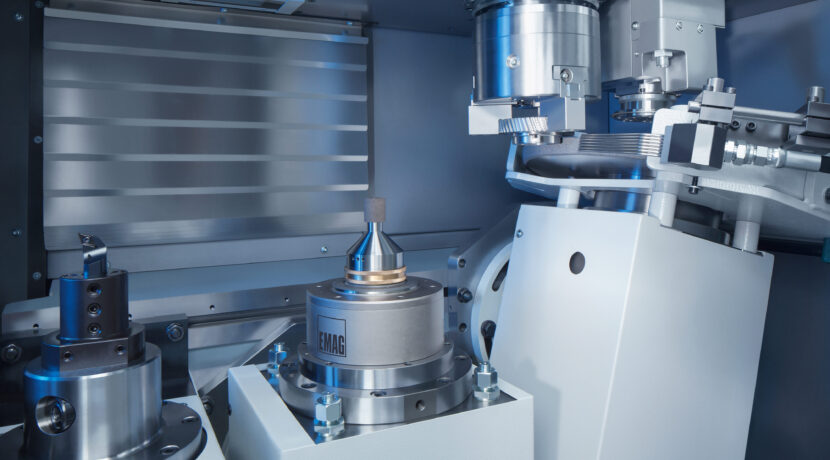
Configurable machining for hardened components
The work area can be adapted to the workpiece and process. Available equipment includes internal grinding spindles for bores. These use corundum or CBN tools. External grinding spindles are available for cylindrical surfaces, shoulders and contours. One or two solid steel holders can be installed for hard turning. Therefore, the machine can be configured for operations ranging from bore grinding to combined turning and grinding. Hard turning is used for end faces, chamfers and flutes. Grinding then finishes the bores, outside diameters and running surfaces. Turning these features before grinding leaves only a few micrometres of stock for the grinding operation. According to EMAG, this shortens total machining time. It also avoids errors caused by reclamping. The lower grinding stock reduces grinding wheel wear. Moreover, it extends dressing intervals and lowers tooling costs. The smaller volume of grinding slurry can simplify coolant treatment and reduce disposal requirements. Certain configurations can also operate dry.
For out-of-round components, such as cams and eccentric surfaces, the X-axis uses a linear motor. The direct drive has no backlash by design. This is relevant when the axis must repeatedly change direction during profile grinding. The drive also supports higher acceleration rates. It is designed for wear-free operation.
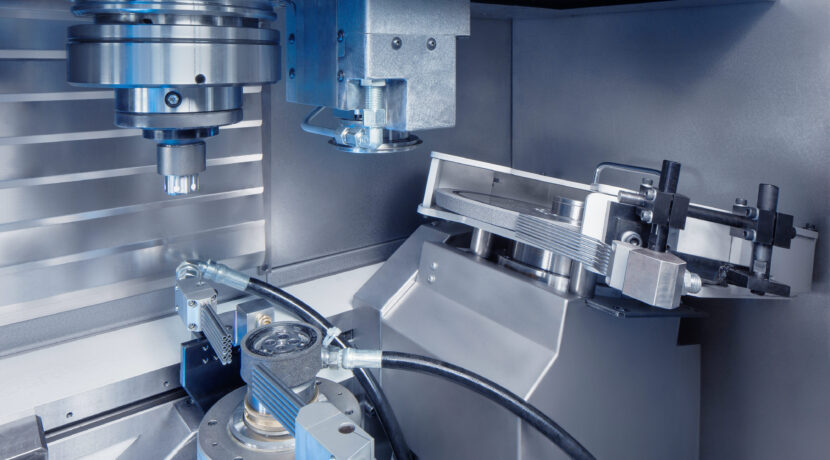
Damping, measurement and automated handling
The machine base is made from MINERALIT polymer concrete. EMAG states that it provides eight times the vibration damping of conventional cast iron. This is particularly relevant in fine machining applications requiring surface roughness values below Rz 1.2 µm. The stated aim is to produce distortion-free surfaces for highly stressed gearbox components. Grinding process monitoring includes a structure-borne sound system. It detects contact between the grinding wheel and workpiece. It also detects contact between the dressing roller and grinding wheel. Adaptive process control monitors grinding conditions in real time. It adjusts the feed rate accordingly. Touch dressing is also possible.
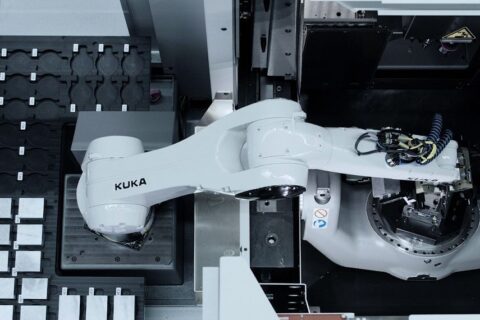
An integrated measuring probe is located between the machining area and pick-up station. This position protects it from contamination. Because the component remains clamped throughout the sequence, measurements can be performed before, during and after machining steps. The workpiece does not need to move to a separate station. The main spindle also performs loading and unloading. It collects a raw part from the circulating conveyor belt. It transfers the part to the work area, returns the finished component and picks up the next blank. This removes the need for a separate robot or gantry loader.
Alternatively, shuttle automation can connect the VL 100 GT to production lines. These lines can include systems that combine soft turning with hard finishing. In one sprocket application described by EMAG, bore grinding, hard turning of both end faces and integrated measurement are completed in less than 35 seconds. Around 10 seconds are allocated to workpiece changeover. Hard turning takes 15 seconds, while grinding takes 10 seconds.