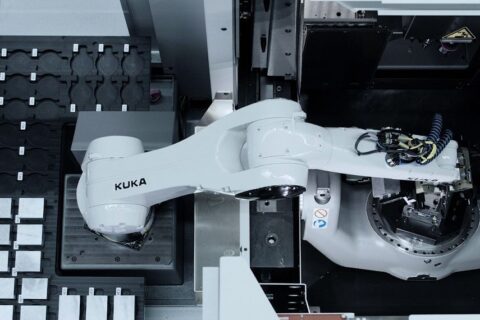

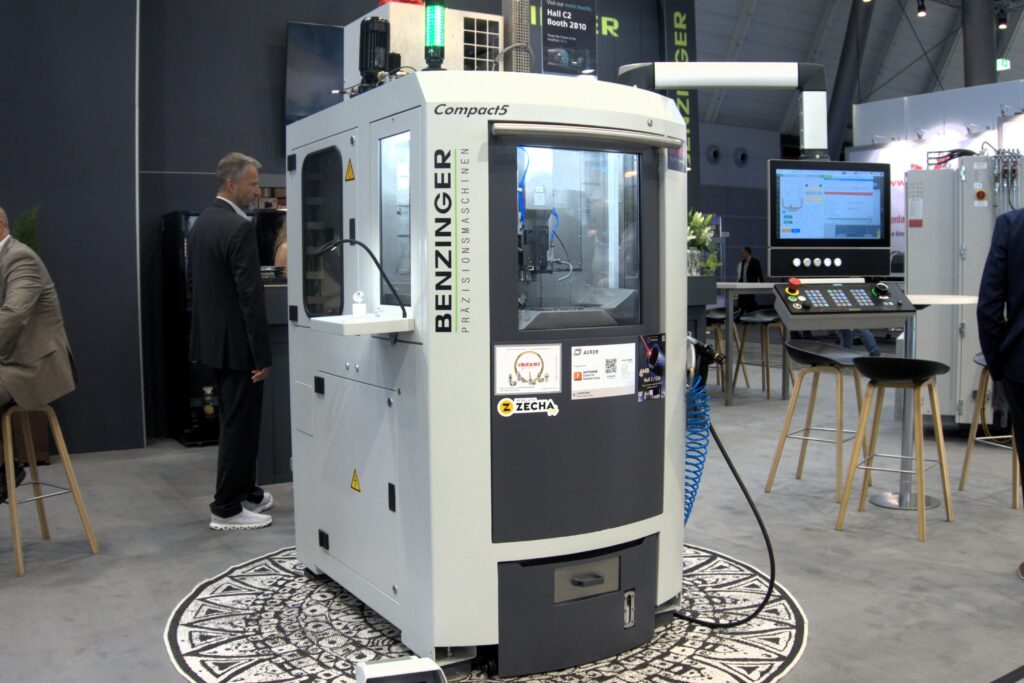
Benzinger has developed the COMPACT 5 as a five-axis machining center. It includes integrated workpiece and tool storage within a footprint of 1.4 m². The concept targets the automated production of small, complex components. Accuracy, surface quality and unattended running time are central requirements.
The machine was originally developed for watchmaking and jewellery applications. These parts require closely coordinated machining, clamping and handling processes. Benzinger has adapted the concept for industrial use. Applications include medical components, fine-mechanical parts and other small products. The machine is designed for one-off parts and small to medium-sized batches. Its compact layout places the main automation functions inside the machine enclosure. The COMPACT 5 combines five-axis machining with a workpiece magazine, tool changer and automatic workpiece handling. Therefore, a separate automation system alongside the machine is not required. This arrangement combines autonomous operation with a compact production cell for manufacturers with limited floor space.
Industrial spindle in a small machine envelope
Although the COMPACT 5 is designed for small workpieces, Benzinger uses industrial drive and guide technology. The water-cooled milling spindle delivers 6.2 kW. It reaches speeds of up to 55,000 rpm. Tools are held in HSK-E25 holders. Mechanical and thermal clamping options are available. This configuration supports the machining of materials including titanium, stainless steel and technical ceramics. The linear travel range is 195 mm in X, 190 mm in Y and 110 mm in Z.
For automated handling, workpieces can measure up to 45 × 55 × 25 mm. The machine can also produce components directly from bar stock. The maximum bar diameter is 14 mm, with a bar length of up to 145 mm. Five-axis kinematics enable machining from different directions in a single setup. Alongside milling and drilling, the machine can carry out engraving and surface machining. Turning can also be integrated, depending on the configuration. Combining multiple operations in one setup is particularly relevant for small components because repeated reclamping can affect dimensional accuracy.

Workpiece and clamping management inside the enclosure
The integrated workpiece magazine is arranged as a carousel around the Z-axis column. It provides 64 positions. The magazine can hold raw and finished workpieces on standardised carriers. Benzinger also uses 3D-printed holders adapted to individual workpiece geometries. The magazine can store more than just components. It also accommodates different clamping devices, including zero-point clamping systems and collets.
An integrated gripper transfers workpieces and clamping devices to the rotary-tilting table. Clamping then takes place automatically. This enables different products to be processed without manual changeover between jobs. Tool management supports longer periods of unattended operation. The tool magazine has 70 positions. It prepares the next tool change while machining is in progress. Workpieces and tools can be replenished through a lockable opening while the machine continues production. As a result, interruptions during magazine refilling are reduced.
Laser measurement supports automated machining
Benzinger specifies an accuracy of better than 3 μm across the working range. According to the manufacturer, components only a few millimetres in size can be produced to IT5 tolerances. The machine uses a laser measurement system to maintain this level during automated production. Following a tool change, the system checks the tool geometry and dimensions. It can also detect tool breakage. This is particularly relevant when using microtools. Small deviations can influence component dimensions and surface quality. The COMPACT 5 is also prepared for connection to higher-level production systems through an OPC UA interface. Therefore, data can be exchanged with planning and control systems. For applications requiring further workpiece automation, the machine can also be integrated with an external robot cell.