
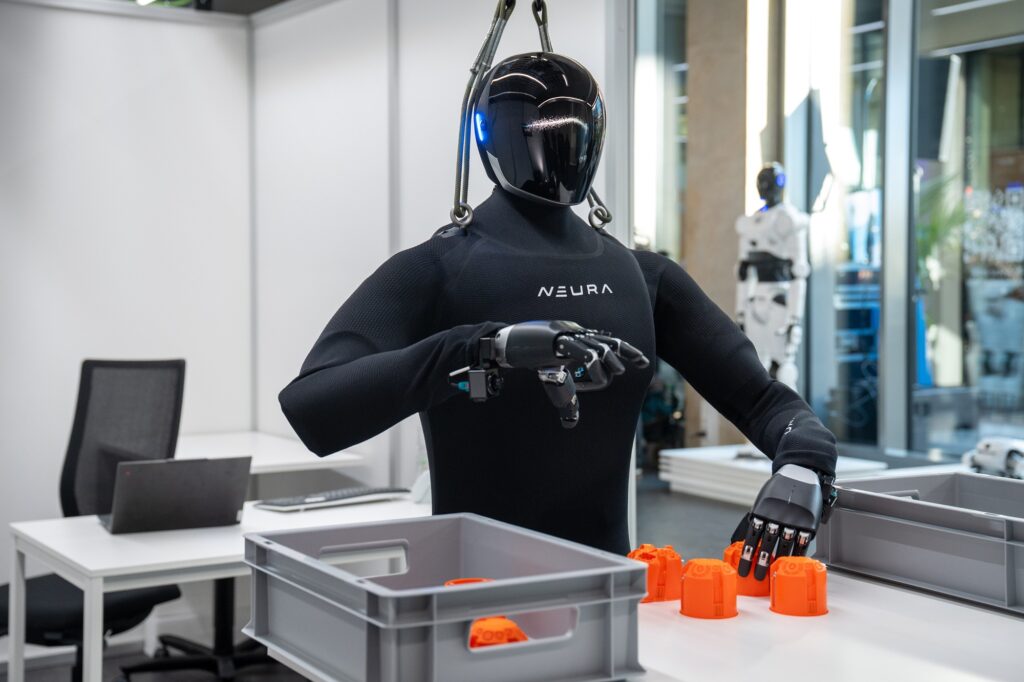
The Technical University of Munich and NEURA Robotics have opened the TUM RoboGym at LabCampus, the innovation hub at Munich Airport. The center will generate real-world training data for embodied artificial intelligence. An initial fleet of around 100 humanoid and service robots will operate in 48 training cells. Its first applications focus on industry and intralogistics.
Unlike language-based generative AI, robots cannot learn physical tasks from large volumes of internet data. They need information from interactions with objects, tools, workspaces and people. Therefore, collecting, processing and evaluating training data is a central challenge in robotics development. At the TUM RoboGym, robots will learn and test tasks in realistic environments. These tasks include folding boxes, assembling components and using tools. The site also combines physical training cells with computing capacity for AI model training and computer simulations. NEURA Robotics supplies humanoid robots and related infrastructure. The Munich Institute of Robotics and Machine Intelligence, TUM MIRMI, contributes research expertise.
Training data from physical interaction
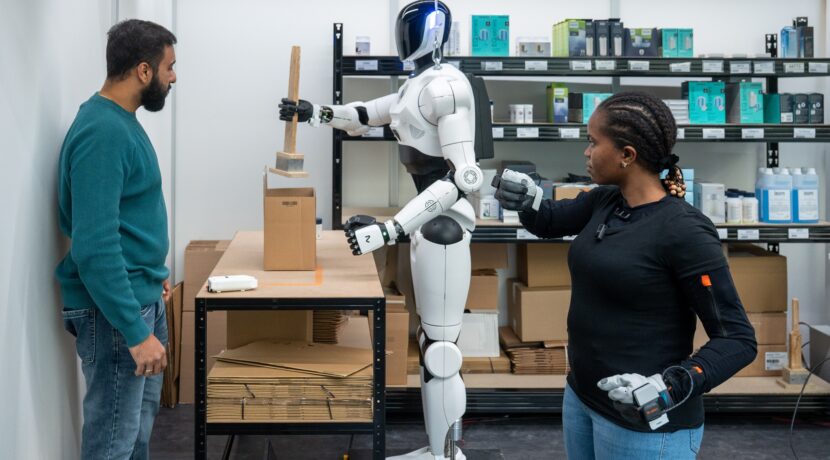
The training center addresses the limited availability of data for embodied AI. Each interaction in a training cell can show how a robot perceives its surroundings, grasps an object and performs a movement. It can also show how the robot responds to changing conditions. This data is needed to develop robotic capabilities that transfer between related tasks and operating conditions. Data generated at the RoboGym will be collected in a curated cloud data lake. TUM describes this resource as a foundation for research into generalizable robotic skills, AI models for robotics and safe human-robot interaction. The approach combines physical training data with computer simulation. As a result, researchers can develop and test models and robot behavior across different environments.
This is particularly relevant to industrial and intralogistics applications. Robots in these settings must perform recurring handling, assembly and material transport tasks. At the same time, they must adapt to changing objects and workplace conditions. The focus is not only on demonstrating individual robot functions. It is also on building a data foundation for more reliable operation in practical settings. NEURA Robotics also used the opening to present the next generation of its 4NE1 humanoid robot. The 4NE1 Gen 4 is expected to become available at the TUM RoboGym. It will expand the range of robots used for training and research at the facility.
Linking research with industrial deployment
A central objective of the collaboration is to shorten the path from robotics research to industrial application. According to TUM MIRMI scientific coordinator Professor Achim Lilienthal, continuous and flexible collaboration with industry is needed. This collaboration can help develop research prototypes into market-ready products. The setup at LabCampus brings university research and a robotics supplier together. Both partners work with a shared training infrastructure. Rather than treating robot development, data generation and industrial application as separate stages, the RoboGym connects them in one location. Research results can therefore be tested under realistic conditions. Industrial requirements can also influence the selection and development of robotic tasks.
The partners see potential uses in factories, skilled trades businesses and care-related settings. Robots could handle material transport, component assembly and physically demanding routine work. The stated aim is to support employees by taking over selected tasks. This would allow people to focus on work that requires human capabilities. For TUM, the project provides a platform for long-term research into physical AI. For NEURA Robotics, the collaboration provides access to a research environment. Its humanoid systems can be used there to develop and evaluate practical skills. The initial focus on industrial applications and intralogistics gives the center a defined starting point. Moreover, its data infrastructure is intended to support broader robotics research over time.