
Cognex has made OneVision generally available. The software is designed to help manufacturers move AI-based inspection beyond isolated pilot projects. It combines cloud-based model development with edge-based inspection. Therefore, deployment can be made more consistent across lines, factories and regions without adding runtime dependence on cloud connectivity.
Since the beta launch in June 2025, more than 100 customers worldwide have used OneVision for AI-powered vision development and deployment. According to Cognex, several users have moved from single-line applications to multi-site rollouts in days rather than months. That change addresses a familiar problem in industrial AI vision. Proving an application on one line is often easier than keeping it reliable, repeatable and manageable across different production environments.
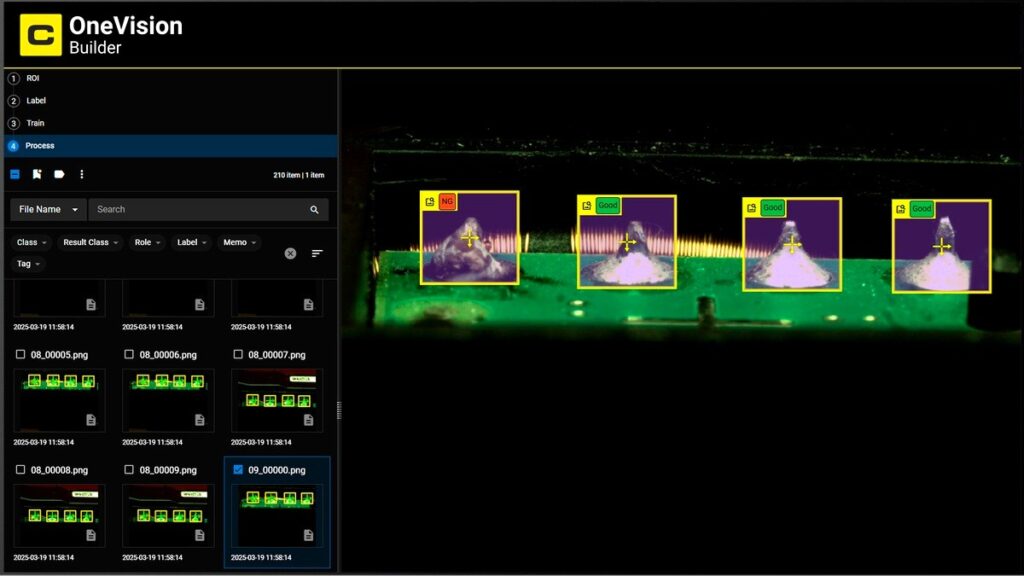
Cognex describes OneVision as a collaborative AI vision development environment. The system is intended to bring image collection, labeling, model refinement, deployment and version management into a shared workflow. For manufacturers with multiple plants, this is relevant because inspection standards often need to be transferred across sites without each local team rebuilding the same application from scratch. The platform is optimized for Cognex’s latest vision systems, including the In-Sight 3900 and In-Sight 6900.
Cloud development with edge execution
The core architecture of OneVision separates development and runtime inspection. AI models are trained, managed and governed in the cloud, while inspection itself runs at the edge on Cognex vision systems. This distinction matters in production environments, where inspection decisions must be made reliably and without introducing unnecessary latency.
Reto Wyss, Vice President of Vision Engineering at Cognex, said that once a model is deployed, no cloud connectivity is required for runtime inspection. Production images remain local and inspection continues on the device. For manufacturers, this can simplify the use of AI vision in applications where continuous cloud access is not desirable or practical.
The cloud side is used for central management of the AI lifecycle. Teams can collect and label production images, refine models, control versions and deploy updates across fleets of devices. This can reduce duplication between sites and help maintain consistency when the same inspection logic is used in several plants. Cognex also states that centralized development and management can reduce scaling costs by up to 50%, while supporting standardized inspection processes and version control across deployments.
From local applications to shared standards
The practical value of a system such as OneVision depends on whether it helps manufacturers avoid repeated engineering work when scaling inspection. In many AI vision projects, a model that performs well on one production line still needs additional tuning before it can be used elsewhere. Differences in process conditions, image data or local workflows can slow down rollout.
Cognex says OneVision is designed to address these issues by combining easier edge deployment with centralized control. The intended result is a more repeatable path from application development to wider use. Instead of treating each line or factory as a separate project, engineering teams can build and validate models centrally, then deploy them across multiple devices and locations.
Schneider Electric used this approach to develop and validate AI inspection standards centrally before deploying the same models across worldwide operations. Christophe Ernis, Smart Operation Manager in the Product Power Division, said the approach helped the company double yield, reduce false rejects and reduce dependence on specialized vision expertise. For manufacturers, those points are significant because false rejects and limited access to vision specialists can both restrict the practical impact of automated inspection.
Faster development using production images
Several customer examples in the beta phase point to shorter development cycles. Essity reported that a sealing inspection application previously required more than a year of iteration and tuning to reach a reliable result. Quality issues in that process could lead to full batch returns and material waste. Using OneVision, the company built and demonstrated a viable solution in less than a day, according to Amin Tajeddine, Operational Technology and Digitization Manager.
The reported reduction in development effort is linked to the ability to work directly with production images and simplify model creation. In AI vision, access to relevant image data is central to application quality. If teams can label real images, adjust models and deploy updates through one environment, the path from problem definition to working inspection can become shorter.
3M also highlighted this aspect. Scott Daniels, Senior Manufacturing Technology Engineer, said engineers can label real production images, build models and deploy them to cameras with less effort. For production teams, that can make AI vision less dependent on narrow specialist knowledge and easier to include in day-to-day manufacturing improvement work.
Collaboration becomes part of inspection scaling
OneVision is also aimed at collaboration between teams. This is important where inspection applications are no longer confined to a single machine or department. When multiple plants, engineers and production teams work on related applications, model versions, labeling practices and deployment status need to remain clear.
A shared environment can help prevent teams from solving the same inspection problem separately. It can also make it easier to apply lessons from one site to another, especially when the same product family or process is produced in multiple locations. Cognex positions this as a shift from fragmented workflows toward enterprise-wide inspection strategies.
The industries mentioned by Cognex include automotive, electronics, food and beverage and healthcare. Across these areas, customers using OneVision have reported faster AI application development, improved throughput and more consistent inspection results. The broader relevance lies not only in the AI model itself, but in the ability to manage inspection as a repeatable production capability across sites.