
Additive manufacturing is moving beyond prototype work at the BMW Group. At its Additive Manufacturing Campus in Oberschleissheim, the company is expanding automation, digital connectivity and material options. These developments support larger-scale applications. New systems and the planned use of Wire Arc Additive Manufacturing in series production from 2027 will extend the technology’s role across development, manufacturing and aftersales.
BMW has used additive manufacturing for decades. It initially produced prototype components and later supported selected series and aftersales applications. Today, development focuses less on 3D printing itself. Instead, the emphasis is on integrating additive processes into industrial workflows. Additive manufacturing is now used throughout the vehicle lifecycle. Applications range from early concepts and functional prototypes to production equipment and customer-facing components. The focus is on shortening lead times, enabling targeted design changes and testing parts under real operating conditions at an early stage. At the same time, BMW is working to make additive processes more automated, robust and compatible with existing production structures. As a result, individual applications are becoming part of a broader production capability.
Development components tested under real conditions
The value of additive manufacturing in vehicle development goes beyond layer-by-layer part production. It enables components to be produced quickly and modified when requirements change. Engineers can also assess parts earlier in the development process. This is particularly relevant when conventional manufacturing would require dedicated tooling. It also avoids longer lead times before a design can be evaluated.
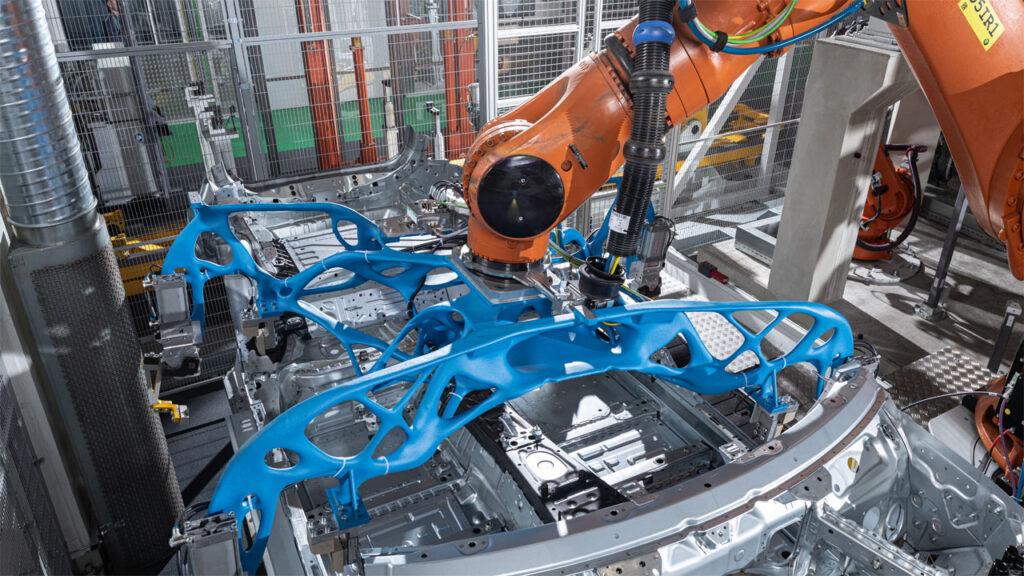
BMW already uses additive processes for highly functional components. These applications go beyond visual or geometric prototypes. Parts can be used in dynamic functional testing and crash tests. This allows technical validation to begin earlier. The technology also supports the development and validation of Neue Klasse vehicles. In addition, 3D-printed components have been used to develop the latest generation of electric drives.
This approach can reduce the time between a design decision and a physical test part. It also gives engineering teams greater flexibility to adapt components as development progresses. Instead of waiting for conventional tools or fixed manufacturing routes, teams can create custom-fit solutions for specific test and validation requirements. For BMW, additive manufacturing is therefore part of the development process. It is no longer a separate specialist activity.
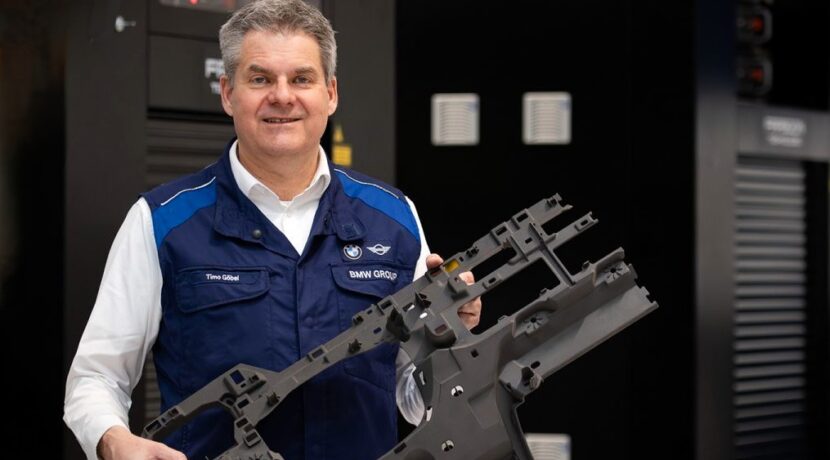
Head of Additive Manufacturing at the BMW Group: “Additive Manufacturing is now fully integrated across all phases of the product lifecycle.” (pictures: BMW Group)
A campus for testing and scaling workflows
BMW opened its Additive Manufacturing Campus in 2020. The facility brings production, research and training together in one location. It is intended to accelerate the transition from new process ideas to applications that can be tested, scaled and transferred across the company. The campus develops more than individual parts. It also establishes workflows for use across BMW’s production network.
Since production began, the campus has manufactured more than 1.6 million parts. BMW vehicle plants also produce a further 100,000 components each year on a decentralised basis. These figures show that additive manufacturing is already part of daily industrial operations. It is used both centrally and within individual plants.
The next stage focuses on new equipment, larger build volumes and digitally connected process chains. According to Timo Göbel, Head of Additive Manufacturing at the BMW Group, automated and digitally networked workflows are central to the scaling strategy.
BMW is also focusing on open-material systems and open interfaces. In practical terms, automation is intended to improve efficiency and process reliability. Open systems can broaden the available technology options. Moreover, open interfaces can simplify the integration of new solutions into established industrial environments.
Larger parts and decentralised production equipment
As system capacity expands, BMW expects the range of applications to increase. Larger build volumes and automated systems should enable the production of bigger, highly functional components with shorter lead times. For some applications, this can remove the need for traditional tools. It can also make production more flexible when requirements change.
The implications extend beyond vehicle components. BMW also sees a growing role for additive manufacturing within the production system itself. Plants worldwide could produce manufacturing accessories locally and at short notice. This would be possible with fast, robust and user-friendly systems. Production sites could therefore respond more quickly when equipment or specific accessories are needed. They would not need to rely solely on centrally produced items.
Decentralised additive manufacturing can also bring the point of use closer to the point of production. The focus is not simply on placing more printers in plants. Instead, BMW aims to provide systems that integrate into industrial operations and can be used reliably by production teams. The combination of larger build volumes, automated workflows and digital process connections is intended to support this approach across BMW’s global production network.
WAAM moves towards series applications
Wire Arc Additive Manufacturing is a central part of BMW’s plans for larger metal components. The process is suited to applications where component size, productivity and integration into industrial production must be considered together. WAAM complements other additive methods rather than replacing them. It extends the range of parts that can be manufactured additively.
BMW has already established WAAM in prototype development. Vehicle testing with WAAM-produced components has been under way since 2025. Series production is scheduled to begin in 2027. The progression from prototypes to vehicle testing and planned series applications reflects BMW’s staged approach to technology validation. The planned series introduction also illustrates the wider direction of the Additive Manufacturing Campus. New processes are identified and developed for industrial use. They are not retained as isolated technical demonstrations. For BMW, the transition of WAAM into series production is linked to the need for large-format metal components. It also supports the broader effort to establish additive manufacturing as a scalable production technology.