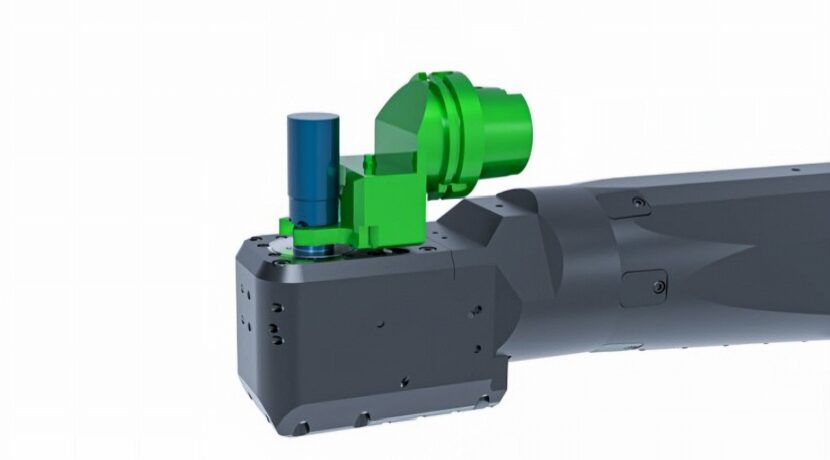

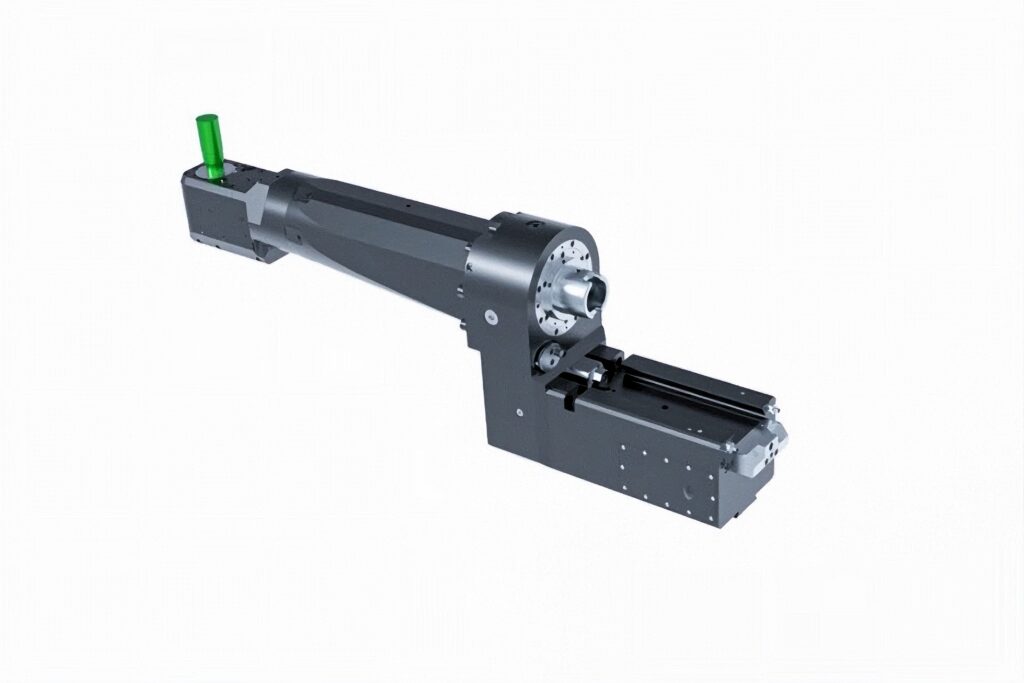
WFL Millturn Technologies has developed a new high-performance angular head for internal machining of complex components. The system is designed for complete machining in a single setup and targets a demanding application area where accessibility, stability, and chip control often limit productivity. Its main significance lies in the combination of automatic tool change, high spindle speed, and integration into a broader machining concept.
Internal machining remains one of the more difficult tasks in metal cutting. Long tool overhangs, confined spaces, and high demands on process stability make it hard to combine output with reliable quality. That becomes even more critical in thin-walled aluminum parts, where high material removal rates are needed but cutting forces can quickly affect the component.
WFL positions the new angular head as part of a coordinated overall approach rather than a stand-alone accessory. Machine design, tool interface, process monitoring, and machining strategy are intended to work together. In practice, that matters because internal milling with rotating tools inside the component is becoming more relevant, especially for larger lightweight structures. The new unit is intended to expand those capabilities while reducing manual intervention in applications with many tool changes and complex internal geometries.
Automatic tool change inside the unit
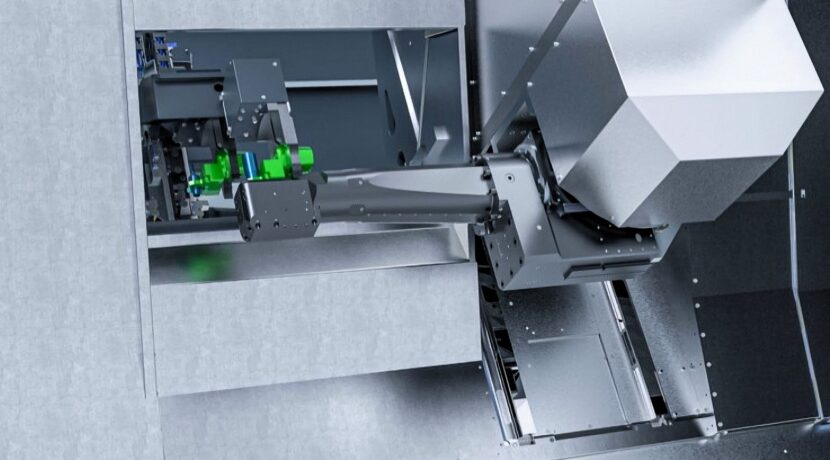
A central feature of the development is a specially designed tool interface based on HSK-A32. According to WFL, this enables automatic tool change directly within the angular head for the first time. In conventional setups, tools in such units often have to be clamped manually, which adds setup time and interrupts the process.
Here, the tool change takes place through the machine’s standard tool magazine. An integrated hydraulic clamping mechanism handles clamping and release inside the unit. With suitable adapters, standard HSK-A32 tools can be used in a 90° orientation. That gives the system a practical advantage in applications requiring a large number of tools, in some cases more than 20, without manual intervention between operations.
For production, the effect is straightforward. Reduced setup time and less downtime improve machine utilization, while the removal of manual handling steps can support more stable and repeatable operation. In series production, where internal machining often becomes a bottleneck, that kind of automation can have a direct effect on cost and planning reliability.
High speed for aluminum machining
WFL also focused strongly on speed capability. In aluminum machining, high cutting speeds are often necessary to reach economical removal rates. At the same time, continuous operation places considerable demands on bearings, lubrication, and thermal stability.
The new angular head is designed for speeds up to 12,000 rpm in continuous operation. This is supported by a specially developed oil mist lubrication system, intended to keep temperature conditions stable and protect bearing life under sustained load. Hydraulics, electrical power, and lubrication are supplied to the unit through an integrated rotating interface.
That combination is relevant because high spindle speed alone is not enough in internal machining. The process also has to remain stable over longer cycles and under restricted cutting conditions. By pairing speed capability with a robust supply and lubrication concept, WFL is addressing the operational side of high-performance internal milling, not just the headline spindle data.
New kinematics for shorter machining times
The angular head also changes what can be done in terms of machining strategy. In combination with the machine’s simultaneously interpolating B-axis, the unit can be used to create alternative tool paths for internal features.
WFL points to the production of internal radii as one example. Instead of machining such forms with ball-end mills and a large number of closely spaced passes, the angular head can be swiveled in a controlled way. This makes it possible to use larger tools and generate the required geometry with fewer movements. The result is shorter machining time while maintaining surface quality.
This is a useful example because it shows that the benefit does not come only from the hardware itself. Gains are created by the interaction between the mechanical design of the head and the machine kinematics. For users, that opens the door to rethinking internal milling strategies where conventional approaches are accurate enough but too slow for productive series work.
Focus on thin-walled lightweight components
The development is aimed in particular at thin-walled aluminum structures machined from solid blanks. In such parts, large amounts of material may be removed, reducing a blank of more than 100 kg to a finished component weighing only a few kilograms. That creates a difficult balance between aggressive cutting and controlled force input.
WFL addresses this with a combination of rigidity, controlled force transmission, and stable process control. The company also refers to customized clamping concepts and integrated measurement cycles for component monitoring. These measures are intended to limit deformation during machining and maintain consistent part quality.
Integrated into complete machining
The company presents the angular head as one element within a wider complete machining concept. That concept covers processes from deep-hole drilling and internal turning to bottle drilling and dynamic internal milling. The common objective is to complete all operations in one setup.
Avoiding re-clamping has a clear practical effect. It reduces cycle time and supports component accuracy by limiting the number of process interruptions and reference changes. In that context, the new angular head is not simply an add-on for a niche operation, but a tool intended to expand what can be completed automatically on one machine.