
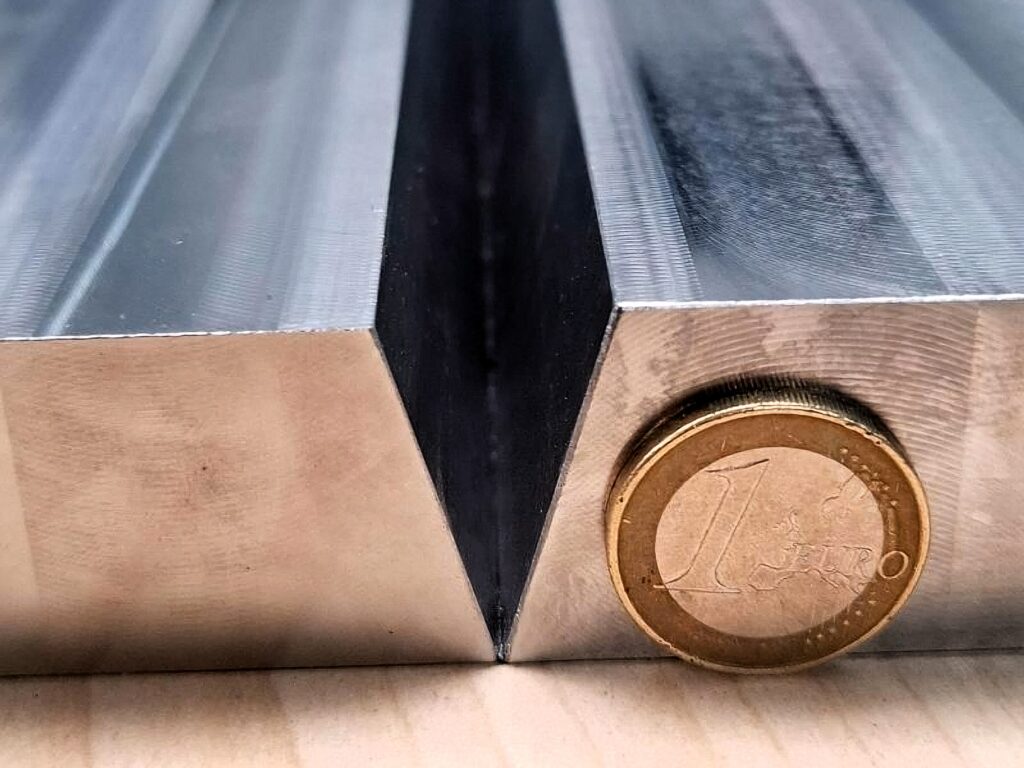
A collaborative project led by Laser Zentrum Hannover is developing a laser beam hybrid welding process for unalloyed steel components up to 30 millimeters thick. The LaHDo project combines two consumable wire electrodes with an oscillating laser beam. Its aim is to fill weld grooves in a single pass. This approach could reduce energy and filler material consumption compared with conventional layer-by-layer welding. Joining thick-walled steel components can require substantial amounts of energy and filler material. The LaHDo process addresses this demand by combining a high-deposition-rate arc process with targeted laser treatment of the groove flanks.
The project covers both the welding process and the required system technology. The partners are developing a processing head, an adapted welding power source, filler wires, an inline monitoring system and a demonstrator system. The work focuses on unalloyed steel components up to 30 millimeters thick. These components are used in mechanical engineering, pipelines, turbine blades and shipbuilding. For manufacturers working with these parts, the intended change is a move away from filling grooves in successive layers.
Single-pass groove filling
The proposed process uses an arc with two consumable wire electrodes. This arc fills the weld seam at a high deposition rate. An oscillating laser beam selectively activates the groove flanks to improve material bonding. The two elements therefore have different roles. The arc supplies the weld material, while the laser acts on the groove sides. The process is designed to fill the groove in a single pass. It does not build the weld layer by layer. As a result, the project partners expect lower energy consumption and reduced material use. However, the source material does not provide measured savings. The team is also developing filler wires with diameters of up to 2.4 millimeters. These wires will have tailored material properties. DURUM Verschleißschutz is responsible for this work and will provide the consumable material for the double-wire process.
Processing equipment and monitoring
Laser Zentrum Hannover is dividing its development work between two groups. The Machines and Controls group is developing the high-performance hybrid processing head. The Joining and Cutting of Metals group is responsible for the associated welding processes. MERKLE Schweißanlagen-Technik is contributing an adapted welding power source. 4D Photonics is developing an inline process monitoring system. HAANE welding systems is supplying the demonstrator system. Together, these contributions cover the equipment needed to combine the welding process and monitoring in one system. The project also receives support from the associated industry partners B.I.G. Technology Services, CIVAN Lasers Europe, Laser on demand, Precitec and Westfälische Drahtindustrie.