
Elastocaloric cooling is moving closer to practical refrigeration, air-conditioning, and industrial temperature control. At Saarland University, researchers are developing 3D-printed nickel-titanium elements with larger active surfaces for heat exchange. The aim is to improve efficiency, reliability, and maintainability in systems that cool or heat without conventional refrigerants.
The work builds on more than 15 years of research by Professor Paul Motzki and his team, together with specialists at the Saarbrücken Center for Mechatronics and Automation Technology. Their focus is the elastocaloric effect in shape-memory alloys. When nickel titanium is mechanically loaded, for example by stretching or compression, the material releases heat. When the load is removed, it absorbs heat from its surroundings. Repeated in a controlled cycle, this effect can move heat from one place to another.
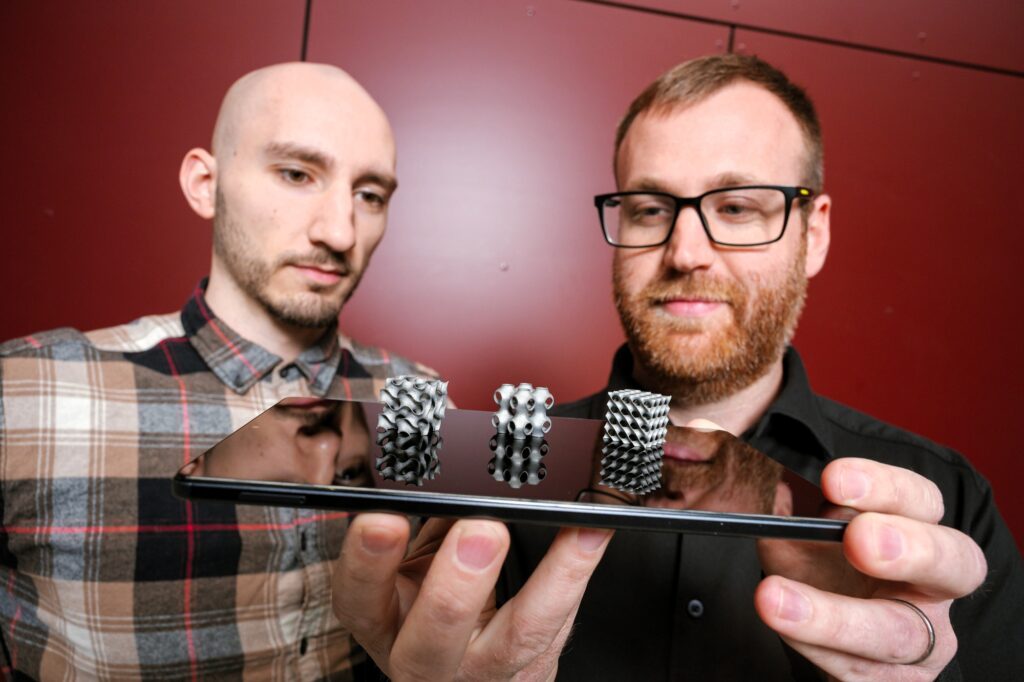
Until now, much of the development has used bundles of ultrathin nickel-titanium wires and thin sheets. These formats have shown how elastocaloric systems can work in compact demonstrators. The next step is more complex geometry. Together with manufacturing specialists led by Professor Dirk Bähre, the Saarbrücken team is investigating additively manufactured structures that give air or water more contact with the active material.
More active surface for heat transfer
Heat transfer is one of the central engineering challenges in elastocaloric systems. The material can only cool or heat effectively if the surrounding medium can exchange energy with it quickly enough. Wire bundles already offer a relatively large contact area, but 3D printing makes it possible to create porous and lattice-based structures that would be difficult to manufacture by conventional routes.
The nickel-titanium elements are built layer by layer. Their internal geometry is designed so that air or water can pass through the structure while remaining close to the active surfaces. This matters because the useful cooling effect depends not only on the material itself, but also on how efficiently heat is transferred into or out of the working medium.
The researchers are comparing different lattice and porous designs to assess thermal performance, mechanical stability, and durability. The geometry must support good flow and heat exchange, but it also has to withstand repeated mechanical loading. In practical equipment, such as refrigeration units, air-conditioning systems, or industrial cooling installations, the active element would need to operate continuously and predictably over long periods.
Shape-memory alloy with built-in sensing
Nickel titanium is suitable for elastocaloric cooling because it is a shape-memory alloy. Under mechanical stress, the alloy changes between two crystal structures and releases heat. When the stress is removed, the transformation reverses and the material cools down. This reversible transformation is the basis for transporting heat in an elastocaloric system.
The same material behaviour also offers a useful control option. The deformation state of nickel titanium can be monitored through its electrical resistance. Each deformation state corresponds to a specific resistance value, giving the material an intrinsic sensing capability. In future systems, this could reduce the need for separate position sensors and simplify control architectures.
For machine builders and system integrators, that point is relevant. Cooling technologies are rarely judged on material performance alone. They also need manageable control, reliable feedback, and components that can be integrated without unnecessary complexity. If the active element provides information about its own deformation, designers gain an additional signal for controlling the mechanical cycle.
Durability remains a key design issue
Moving elastocaloric cooling beyond the laboratory depends heavily on service life. The active material is repeatedly stretched or compressed, and these cycles create fatigue. The Saarbrücken researchers are therefore studying how different loading regimes affect the alloy and how the material properties can be matched to the mechanical cycle of the system.
In wire-based designs, the team is aiming for lifetimes of more than one million cycles. Even with that target, fatigue remains a practical concern for real equipment. A cooling system in a vehicle, building, appliance, or industrial installation must be maintainable, not only efficient under ideal test conditions.
For this reason, the researchers are also working on replacement concepts for active components. If the elements can be exchanged quickly, the technology becomes easier to service and more realistic for everyday use. This is particularly important for applications where downtime, access, and maintenance cost determine whether a new cooling principle can compete with established systems.
From mini-fridge to vehicle and building systems
One demonstrator developed by the team is an elastocaloric mini-fridge that cools a drinks can. It uses bundles of 200-micrometre-thin nickel-titanium wires arranged around a circular cooling chamber. The wire bundles are stretched on one side and released on the other, while air flowing past the wires transports heat out of the chamber and lowers the temperature inside.
The 3D-printed elements add another development route to this work. Instead of relying only on simple wire or sheet geometries, the researchers can tailor the internal structure of the nickel titanium to improve contact with air or water. That could support more compact systems with improved heat transfer, provided the printed structures also meet mechanical and fatigue requirements.
Several research programmes are supporting the work in Saarland. The German Federal Ministry of Research, Technology and Space is funding the DEPART!Saar project with up to 18 million euro through its T!Raum programme, with a focus on regional innovation and technology transfer. In the SmartCool project, funded by the Federal Ministry for Economic Affairs and Energy, the Saarbrücken engineers are working with Volkswagen, Fraunhofer IPM, and Ingpuls on lightweight, energy-efficient cooling systems for electric vehicles. Another project, supported by the European Innovation Council, is aimed at an elastocaloric air-conditioning system for heating and cooling individual rooms in residential buildings. Additional funding from an ERC Starting Grant allows Motzki’s team to combine elastocaloric nickel titanium with smart film actuators based on dielectric elastomers.