
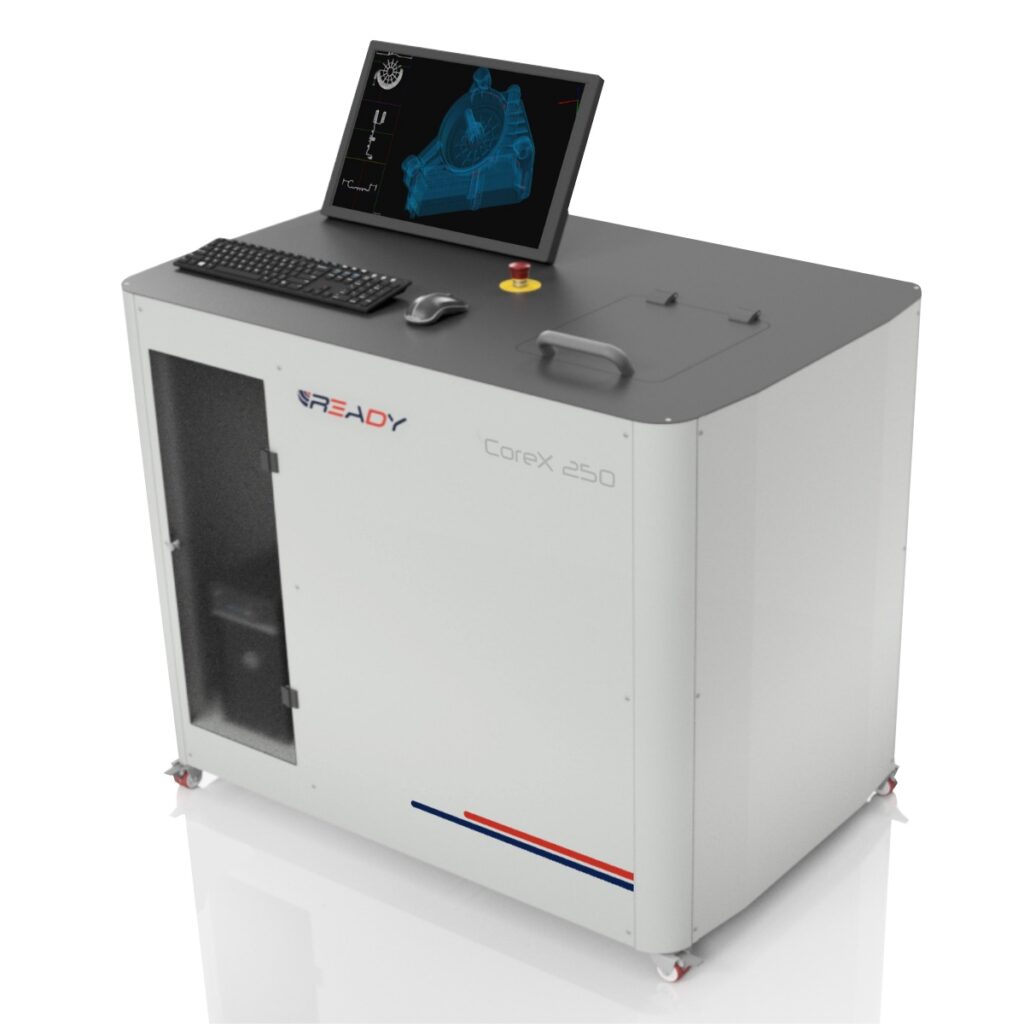
Ready Metrology has introduced CoreX, an industrial CT inspection system designed for use directly on the production line. The system is aimed at manufacturers that need internal part inspection without sending components to a metrology lab. By shortening scan cycles and simplifying operation, CoreX addresses a common bottleneck in quality control, access to non-destructive internal measurement when production decisions are being made.
Industrial computed tomography is valued because it can reveal features that surface measurement cannot reach. Voids, cracks, assembly errors and dimensional deviations inside a component can be detected without cutting the part open. In many production environments, however, CT inspection has remained separate from day-to-day manufacturing. Conventional systems often require specialist operation, controlled conditions, longer scan times and regular source maintenance.
That separation matters. When internal defects are found only after parts have left the line, process feedback arrives late. Operators may already have produced a batch of components before the inspection result is available. CoreX is positioned as a response to that gap. Instead of treating CT as a laboratory process, Ready Metrology has developed a fully shielded, top-loading system intended to sit where parts are produced and where quality decisions need to be made quickly.
CT inspection without a metrology lab
The main technical difference highlighted by Ready Metrology is the X-ray source. Conventional industrial CT systems often use open-anode sources, which the company associates with annual maintenance and scan cycles of around 20 to 30 minutes. CoreX uses a rotating closed-anode source with power up to 2,400 W. According to the company, the X-ray source requires no maintenance.
The practical aim is to reduce the barriers that usually keep CT away from production areas. CoreX is built as a fully shielded enclosure, so it does not require a bunker or a controlled environment. Its top-loading design is intended to make part handling faster, with simpler loading and removal. For operators, that can reduce the non-measurement time around each inspection cycle, which is often critical in a production setting.
The system is also designed to avoid complex parameter setup. Ready Metrology states that any shop-floor operator can load a part and generate a full measurement report in one click. This does not remove the need for a defined inspection strategy, but it does change where routine CT checks can take place and who can carry them out during production.
Short scan cycles and higher inspection frequency
CoreX is designed around short scan times. Ready Metrology gives cycle times of 20 to 30 seconds for rubber, plastic and carbon fiber, and 40 to 50 seconds for aluminium, magnesium and titanium. These figures are central to the system’s intended role, because shop-floor inspection only becomes useful if the measurement result arrives quickly enough to influence the process.
The detector concept also reflects that requirement. CoreX uses large-pixel detectors to combine speed with signal-to-noise ratio. In production inspection, the key issue is not only image quality in isolation, but whether the data is good enough to support reliable pass or fail decisions within the available takt and handling time.
Shorter CT cycles can make high-frequency inspection more realistic. In some cases, Ready Metrology says the system can support 100% part inspection. That is significant for applications where internal defects are difficult to detect by other means, or where non-conforming parts must be identified before they move further downstream. The system’s color-coded interface is intended to support real-time process monitoring, making deviations visible before a larger number of parts are affected.
Faster feedback after batch changeovers
One of the clearest production use cases is the first inspection after a batch or format changeover. These moments often carry increased risk, because tooling, settings, materials or part variants may have changed. If inspection depends on an external lab or a specialist metrology team, the line may either wait for approval or continue producing while the result is still pending.
With CoreX installed on the line, operators can inspect the first parts of a new batch within minutes of changeover, according to Ready Metrology. The practical value is not only the inspection speed itself, but the reduction in dependency on a separate department or external service. If the result is available at the machine or cell, corrective action can be taken sooner.
For manufacturers running multiple shifts or frequent changeovers, those minutes can accumulate. Faster release after changeover helps reduce idle time and limits the risk of producing parts outside specification. In this context, CT is not used as a late-stage validation tool, but as a process feedback instrument close to the point of manufacture.
Inspection reports for regulated supply chains
The system is also aimed at manufacturers that need documented inspection evidence for customers in sectors such as automotive, aerospace and medical manufacturing. Ready Metrology notes that CT-backed inspection reports are increasingly required in these environments. Outsourced CT scanning can provide that documentation, but it introduces cost, scheduling constraints and a delay between production and verification.
CoreX generates inspection documentation at the point of production. For suppliers, this can make CT reporting part of the normal quality workflow rather than a separate service step. That is particularly relevant when internal features, hidden defects or assembled conditions must be verified without destroying the component.
The ability to produce reports quickly also supports contract and customer requirements where traceable inspection evidence is part of the delivery package. The press material describes this as a lower-cost alternative to outsourced scanning. For manufacturers, the more important operational question is whether inspection can be integrated into existing quality routines without slowing production or requiring specialist CT knowledge for every check.
Shop floor workflow on display at MACH 2026
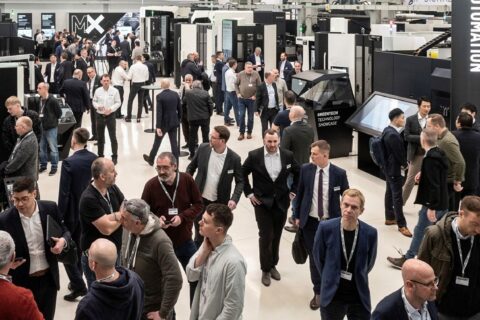
CoreX will be shown at MACH 2026, where Ready Metrology plans to demonstrate the system in an interactive environment that replicates shop-floor CT inspection workflows. The demonstration will show how inspection cycles are executed, including scanning, analysis and output of results through the system interface.
Ready Metrology will exhibit together with Measurement Solutions Limited, its new UK distribution partner. MSL has more than 25 years of experience supporting British manufacturers in aerospace, automotive and defense, according to the announcement.
The launch also fits within Ready Metrology’s broader focus on production-oriented metrology. Alongside CoreX, the company produces RUN, a shop-floor CMM developed around the same idea of bringing measurement closer to manufacturing. With CoreX, the company is extending that approach to non-destructive internal inspection, a measurement category that has traditionally been powerful, but often too slow or complex for routine use on the line.