
A new research project aims to develop an AI-supported planning platform for complex industrial processes. These processes involve many interdependent variables. Led by Saarland University, DFKI and abat+ GmbH, the PreAIrranging project will focus on sequencing, production changes and simulation-based AI training. The work is intended to help manufacturers respond more effectively when supply, model variants and staff availability affect production schedules.
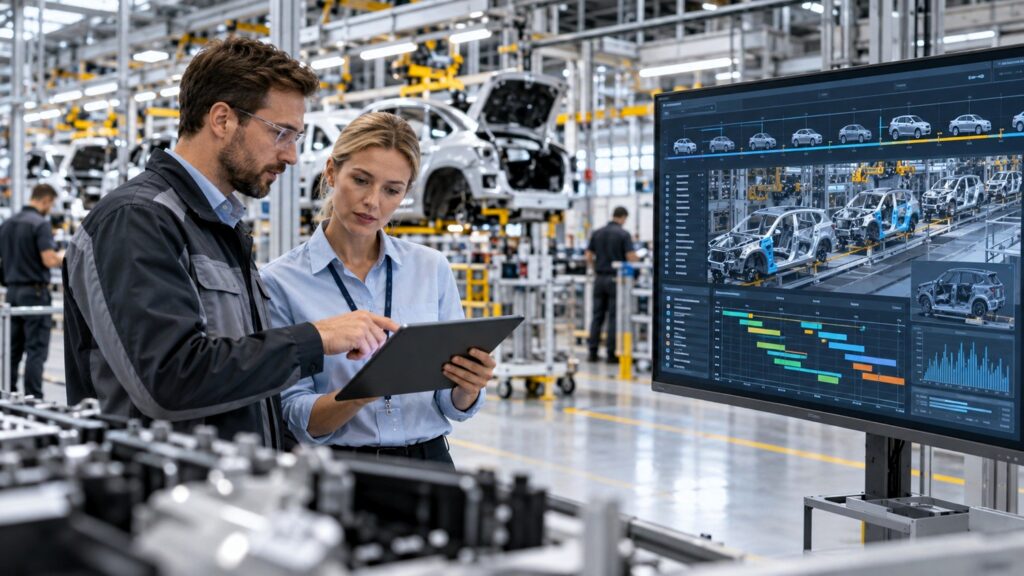
Production planning becomes particularly demanding when components, product configurations and personnel must be coordinated simultaneously. Automotive manufacturing illustrates this challenge. Supplier parts must arrive on time and be installed in the correct sequence. At the same time, series production must accommodate numerous vehicle variants. Shorter innovation cycles add further pressure. According to Verena Wolf, professor of computer science at Saarland University, conventional planning systems reach their limits as industrial processes become more complex. The project builds on self-learning algorithms developed in recent years. It seeks to transfer these algorithms into industrial practice. The project has received just under €900,000 from the European Regional Development Fund and the European Union.
Sequencing under changing production conditions
The planned platform will address sequencing tasks in which components must be available at a defined point in the production process. In vehicle manufacturing, this means ensuring that parts are delivered and installed in the required order. Such planning must account for dependencies between suppliers, model variants and staff availability. AI is therefore intended to process these interdependencies more effectively than conventional systems when schedules become difficult to manage. The project extends beyond planning a new production process. The partners also want to examine active production lines that require short-notice rescheduling. Delays in the delivery of individual components are one example. Another is the need to prioritize certain vehicles. These changes are part of daily production planning. However, they can become more difficult to manage when supply chains are less resilient.
The project therefore focuses on a system that can support planning decisions when conditions change during ongoing operations. Verena Wolf describes this ability to rearrange schedules as particularly relevant in an environment shaped by global competition and disrupted supply chains. The aim is not limited to generating an initial sequence. It also includes revising that sequence when new constraints arise.
Digital twins for AI training
A central element of the project is the use of digital twins. The research teams plan to create simulations tailored to real production systems. These simulations will allow AI models to be trained without directly affecting live operations. This approach is intended to connect the algorithms with the conditions of specific manufacturing environments. The resulting platform is designed to be open and scalable. It should be able to optimize different types of production data. Over the coming months, the platform is to be expanded into an AI toolkit. The toolkit will be adaptable to the planning problems of individual industrial customers.
Small and medium-sized companies are also part of the project’s intended application area. Many of these businesses still plan a substantial share of their processes manually. The partners want to use the platform to support their digital transformation. This is particularly relevant where planning tasks involve numerous dependencies. It also applies where resources for developing dedicated systems are limited. Based in St. Ingbert, abat+ GmbH contributes software and cloud infrastructure expertise. The company also provides experience in production planning for large industrial companies. The project is led by Verena Wolf, Timo Philipp Gros of DFKI and Philipp Stopp of abat+ GmbH.
Potential applications beyond manufacturing
Industrial production is the project’s primary focus. However, the project also considers planning scenarios in other complex operational environments. One example is operating theater scheduling in large hospitals. Each procedure may require specific surgical instruments, reconfigured medical equipment and suitably qualified staff. The platform could support schedules that place operations with similar requirements in succession. As a result, preparation work between procedures could be reduced. This could also help save time and costs. The example reflects the broader purpose of the PreAIrranging project. It applies AI-supported sequencing to processes in which resources, timing and changing requirements must be closely coordinated.