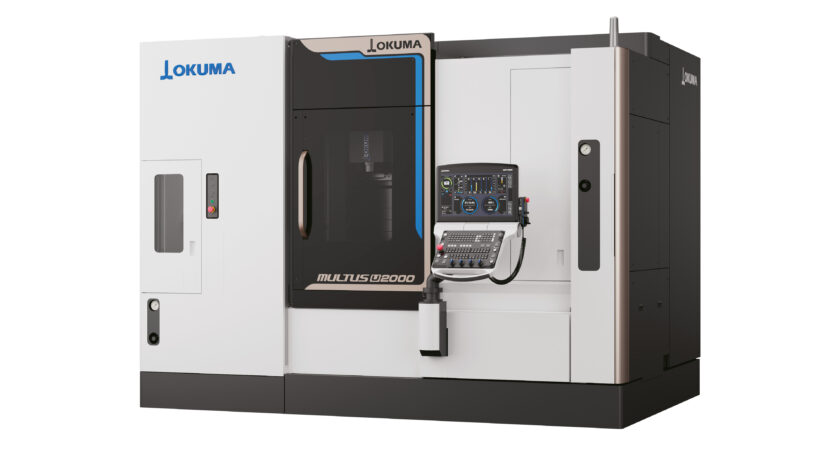

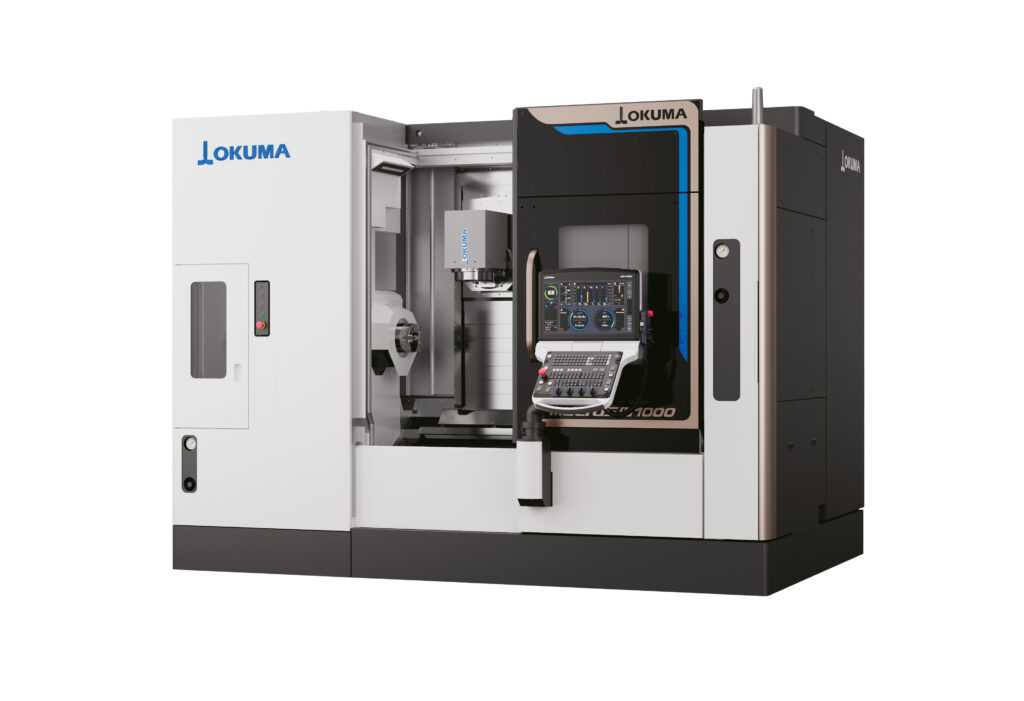
Okuma has expanded its MULTUS U series with two multitasking machines designed for 5 axis simultaneous machining in a compact footprint. The new MULTUS U1000 and MULTUS U2000 combine turn mill capability, large tool capacity and automation options within 8.2 m² of floor space, a combination aimed at manufacturers dealing with rising part complexity, limited space and pressure on staffing.
The announcement reflects a familiar situation in many production environments. Components for sectors such as medical technology, robotics and electric mobility are becoming more complex, while the available shopfloor area is often not. At the same time, mixed production with frequent changeovers puts pressure on machine utilisation and operator workload. Okuma positions the two new models as an answer to that combination of constraints. Both machines are intended to handle complete machining of demanding parts in one setup, while leaving room for integrated automation around the machine. Their compact design is therefore not just a matter of installation, but also of how much process capability can be concentrated into a small cell. That matters most where manufacturers need flexibility without giving up output or process stability over longer runs.
Machine layout combines compact size with broad process range
The MULTUS U1000 and MULTUS U2000 share the same axis travels of 550 mm in X, 220 mm in Y and 880 mm in Z, combined with B and C axes of 240° and 360°. In practice, that gives both models the kinematic range needed for complex multisided machining and simultaneous 5 axis work on a single platform. The U1000 is equipped with a main spindle up to 6,000 min-1 and a 6 inch chuck, while the U2000 uses a main spindle up to 5,000 min-1 with an 8 inch chuck.
A notable part of the concept is the standard tool capacity. Both machines come with an automatic tool changer for up to 80 tools, which reduces the need for manual intervention when a broad mix of operations must be covered. For shops running varied batches and parts with multiple machining steps, that can limit downtime linked to retooling and support more stable unattended running. If required, the magazine capacity can be extended to 120 tools with a chain magazine or to 180 tools with a matrix magazine. That makes the machines relevant not only for compact installations, but also for applications where process consolidation depends on keeping many tools available inside the machine.
Automation options focus on cell integration
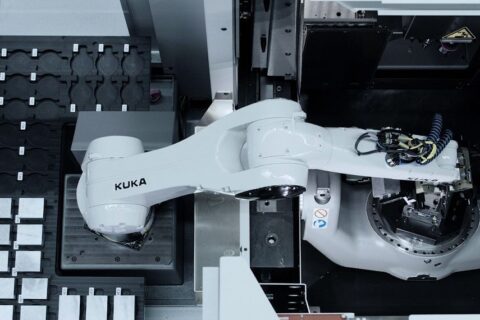
Okuma also places strong emphasis on how the machines can be automated within a restricted footprint. The flat machine front allows loading and unloading robots to be positioned closer to the machine, which helps reduce the overall size of the cell. For users where floor space is a limiting factor, that detail can be as important as the machine dimensions themselves.
The company also offers the option to integrate a loading robot into the machine. Especially in higher volume production, this can simplify cell layout and reduce the space normally needed for external handling equipment. Further automation options include a bar feeder for supplying material to the spindle and a parts unloader for removing finished components. Together, these features point to a setup in which the machine is not treated as a standalone asset, but as the centre of a compact and increasingly autonomous process.
That approach is particularly relevant where labour availability is tight and longer unmanned operating windows are needed. In those cases, automation is not just about faster loading cycles, but about reducing operator dependency across the entire process chain around the machine.
Compensation and monitoring support stable long run machining
For continuous operation, the machines use Okuma’s 5 Axis Auto Tuning System. After calibration, the system detects and compensates for manufacturing tolerances and wear related changes in machine geometry. The practical value lies in maintaining consistent part quality over time, especially during longer production runs where small deviations can accumulate into scrap risk or rework.
Okuma says the turret rotation axis and main spindle have also been further developed to increase accuracy. In addition, the Thermo Friendly Concept is intended to help the machine adapt to changing ambient temperatures. Thermal effects remain a common source of dimensional variation on the shopfloor, so compensation at machine level can improve process stability when conditions fluctuate across shifts or between day and night operation.
The Collision Avoidance System is included to support process safety, and an optional AI based monitoring function can be used to track machine condition and detect potential failures at an early stage. For manufacturers aiming to extend unattended operation, that combination of geometric compensation, thermal control and condition monitoring addresses a central requirement, keeping output stable while reducing the risk of interruption.
Designed for confined production environments
The compact dimensions are one of the clearest differentiators in this launch. Okuma states that both the MULTUS U1000 and MULTUS U2000 require only 8.2 m² of floor space and measure 3,510 x 2,345 mm. According to the company, that makes them the most compact machines in the MULTUS U series. The narrower design also leaves room for optional attachments, which is important when automation equipment must be added without disrupting the surrounding layout.
Operation is handled via the OSP P500 CNC control, which Okuma describes as user friendly, including for less experienced users. In practical terms, that matches the broader direction of the machines. If manufacturers are expected to run increasingly capable multitasking systems with fewer skilled operators available, ease of operation and process support at control level become part of the machine concept rather than an extra feature.