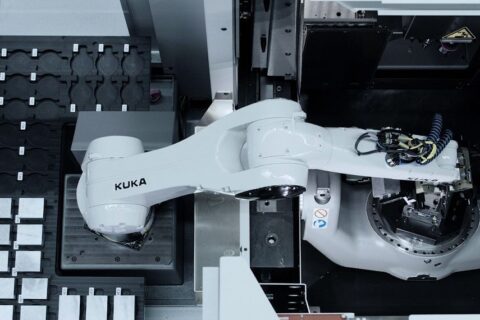

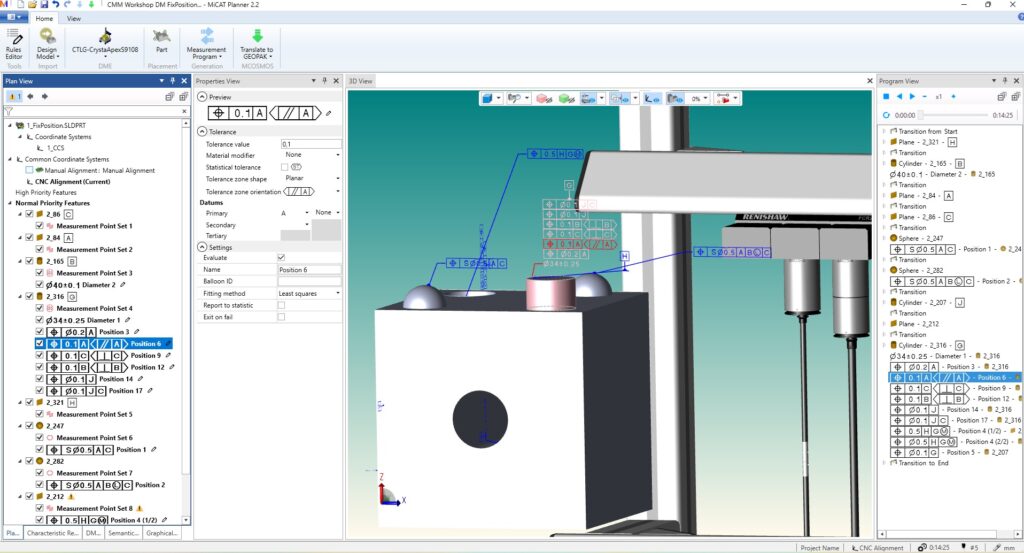
Mitutoyo CTL developed MiCAT Planner to address a persistent bottleneck in industrial metrology: turning annotated 3D CAD models into reliable CNC measurement programs. By automating much of the programming work that was previously manual, the software helps manufacturers reduce dependency on scarce specialist knowledge while improving consistency across measurement strategies, machines and production sites.
Since 1983, Mitutoyo Computer Technology Laboratory in Germany has been responsible for developing metrology software used within Mitutoyo’s global measurement systems. MiCAT Planner emerged from a clear shift in manufacturing practice. Companies were moving from 2D drawings to 3D CAD models containing product manufacturing information, yet measurement programming still often depended on manual interpretation and individual experience.
That gap created practical problems. Programming could be slow, results could vary between users and experienced metrology specialists were needed for tasks that increasingly had to fit into faster production cycles. Petra Brieger, Feature Owner of MiCAT Planner and a CTL team member for 14 years, describes the challenge directly: “Customers had powerful CAD models, but they lacked a fast and reliable way to convert all this PMI information into a high-quality measurement program. MiCAT Planner was our answer to this industry-wide problem.”
From CAD data to executable measurement programs
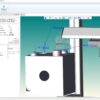
The core idea behind MiCAT Planner is to use CAD and PMI data as the basis for automated CMM programming. Instead of requiring a user to manually create a measurement program feature by feature, the software interprets the model information, applies predefined measurement rules, selects suitable probes and tools and generates paths intended to avoid collisions.
This changes the role of the metrology specialist. Expert knowledge is not removed from the process, but embedded in the rules and strategies used by the software. That is important for companies that need repeatable inspection routines across different operators, departments or production locations. Brieger puts it this way: “We wanted to take a big step into Industry 4.0 and automate what was previously expert work. If we could embed metrology knowledge directly into the software, customers could save enormous time and get consistent results.”
A key practical point is that programs can be prepared offline, even before the physical part is available. This helps keep CMMs available for inspection rather than programming, which can improve machine utilization in environments where measurement capacity is a constraint.
Rule-based logic for consistent inspection
One of the main technical characteristics of MiCAT Planner is its rule-based approach. Customers can define measurement strategies and apply them consistently to CAD-driven programming tasks. The aim is not only to generate programs faster, but to reduce variation between users who might otherwise choose different measurement methods for the same type of feature.
For production companies, this has direct operational relevance. Standardized measurement strategies support traceability and make it easier to maintain comparable inspection routines across multiple sites. In sectors such as automotive, aerospace and medical devices, where the source material notes broad use cases, consistency is often as important as speed.
Brieger describes the practical effect clearly: “No matter who presses the button, the logic behind the program is always the same.” That consistency can be especially valuable when experienced programmers are scarce or when new employees need to become productive without first mastering every detail of manual CMM programming.
The software also supports adaptation when a CAD model is revised. According to the source material, a new CAD revision can be replaced in an existing project while retaining and transferring project changes and settings to the new model. This reduces the need to restart programming work from zero after design updates.
Development across software and metrology disciplines
MiCAT Planner was developed through cooperation between Mitutoyo CTL and Mitutoyo teams in Belgium and the United States. The work combined several specialist areas, including CAD translation, feature recognition, path optimization and application workflows. That mix reflects the complexity of automated metrology programming, where geometry processing, machine behavior, tooling and user interaction all have to work together.
The technical challenge was not limited to reading CAD data. The development team had to work with different CAD formats, external geometry libraries and complex logic while balancing computing speed, measurement accuracy, software capability and ease of use. In practice, an automated programming system must be powerful enough to handle complex models, but understandable enough for users who need reliable output without spending excessive time configuring the process.
Brieger emphasizes that the project depended on both software engineering and metrology knowledge: “Beyond their strong development skills, our software developers bring many years of experience and deep metrology expertise that directly shape the product.” That combination is important because automated decisions in measurement planning are only useful when they reflect real inspection practice, not just geometric interpretation.
Time savings and machine availability
The most visible effect for users is shorter programming time. The source material reports customer reductions of 80 to 95 percent, especially when models contain extensive PMI data. While the exact gain will depend on the complexity of the part and the quality of the model information, the direction is clear: automated interpretation can remove a large part of repetitive manual programming effort.
For manufacturers, this affects more than the programming department. Offline program generation can free CMM capacity, because the machine does not have to be occupied while a programmer builds and checks routines. This can help shorten the path from design or machining to inspection, particularly when production schedules are tight or inspection resources are shared across many parts.
Collision-aware path planning and optimized tool changes also matter in day-to-day use. A measurement program must not only be generated quickly, it must run predictably on the machine. The source material points to stable, safe programs as one of the main outcomes of the software’s planning logic. For production teams, that means less manual correction and a lower risk of interruptions during inspection.
Preparing metrology for more connected workflows
MiCAT Planner has continued to develop since its first release. Brieger identifies the initial version as the point where rule-based, CAD-driven programming was proven in practice, while version 1.9 marked a step toward a more mature professional product. Feedback from application engineers and customers has been an important part of that development, particularly when users reported that they did not want to return to manual programming.
The next stage is expected to focus on smarter automation and closer integration with digital manufacturing workflows. Areas mentioned in the source material include AI-supported interpretation, adaptive rules, more intelligent path optimization, advanced simulation and validation and tighter links between CAD, CAM and CMM processes. Deeper integration with MiCAT ecosystem tools is also part of the direction described.
These developments point to a broader role for metrology in manufacturing data flows. If measurement planning can be generated earlier, updated more easily after design changes and linked more closely to upstream and downstream systems, inspection becomes less of a separate step and more of an integrated part of production control. For companies working with complex parts and frequent revisions, that may become as important as the programming time saved.
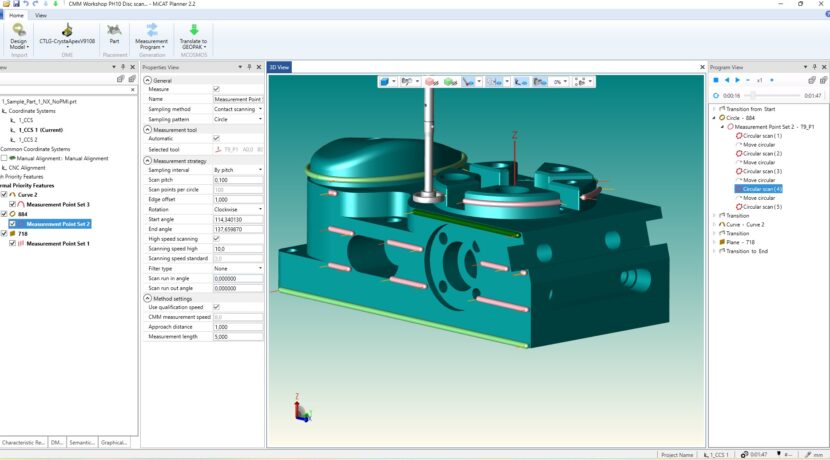
paths and feature-based inspection logic. (Pictures: Mitutoyo)