
A research team at Heidelberg University has developed a polymer material for light-based 3D printing that can be chemically broken down and reused. The approach addresses a key limitation of common printing resins. These materials form stable but largely non-recyclable networks. The new material is designed to retain print quality and mechanical stability. It also enables the recovery of its molecular building blocks. Light-based additive manufacturing methods, such as digital light processing, produce small and complex structures. Applications include personalized medicine and soft robotics. During these processes, liquid inks solidify into three-dimensional parts when exposed to light. The resulting materials are commonly thermosets. Their molecular building blocks are permanently linked into a network. This structure provides stability. However, it also makes the printed products difficult to recycle. Once cured, conventional thermosets generally cannot be returned to their starting components. As their use increases, this can contribute to continuing waste streams.
A chemical trigger releases the polymer chains
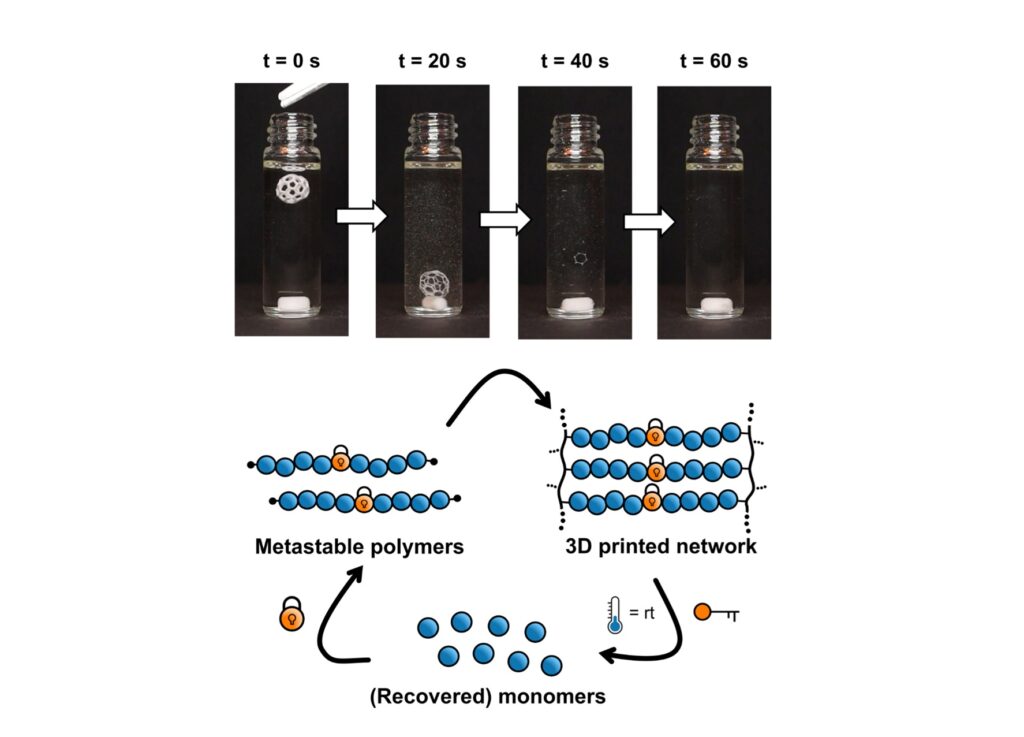
The Heidelberg researchers designed a metastable polymer material that responds to a specific chemical signal. Its molecular chains contain a predetermined breaking point. This point acts as a lock that can be opened by the appropriate chemical key. Once triggered, the long polymer chain breaks down into its individual components within seconds at room temperature. According to doctoral researcher Johannes Markhart, the reaction proceeds like a row of dominoes. Opening the designated site initiates the breakdown of the entire chain. This process differs from conventional thermoset networks. Their irreversible chemical links provide durability but prevent straightforward material recovery.
The researchers faced the challenge of introducing this controlled disassembly mechanism without compromising the properties required for light-based 3D printing. They report that the material maintained the quality and mechanical stability needed to produce printed structures. At the same time, it added a route for chemical recovery after use. In practical terms, the approach separates the material’s functional requirements during printing from its end-of-life requirements. A part can remain stable during service. However, it can also be deliberately dismantled when material recovery is required.
Micrometer-scale structures and material recovery
In experiments, the team used the metastable polymer as an ink for producing complex three-dimensional structures. These structures included details at the micrometer scale. The tests showed that the material is suitable for high-resolution light-based printing. It also retained its ability to be completely disassembled after printing. Following chemical breakdown, the researchers isolated the recovered molecular building blocks. They then converted them back into a polymer. Spectroscopic analyses showed that the recycled polymer had the same chemical composition at the molecular level as the original material. Doctoral researcher Philipp Mainik states that the reused material also displayed the same printing properties as in the initial process. Therefore, the recovered polymer could be used again as a material for light-based 3D printing.
This recovery route is central to the concept of chemical circularity. Instead of treating a printed polymer part as its final material state, the process is intended to return it to reusable components. These components can then be used to produce polymer feedstock again. For light-based 3D printing, liquid resins are converted into permanently solid structures. The new approach could therefore retain the benefits of stable printed parts while reducing material loss after use. The work was carried out by Prof. Dr. Eva Blasco’s group at the Institute for Molecular Systems Engineering and Advanced Materials and the Institute of Organic Chemistry at Heidelberg University. It formed part of the Excellence Cluster 3D Matter Made to Order. The cluster is a collaboration between Heidelberg University and the Karlsruhe Institute of Technology. The findings were published in Advanced Materials.