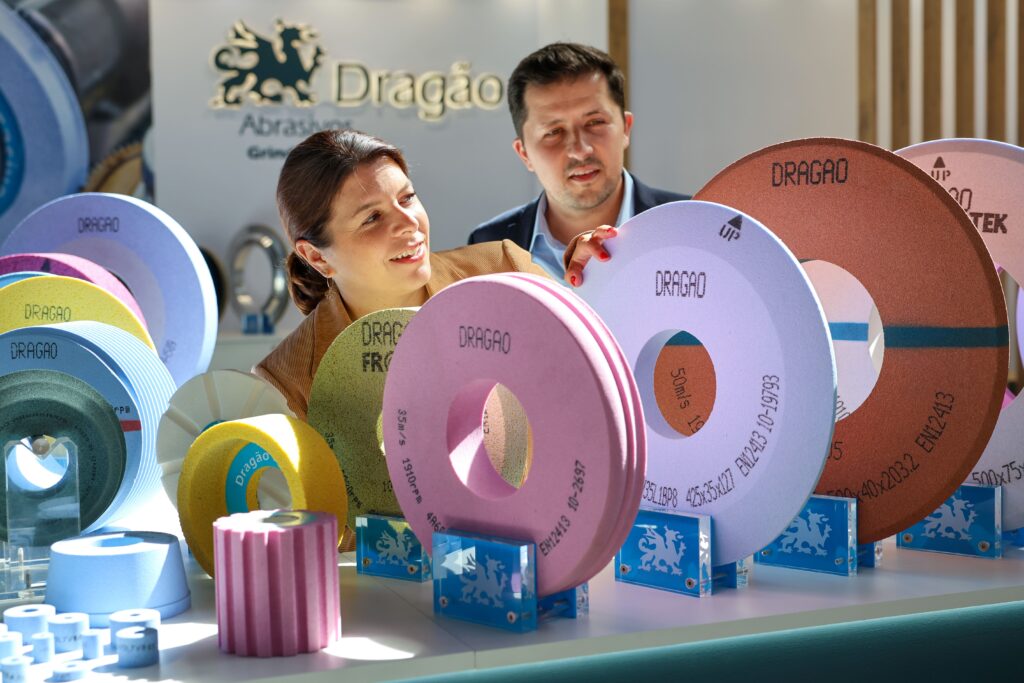
GrindingHub 2026 opens in Stuttgart at a difficult moment for the grinding technology sector. Orders, production and exports have all weakened, but the fair still brings together 462 exhibitors from 28 countries. For machine builders, tool manufacturers and industrial users, the event is less about optimism and more about practical answers to cost pressure, automation demands and process reliability.
The international grinding industry enters the event with a stable technological base but limited market momentum. According to figures released for the fair, incoming orders fell by about 5 percent in 2025, with the domestic market particularly affected. At the start of 2026, the picture became more uneven. International orders dropped by 51 percent in January and February, while domestic orders rose by 35 percent.
Production also declined, falling by 19 percent in 2025. Exports were down 24 percent, and the export ratio fell to around 76 percent, the lowest level in about six years. These figures set the tone for GrindingHub 2026. The focus is not only on new machines, tools and software, but on how grinding technology can help manufacturers secure throughput, quality and cost-effectiveness in a more demanding investment climate.
A full value chain under one roof
GrindingHub covers the main areas of industrial grinding technology, from grinding machines and tools to measurement systems, automation, software and services. That breadth matters because many of the current challenges in grinding are not solved by one component alone. Process stability, cycle time, tool life and part quality depend on the interaction between machine design, abrasives, workholding, measurement, coolant strategy and digital control.
More than half of the exhibitors come from outside Germany, underlining the international role of the event. At the same time, the location in Baden-Württemberg gives the fair direct access to one of Europe’s strongest manufacturing regions. For visitors, this combination is useful. It brings global suppliers into a setting where many users face demanding production requirements in automotive, machine building, toolmaking and other industrial sectors.
The practical value of such a platform lies in comparison. Users can assess automation concepts, measuring equipment, grinding tools and software in relation to their own production bottlenecks. In a market where investment decisions are being scrutinized more closely, the ability to compare technologies and discuss applications directly with suppliers becomes more important than a general overview of available equipment.
Weak demand changes the investment discussion
The latest market figures show why productivity is central to this year’s event. A fall in orders and production does not reduce the need for technological development. In many cases, it makes investment decisions more selective. Companies must justify new equipment through measurable effects on uptime, quality, staffing requirements and unit costs.
VDW Managing Director Dr. Markus Heering describes the sector as economically challenged but structurally strong, pointing to its technical expertise, high accuracy requirements and continuous work on process efficiency. For users, that translates into a search for solutions that can make grinding operations more predictable. A stable process reduces scrap, rework and inspection effort, especially where tolerances are tight and materials or geometries are difficult.
Automation is also becoming more relevant as skilled labor becomes harder to secure. In grinding, however, automation is not only a handling issue. Loading and unloading systems must fit with dressing strategies, measurement routines, tool management and machine availability. This is why the fair’s mix of machines, measuring technology, software and services is significant. It allows visitors to look at grinding as a connected production process rather than an isolated finishing step.
Hubi adds digital guidance for visitors
A new element at GrindingHub 2026 is Hubi, an AI-powered chatbot designed to support trade fair planning. The tool helps visitors search for exhibitors, technologies and applications, and links relevant parts of the supporting program to individual interests. Its role is practical: reducing the time needed to navigate a large technical event and helping visitors identify the stands and sessions most relevant to their production questions.
Hubi was developed by the VDW in collaboration with aiXbrain GmbH from Aachen. Its information is based on the online exhibitor catalog and on content from exhibitor websites adapted for the trade fair context. According to Dr. Alexander Broos, Head of Research and Technology at the VDW, the system is being updated continuously and is intended to help visitors plan their stay in more detail.
For manufacturing professionals, this kind of tool is useful only if it improves relevance. A grinding user looking for in-process measurement, automation for small batches or software for process monitoring does not benefit from a generic search result. If the data quality is sufficient, an AI-supported guide can make a fair visit more efficient by narrowing the route from broad interest to specific technical discussion.
Forum targets real production problems
Alongside the exhibition, GrindingHub 2026 includes a revised Grinding Solution Forum. The format is built around practical industrial challenges and follows a challenge-solution-insight approach. The subjects include process stability, quality, automation, data, digitalization, AI, cost effectiveness and the future position of grinding technology in manufacturing.
This is a relevant shift in emphasis. Grinding is often discussed through machines and tools, but users usually experience problems as combinations of symptoms: unstable results, rising inspection costs, dressing intervals that are too short, limited staffing, difficult materials or a lack of usable process data. A forum built around challenges can help connect technical solutions to those real operating conditions.
The program includes hands-on sessions and interactive co-creation workshops, giving exhibitors and visitors a structured setting for direct exchange. That is particularly useful in areas such as digitalization and AI, where many manufacturers are still assessing which applications are mature enough for the shop floor. In grinding, the value of data depends on whether it supports process control, maintenance, quality assurance or cost transparency. The forum format gives users a way to test those questions against practical examples rather than abstract technology claims.
Stuttgart expands the technical exchange
GrindingHub takes place from May 5 to 8, 2026, at Messe Stuttgart. The event is organized every two years by the VDW in cooperation with Messe Stuttgart and Swissmem as a promotional supporter for the machine tool sector. In 2026, it runs at the same venue as SurfaceTechnology Germany and MedtecLIVE, with one ticket providing access to all three events.
That overlap can be relevant for visitors whose production questions extend beyond grinding alone. Surface technology, medical manufacturing and grinding often intersect through requirements for accuracy, surface integrity, cleanliness, traceability and stable processes. Access to neighboring events gives manufacturers more room to explore related process steps, materials and application requirements during the same visit.
The organizers are also extending the GrindingHub concept internationally, with GrindingHub Americas planned for May 18 to 20, 2027, in Cincinnati, Ohio. For the current event in Stuttgart, however, the immediate issue is clear: grinding companies and users are operating under pressure, and the technologies that gain attention will be those that help make processes more reliable, efficient and easier to manage in day-to-day production.