
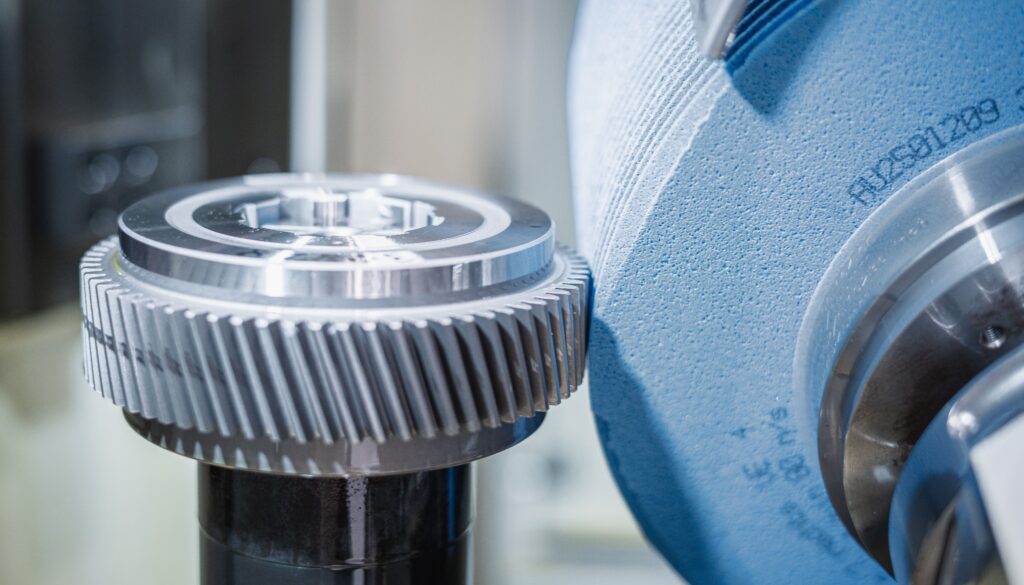
Electric drives have made grinding quality more visible than ever. Without combustion noise to mask drivetrain behavior, small deviations in gears, shafts, and sealing surfaces can directly affect noise, efficiency, and service life. That puts surface quality, tolerance control, and process stability at the center of manufacturing decisions for e mobility components.
The shift is not only about achieving finer surfaces. It is also about controlling the full tolerance chain in series production. According to Prof. Thomas Bergs of RWTH Aachen University and Fraunhofer IPT, geometric deviations on tooth flanks are transmitted directly into the drivetrain as rotational vibrations. In electric vehicles, where high speeds and low background noise expose even subtle irregularities, this has an immediate effect on NVH, noise, vibration, and harshness. Shaft seal surfaces present another example. Microstructures left by conventional grinding can contribute to unwanted leaks, showing that grinding quality influences both acoustic behavior and functional reliability.
These requirements raise the bar for production engineering. Manufacturers need grinding processes that deliver very small deviations consistently, not only in laboratory conditions but across volume production. That makes monitoring, data evaluation, and process modeling just as important as the machine tool itself.
Digital twins move into the grinding process
One of the central themes emerging from current research is the use of data driven monitoring and digital twins to stabilize grinding processes. Bergs describes this as a way to identify critical issues early and optimize production in a targeted manner, especially for heavily loaded components such as gears in e mobility transmissions.
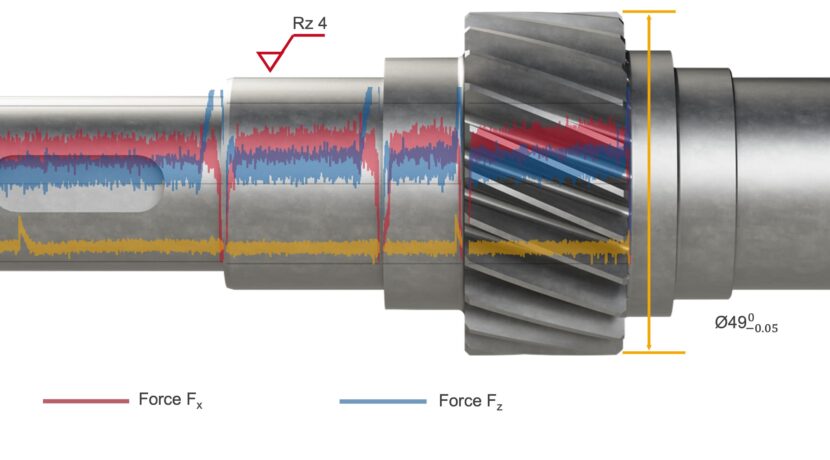
The focus is on surface integrity, because it has a direct influence on component service life. New methods are being developed to predict surface roughness and residual stresses with data based models linked to the actual process. In practice, this means combining real time sensor data from the machine with physical models in a digital twin. The result is not simply more data on screen, but a basis for assessing component quality during production and intervening quickly when deviations appear.
That matters in serial production, where defects are costly and often difficult to trace once parts have moved downstream. Model based digital methods allow demanding quality targets to be considered earlier, already in process design. This improves robustness before production ramps up and helps translate tight quality requirements into a process that remains economically viable over time.
Surface finish becomes a drivetrain issue
For electric vehicles, surface finish is not an isolated quality metric. It affects how quietly and efficiently the drivetrain runs. Bergs points to ultra smooth surfaces as an important route to improving component efficiency further, particularly in gears for electric gearboxes. He sees optimized process chains, combined with polishing and generative grinding, as especially promising.
The practical relevance is straightforward. Better surface quality can reduce friction losses, improve running characteristics, and support more stable NVH behavior. At the same time, the challenge is one of scale. Achieving results in the micrometer and nanometer range is one thing, holding them consistently over long production runs is another.
United Machining Solutions, which will exhibit at GrindingHub, frames this as a machine tool challenge tied directly to e mobility requirements. CTO Christoph Plüss says the company is focused on grinding technologies for surfaces in the micro and submicrometer range, with the aim of reducing friction and noise while keeping processes stable and reproducible in series production. The technical point here is less about headline values and more about repeatability. For component manufacturers, reproducible grinding quality is what turns a demanding target into a controllable manufacturing process.
Flexibility matters as powertrains diversify
The production landscape is further complicated by the fact that e mobility will not replace every other drivetrain concept overnight. Plüss expects a long period in which battery electric systems coexist with hybrid drives, optimized diesel engines, hydrogen fueled combustion engines, and fuel cell technologies. For manufacturing companies, that means the component mix will change gradually rather than in one abrupt step.
This has consequences for investment planning. Grinding systems must not only meet stricter demands on accuracy, process reliability, and flexibility, they also need to adapt to different materials, geometries, and combined component functions. Plüss says United Machining Solutions is responding with flexible machine concepts and modular production solutions that can be adjusted to changing requirements, supported by digital technologies for data driven process optimization.
For suppliers, that combination is becoming strategically important. The transition in mobility is creating uncertainty in volumes and product portfolios, while technical demands continue to rise. A production setup that can be reconfigured more easily reduces risk when market demand shifts. It also helps manufacturers stay competitive across a broader range of applications, rather than tying capacity too tightly to a single drive concept.
GrindingHub puts these issues into a practical setting. At the 2026 event in Stuttgart, solutions for electric vehicle component production will be shown particularly in Halls 7 and 9, including generative grinding machines aimed at smooth running electric drives and grinding systems designed for accurate concentricity at high speeds. The forum program in Hall 10 will add the research and application perspective, with industry and academic experts discussing current manufacturing challenges and possible solutions.