
Fraunhofer IWU has redesigned high-pressure sheet metal forming to increase output. Production rises from six to eight strokes per minute to as many as 60 cycles per minute. The development addresses hydroforming’s long cycle times and reduces tooling complexity. A second process combines tube hydroforming with flow pressing for simpler metal-plastic hybrid production.
Hydraulic forming uses fluid pressure to shape sheet metal or tubes. The fluid replaces a second rigid tool with a force-transmitting medium. This approach can improve surface quality, material thickness distribution and component design. However, conventional hydroforming is often slower than stamping or deep drawing. Press opening and closing, clamping-force build-up and forming usually occur sequentially. Researchers at Fraunhofer IWU in Chemnitz have changed this sequence through passive high-pressure sheet metal forming, or HPSF. The institute has also developed a hybrid component process. Thermoplastic preforms are reshaped together with a metal tube. This avoids integrating injection-molding equipment into the forming line.
Passive HPSF integrates forming pressure
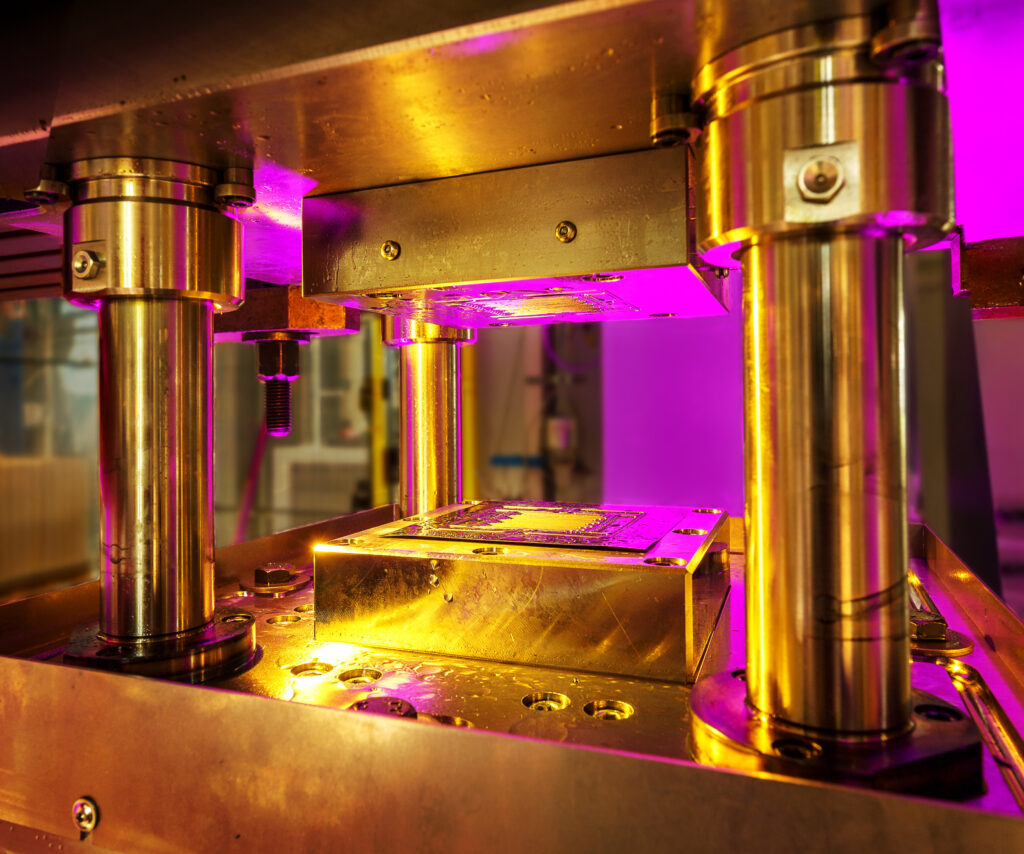
In passive HPSF, a hydraulic cylinder generates forming pressure directly in the tool. When the press closes, its clamping force automatically creates the pressure required for forming. As a result, press movement, clamping-force generation and forming occur simultaneously rather than sequentially. The revised tool concept allows standard presses to be used. A separate high-pressure water-hydraulic system is not required. Combined with coil-fed production, the process has enabled bipolar plate manufacturing at up to 60 cycles per minute, according to Fraunhofer IWU.
The institute is researching passive HPSF mainly for bipolar plates used in fuel cells and electrolyzers. The process could also produce smaller sheet metal components currently made by stamping. Smartphone housings are one example. The technology could replace deep drawing or be used alongside it. Fraunhofer IWU identifies cost-effective tooling as a factor supporting series production of these parts. Fluid pressure presses the sheet uniformly against the die surface. Therefore, the process can improve surface quality and create a more consistent material thickness distribution.
Flow pressing reshapes polymer preforms
The second development targets metal-plastic hybrid components. Examples include structural elements for automotive instrument panels and front-end assemblies. Other applications include furniture legs. These parts are commonly produced by combining hydroforming with injection molding. Integrating both technologies into one system requires equipment and process expertise for two different manufacturing operations. Fraunhofer IWU developed an alternative with Chemnitz University of Technology, Schicktanz GmbH, IWC Engineering and industrial designer Felix Monza.
The process combines tube hydroforming with simultaneous flow pressing of thermoplastic components. Instead of injecting plastic into the tool during metal forming, a pre-manufactured plastic element is placed in the tool. The element can be produced by extrusion or injection molding. It is then reshaped during the forming operation. The metal tube and thermoplastic component are heated together. They are then inserted into a temperature-controlled tool. During internal-pressure forming, the plastic element is pressed into its final shape at the same time. Tool slides can control material flow for complex polymer geometries. Injection-molded preforms and additional elements, such as threaded inserts, can also be incorporated where required. After cooling, the finished hybrid component is removed from the tool. Process control largely follows conventional internal high-pressure forming. The tool and workpiece operate at elevated temperatures. Therefore, gaseous nitrogen is used as the forming medium. The approach eliminates the need for injection-molding equipment and its integration into the forming system. This is intended to lower machinery and tooling requirements for small and medium-sized manufacturers.
Both processes will be presented at the Technical Forum on Tube, Profile and Hydroforming Technologies in Chemnitz on September 30 and October 1, 2026.