
Tetrahedral amorphous carbon coatings, known as ta-C, are used where low friction and wear resistance are required. Fraunhofer IWS has adapted its Laser-Arc process to produce coatings up to 100 micrometres thick. The institute has also reduced coating defects through plasma filtration. These developments address two limitations that have restricted the use of ta-C under high mechanical and abrasive loads. ta-C is the hardest form of diamond-like carbon coating. Its high proportion of sp³-hybridised diamond bonds provides high hardness and wear resistance. Its low friction also supports stable operation in tribological systems.
The coatings are already used on engine and machine components, as well as machining and forming tools. However, conventional vacuum-arc deposition presents practical challenges. Particle-like droplets from the cathode can become embedded in the coating. This increases surface roughness and the need for post-processing. Compressive residual stresses can also limit coating thickness. In addition, they can increase the risk of coating failure under load. Fraunhofer IWS has therefore focused its process development on both issues.
Ultrathick coatings for highly loaded components
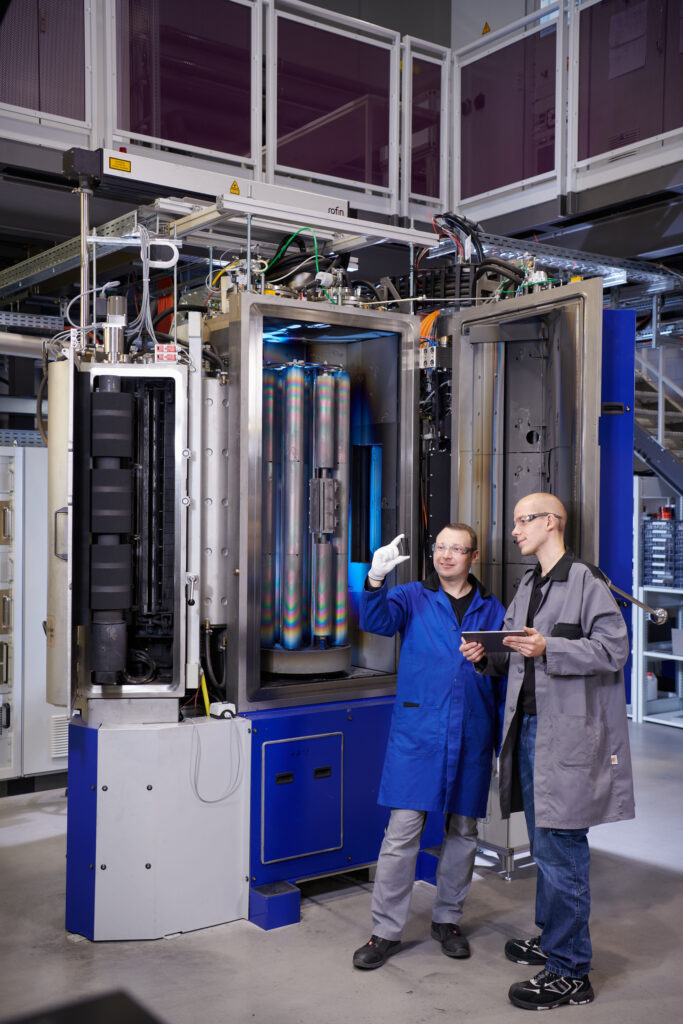
Researchers in Dresden have developed coating systems that deposit ta-C layers more than 20 micrometres thick. The layers have reduced residual stress. According to Fraunhofer IWS, the process can now reliably produce coatings up to 100 micrometres thick. The process is suitable for engineering substrates such as rolling bearing steel, cemented carbide, cast materials and selected polymers. The development combines adapted pulsed power supply technology with a revised coating architecture. This reduces compressive residual stresses below the critical level without reducing coating hardness. The institute has also developed adhesion layer systems for different substrate materials. These layers are designed to provide reliable bonding between the substrate and the thick ta-C coating.
Long-term process stability was another requirement. High deposition rates are among the stated strengths of the Laser-Arc process. However, thick coatings require stable operation over extended periods. The updated technology can operate stably for more than 24 hours. This enables reproducible deposition of thicker layers. For components exposed to severe abrasive or erosive wear, the increased thickness allows the coating to provide load-bearing capacity. As a result, it is intended to prevent the so-called eggshell effect. This effect occurs when local overload causes a thin coating to fail because the substrate cannot support it sufficiently.
Plasma filter reduces droplets and surface defects
Fraunhofer IWS has also integrated plasma filter technology into the Laser-Arc process. The aim is to improve coating surface quality. In vacuum-arc deposition, droplets detached from the cathode can travel with the plasma beam. They may then become incorporated into the growing coating. These inclusions increase surface roughness and can affect coated contact surfaces. The new system uses a 90-degree deflection filter to separate the ion flow from the particles. Therefore, the coating can grow with a lower defect density while retaining the process’s high deposition rate. This approach is particularly relevant when a smooth ta-C surface is more important than a thick, load-bearing layer.
For hard substrate materials, coating thicknesses between one and five micrometres may be sufficient. In these applications, the filtered process is designed to produce homogeneous, smooth coatings with low defect levels. Fraunhofer IWS identifies plain bearings, shafts, guides, and machining and forming tools as typical applications. A smoother coating can improve component surface quality and support more stable tribological operation. The coating system can therefore be adapted to the substrate material, load level and functional requirement. It does not rely on a single layer design for every application.
Low friction across different lubricating media
Alongside wear protection, ta-C is used for its low-friction behaviour. According to Fraunhofer IWS, the coatings can maintain friction coefficients between 0.1 and 0.2 across various lubricating media. These media include engine and machine oils, greases, waxes, water-based media, acids and bases. Stable friction behaviour can also be achieved when only one surface of a friction pair is coated. This characteristic is relevant where lubrication is insufficient or temporarily lost. The coating can help prevent immediate damage to contact surfaces. As a result, ta-C coatings may be suitable for environments such as food processing, drinking-water systems, medical technology and implant coatings.
The institute also reports progress in transferring superlubricity to practical machine components. Within the CHEPHREN research project, funded by the Federal Ministry for Economic Affairs and Climate Action, smooth ta-C coatings produced with plasma filter technology reached superlubricity under application-oriented conditions for the first time. Superlubricity refers to friction coefficients that approach the limits of measurement. If this friction-reducing effect remains stable over time, it could improve the energy efficiency of drive and machine elements. Fraunhofer IWS states that the energy consumption of engines, pumps and systems could be reduced by up to ten percent. The combination of thick, load-bearing layers and smooth, filtered coatings provides two routes for adapting ta-C surfaces to demanding industrial applications.