
Fraunhofer IAPT has started a research project aimed at making recycled thermoplastics more usable in industrial additive manufacturing. The work focuses on reducing scrap and post-processing by replacing static print processes with adaptive control, digital twins and AI-based data analysis. For manufacturers, the relevance lies in turning variable recycled material into a more predictable production resource.
Recycled polymers can reduce material costs and support more sustainable production, but they also introduce variation that conventional 3D printing processes are poorly equipped to handle. Batch-to-batch differences in flow behavior, moisture content and purity can change the way material is extruded or fused during a build. At the same time, each machine develops its own behavior over time through nozzle wear, contamination and other condition-related effects.
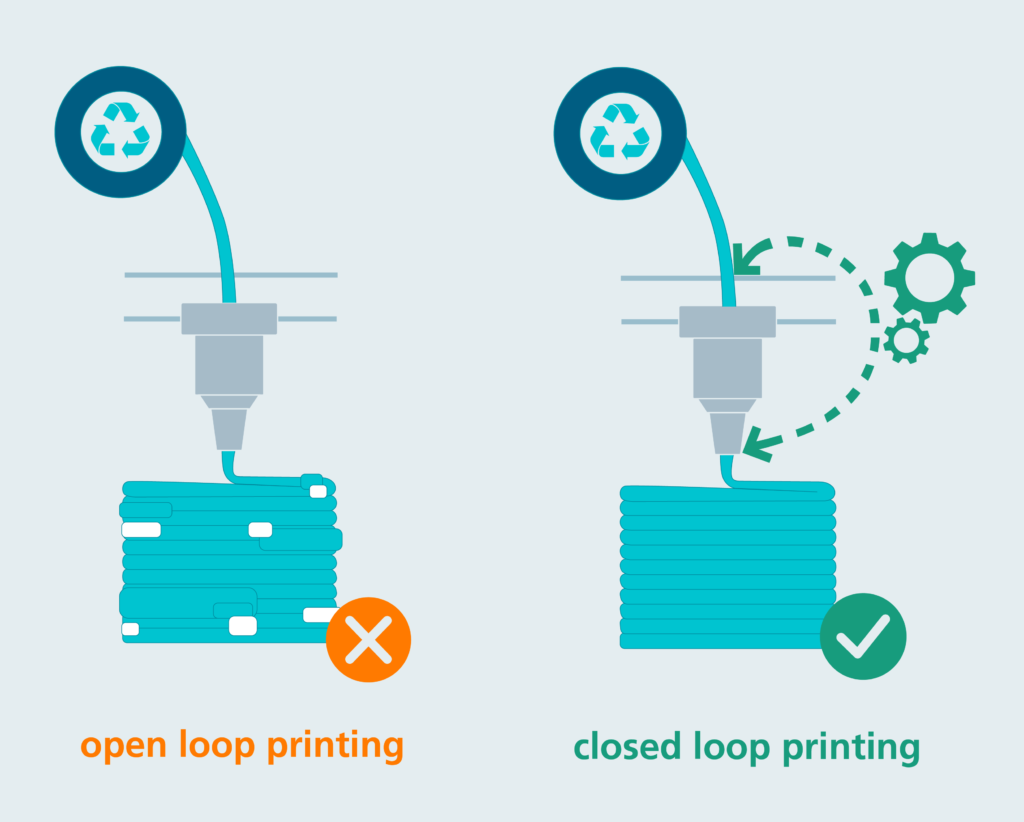
Most printers still operate with static G-code. Once the job starts, the system follows a fixed toolpath and fixed parameter set, regardless of what is happening in the process. That approach becomes more vulnerable when recycled feedstock is used. It also becomes harder to manage when production scales from a single printer to a larger printer farm. Fraunhofer IAPT’s project addresses that gap by moving toward closed-loop printing, where sensor data and AI analysis influence the process while the part is being built.
Closed-loop control for variable materials
The central technical shift in the project is from open-loop operation to closed-loop control. In an open-loop process, the printer executes predefined instructions without responding to changes in material quality or machine behavior. In a closed-loop process, observations from the build are fed back into the control system, allowing parameters to be adjusted in real time.
Fraunhofer IAPT is equipping printers with sensors and computer vision to monitor relevant process signals during production. These include layer height, extrusion width, vibration and extrusion behavior. AI algorithms analyze the data while the build is running and adjust variables such as extrusion rate, speed, temperature or laser power.
For recycled thermoplastics, this is especially important because the material itself is less consistent than virgin feedstock. A small change in moisture content or flow behavior can affect layer formation and dimensional accuracy. The same applies to machine-specific effects, such as a worn nozzle that changes extrusion stability. By compensating for these deviations within a print layer, the system is intended to reduce scrap and limit the need for costly correction after printing.
From static files to process knowledge
A second focus of the project is the use of digital twins and structured data management. In many additive manufacturing workflows, important information remains scattered across separate files, such as STL models, G-code, process logs and inspection data. This makes it difficult to learn systematically from each build, especially when results vary because of recycled material or machine condition.
Fraunhofer IAPT aims to link process data, geometry information, slicing parameters and quality metrics within a digital twin. The goal is not only to react to a deviation during a build, but also to build knowledge that can be used in future jobs. Each print, whether successful or not, becomes part of the training data for the system.
In practice, this could help identify better parameter combinations for specific geometries, material qualities and machine states. A printer would not simply repeat a fixed recipe. It would use accumulated process knowledge to select and adapt settings more effectively. For production teams, that matters because recycled material can only become a realistic industrial option if its variability can be understood, documented and controlled.
Scaling the approach to printer farms
The project is also being developed with larger production environments in mind. A control strategy that works on one printer is useful, but industrial additive manufacturing often depends on consistency across multiple machines. Differences between printers can otherwise lead to unstable output, even when the same material and print file are used.
Fraunhofer IAPT is therefore designing the architecture for printer farms. Edge devices on individual machines handle local monitoring and control, while a central platform collects and aggregates data from all connected systems. This makes it possible to transfer knowledge from one machine to others. If one printer generates useful insight about a particular recycled material, that information can be applied across a wider fleet.
This fleet-level approach is important for profitability. As the number of printers grows, static processes can amplify variation instead of controlling it. Centralized learning combined with local real-time control offers a way to improve stability without treating each machine as an isolated unit. It also supports continuous optimization across the production environment, rather than only at the level of individual builds.
Reducing uncertainty in recycled AM
The project addresses a practical barrier that has limited the use of recycled materials in additive manufacturing. According to Fraunhofer IAPT, recycling in AM is not mainly constrained by material availability, but by process uncertainty. Variable feedstock, machine wear and fixed print instructions create a combination that can lead to scrap, dimensional deviations and higher post-processing effort.
Dr. Matthias Brück, Head of the Virtualization Department at Fraunhofer IAPT, describes adaptive, data-driven control as a way to turn these uncertainties into manageable variables. That framing is relevant for manufacturers considering recycled polymers, because sustainability targets alone are not enough to justify production risk. The process must also be economically viable and sufficiently predictable for industrial use.
By combining real-time monitoring, AI-based parameter adjustment, digital twins and structured data management, the project aims to make recycled raw materials a more stable part of the AM chain. If successful, the approach could give companies a clearer route to using recycled thermoplastics in production, from single-machine applications to larger printer farms where repeatability, traceability and cost control are decisive.