
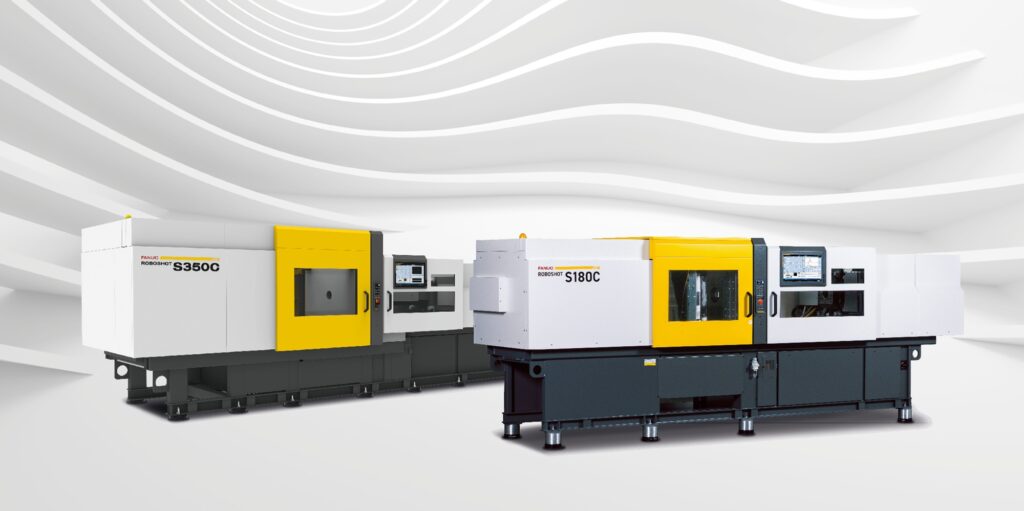
FANUC will use Fakuma 2026 to demonstrate how all-electric injection moulding, robotics, artificial intelligence and connected production systems can work together in practical manufacturing cells. The exhibits address recurring challenges for processors, including labour shortages, rising costs and the need for consistent quality. Two ROBOSHOT applications will show how process monitoring, automated handling and digital connectivity can support more stable production.
The stand in Hall 7 will focus on integrated production rather than individual machine functions. FANUC plans to show two all-electric ROBOSHOT injection moulding applications, collaborative robots, machine vision concepts and an industrial Internet of Things (IIoT) area. The common objective is to connect moulding, handling, quality control and production data. This approach can improve visibility and automate workflows. For processors, the concept is relevant where output requirements are increasing. At the same time, space, staffing and process stability remain limiting factors. The demonstrations also place CNC control at the centre of the moulding applications, supported by automation and digital tools.
Process monitoring for technical moulding
One of the main exhibits will be a ROBOSHOT S180C running a technical moulding application. The cell will use cavity pressure monitoring in every cavity. It will also use simulation-supported balancing of the hot runner. FANUC presents these functions as tools for improving process stability, optimising part quality and reducing waste in demanding production environments. Monitoring cavity pressure across all cavities gives operators direct process information at the cavity level. In a multi-cavity tool, this can help identify variation during moulding. It reduces reliance on checks performed only after parts have been produced. The hot runner balancing element is supported by simulation. This links mould design with process behaviour in the demonstration.
The application shows how machine control and monitoring can work together in an all-electric moulding process. FANUC’s stated focus is consistent quality and operational efficiency. This is particularly relevant where technical components require repeatable processing. Therefore, the exhibit addresses the effects of process variation on production, including waste and instability. It does not treat automation as a separate downstream activity.
Automated packaging cell supports compact production
A second ROBOSHOT application will use the S350C in an automated medical packaging process. The cell combines high-accuracy injection moulding with automated part handling and packaging. FANUC describes the installation as a compact production cell. It is designed to support reliable, repeatable output while using floor space efficiently. The application brings several production stages together, from moulding and handling to packaging. This integration is relevant to manufacturers seeking to automate tasks around the injection moulding machine. It also supports a compact cell layout. Rather than presenting handling as a stand-alone robot task, the demonstration links it directly to moulding output.
FANUC will also show wider automation concepts using machine vision systems. These concepts demonstrate how automation can support a broader range of production tasks. They also focus on adaptability and ease of use. In addition, the CRX collaborative robot will be shown with voice-command programming supported by generative AI technology. According to FANUC, this approach is intended to reduce programming complexity. It may also lower the barrier to adopting automation.
Connectivity links machines with production workflows
The digitalisation area will cover systems that connect machinery and production data across the factory floor. FANUC plans to display its LINKi2 platform, MES connectivity, EUROMAP 82.1 and 82.2 interfaces, WebAPI applications, Moldex3D integration and AI-based digital tools. These technologies are intended to provide greater visibility into production performance. In practical terms, the systems address the connection between machines, automated workflows and quality control data. The stated aim is to help manufacturers make data-driven decisions that improve operational efficiency.
The Fakuma presentation places digital connectivity alongside moulding and robotics. This reflects FANUC’s view that these elements should work together in future production operations. Paul Ribus, head of sales coordination at FANUC Europe, said manufacturers face pressure to improve productivity, quality and flexibility. They must also manage skills shortages and economic uncertainty. FANUC will exhibit at Fakuma 2026 in Hall 7, booth A7-7304.