
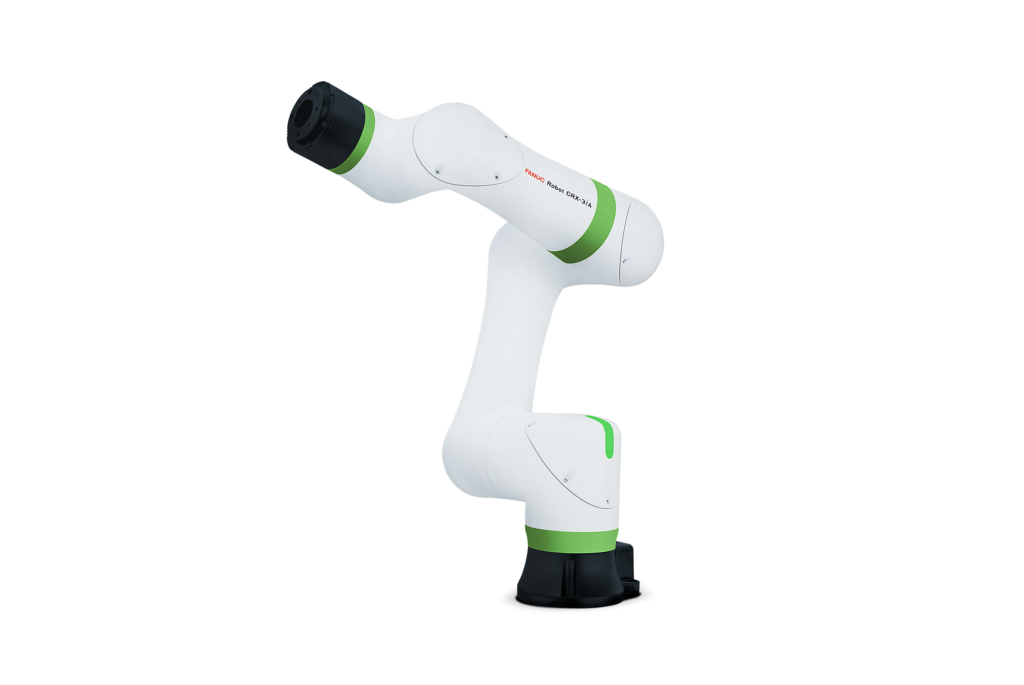
FANUC is expanding its CRX collaborative robot range in Europe with the CRX-3iA, a compact 11 kg model designed for work that moves across large structures. The robot targets applications where fast relocation, simple teaching and autonomous seam detection can reduce dependence on fixed automation cells, especially in welding environments with limited skilled labour.
The CRX-3iA is the smallest and lightest model in FANUC’s CRX portfolio. Its 3 kg payload is intended for tasks such as carrying a welding torch together with a seam-tracking sensor, while its low mass allows an operator to move the robot manually between work locations. That positioning is relevant for sectors such as shipbuilding and steel construction, where welds are often spread over large parts rather than concentrated in a repeatable fixture.
Instead of bringing the workpiece to a robot cell, the concept is to bring the cobot to the seam. FANUC states that an operator can carry the unit with one hand, place it at a new weld, and resume work within seconds. In practice, this can help one person oversee several welding locations, provided the surrounding process, fixturing, and safety conditions are arranged accordingly.
Portable welding at the point of work
The main technical distinction of the CRX-3iA is not payload, but portability. At 11 kg, the robot is light enough to be relocated frequently, which changes how collaborative automation can be used on large steel structures. Traditional robotic welding installations often rely on fixed bases, larger manipulators, and dedicated safeguarding. That approach remains relevant for high-volume, repeatable work, but it is less suited to seams distributed across a ship section or steel assembly.
FANUC offers an optional magnetic base for attaching the robot directly to large steel structures. This gives the system a practical route into applications where building a fixed robot station around every weld would add complexity. The robot also detects its installation angle after relocation, an important feature when it is repeatedly placed in different orientations.
For seam location, the CRX-3iA can use a third-party laser scanner or touch sensor. The robot identifies weld seam positions and calculates paths accordingly. This reduces the amount of manual reprogramming needed after each move and supports more consistent operation when the robot is shifted from one joint to another.
Teaching and setup without a complex cell
Fast deployment depends not only on weight, but also on how easily operators can teach and adjust the robot. The CRX-3iA integrates with FANUC’s existing control and software environment, which is relevant for manufacturers already using the company’s robots or CNC systems. Within that ecosystem, the robot includes FANUC’s wrist button technology, allowing operators to guide and teach positions directly from the robot arm.
This can shorten changeover time because the operator does not need to hold the FANUC Teach Pendant while manually guiding the arm. For welding applications with many short seams or varied positions, that kind of direct interaction can be more practical than programming every movement from a pendant interface.
The robot’s stated repeatability is ±0.02 mm. In welding, repeatability alone does not determine final weld quality, since joint preparation, torch angle, wire feed, shielding gas, and seam tracking also influence the result. However, stable path execution is a necessary part of automated welding, particularly when the robot is expected to work after frequent relocation. Combined with sensor-based seam detection, the repeatability figure indicates that FANUC is aiming the CRX-3iA at more than simple handling tasks.
Use beyond welding and heavy structures
Although welding is the clearest application in the release, FANUC also points to intralogistics and mobile automation. The compact footprint and low mass make the robot suitable for mounting on an automated guided vehicle, where it could support picking, placing, and line supply tasks. In that setup, the robot becomes part of a mobile system rather than a fixed production asset.
This is a different automation model from the conventional robot cell. A small cobot on an AGV can move between stations, support operators at changing locations, and help cover variable material flows. The 3 kg payload limits the range of parts it can handle, but for light components, tools, or supplies, the low mass of the robot may be more important than maximum lifting capacity.
FANUC also identifies education and training as a possible area of use. Larger industrial robots can be difficult to accommodate in training rooms or smaller technical facilities because of their footprint and installation requirements. A smaller collaborative robot gives schools and training centres a more manageable way to introduce robot programming, handling, and automation concepts without dedicating space to a full industrial cell.
A smaller member of a wider CRX range
The CRX-3iA joins a CRX series that extends up to 30 kg payload and 1,756 mm reach. That wider range matters because it allows users to select a robot size according to task weight, reach, and installation constraints while staying within the same family of controls and software. The new model is positioned at the portable end of that range.
Paul Ribus, FANUC’s Head of Sales Coordination Europe, says manufacturers need automation that adapts to their environment rather than requiring the environment to be built around the automation. The CRX-3iA reflects that direction through its low weight, magnetic mounting option, direct teaching features, and sensor-supported path generation.
For manufacturers dealing with large welded assemblies or distributed handling tasks, the practical question is whether a mobile cobot can reduce non-productive movement and make better use of scarce skilled labour. The CRX-3iA is designed for that kind of use case, where the value lies less in replacing a fixed robot cell and more in bringing automated assistance to work that cannot easily be centralized.