
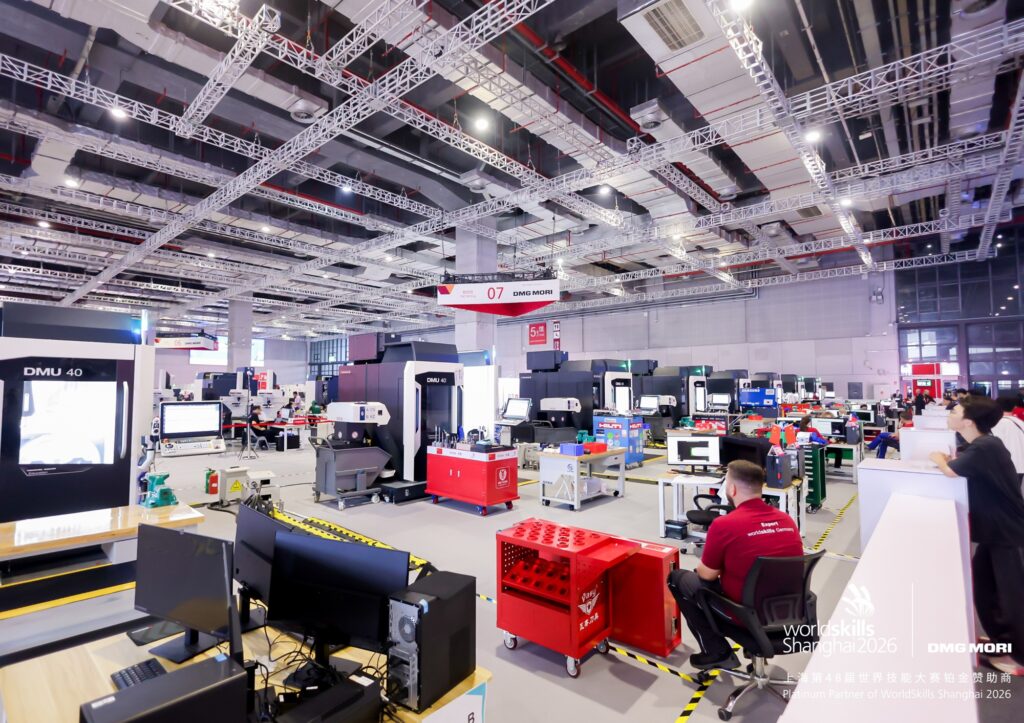
WorldSkills 2026 in Shanghai brought young manufacturing specialists together from around the world. They competed in CNC turning, CNC milling and additive manufacturing. The event demonstrated how technical skills, process knowledge and structured work methods are assessed under time pressure. For vocational education, the competition tasks also provide a reference closely linked to industrial practice.
Held from September 22 to 27, the competition covered 64 trades. Participants came from multiple countries. DMG MORI has been a WorldSkills International partner since 2009. It became a Global Industry Partner in 2016. The company supported CNC turning, CNC milling and additive manufacturing. Its contribution included preparatory training at several locations, including Shanghai. DMG MORI also supplied machine tools for the turning and milling competitions. The relevance of WorldSkills extends beyond medal results. WorldSkills experts develop and refine the competition tasks internationally. Their aim is to reflect the requirements of real manufacturing environments. Therefore, the event provides a practical platform for comparing skills, training approaches and manufacturing methods across national borders.
CNC tasks demand process control under pressure
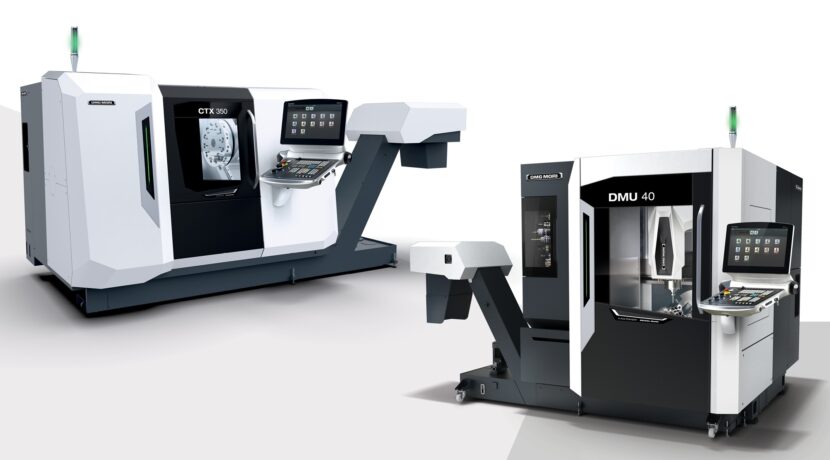
The CNC turning competition involved 21 participants. They worked on 13 CTX 350 V4 machines supplied by DMG MORI. China’s Liao Junjie won the gold medal. Ryoto Katano of Japan took silver, and Muhed Ali Mirza of Korea won bronze. In CNC milling, 23 competitors used 14 DMU 40 Plus machines. Li Zhuoping of China took first place. Manuel Nussbaumer from Switzerland received silver. Alisson Gabriel Genova de Oliveira from Brazil won bronze.
The machining disciplines require more than machine tool operation. Participants must interpret the task and select a suitable manufacturing sequence. They must also execute it reliably within the available time. The work therefore combines machine operation, process planning and disciplined manufacturing methods. For schools and training providers, this connection to production requirements is significant. The competition setting shows whether participants can apply technical knowledge within a structured process. It also assesses more than isolated theoretical skills.
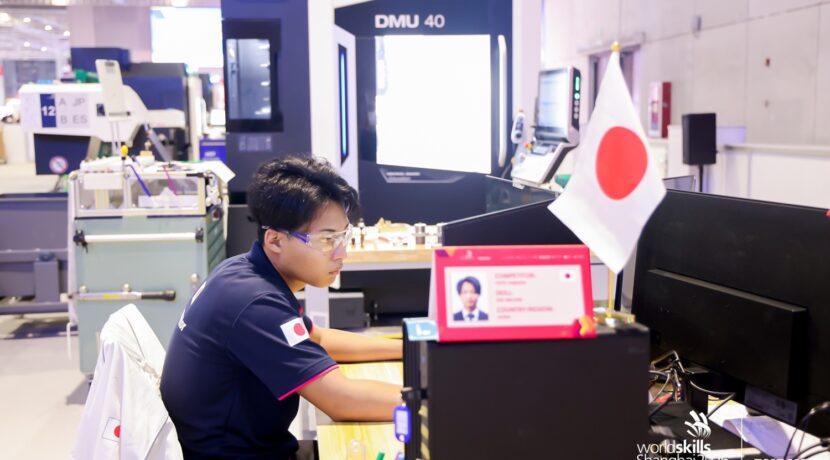
with real-world practice and industry requirements. (pictures: DMG MORI)
Additive manufacturing links design, printing and logistics
The additive manufacturing competition showed how digital workflows can connect teams and production sites across countries. DMG MORI supported the discipline through online collaboration involving a German-Japanese team. Competitors designed their workpieces using Siemens NX. The resulting data were prepared for metal 3D printing using selective laser melting, or SLM. Components were then printed in Japan. They were transported by express courier to Shanghai for the competition. This process combined digital preparation, additive manufacturing and international logistics. It also illustrated how the production of additively manufactured components can involve separate locations. These stages included design, data preparation, printing and final use. Alexis Aubert of France won gold in the additive manufacturing discipline. Nobutada Miyado from Japan received silver. Oliver Coombs of the United Kingdom took bronze. The competition placed their work within a manufacturing chain that extended beyond the competition venue.
Competition standards influence vocational training
According to Sebastian Plau, head of Global Education Projects at DMG MORI, WorldSkills influences schools and companies as well as competitors. WorldSkills experts discuss standards and skills that can be adopted in vocational education. As a result, training programmes can align more closely with industrial requirements. This is particularly relevant in training environments that have traditionally focused more strongly on theory. Competition tasks require participants to convert knowledge into practical manufacturing decisions. These decisions range from machine operation to workflow organisation. The biennial event also highlights the role of vocational education in industrial production. CNC machining and additive manufacturing depend on employees who understand the equipment and the underlying process. By placing these disciplines in an international competition, WorldSkills makes the required level of technical capability visible. This applies to students, schools and companies alike.