
CERATIZIT used a titanium spinal implant to demonstrate two challenges in titanium machining: keeping heat away from the cutting edge and turning different contours without changing tools. The company showed how tool geometry and coatings can help manage heat and wear, and how its FreeTurn system lets the machine change the cutting edge’s approach angle during a cut.
Titanium’s strength, corrosion resistance and biocompatibility make it suitable for medical implants. At the cutting edge, however, the material’s poor thermal conductivity means much of the heat generated during machining stays close to the tool. Cutting forces are also high. Together, heat and force can accelerate tool wear, which can affect both dimensional accuracy and surface quality.
Tool geometry for titanium machining has to balance two demands. A free-cutting geometry limits heat generation, but the edge still has to withstand the cutting forces. CERATIZIT’s approach is to match the geometry, carbide substrate and coating rather than consider each in isolation. Coolant directed at the cutting zone and controlled chip evacuation are also part of keeping the process stable.
Coated and uncoated tooling for titanium
CERATIZIT’s CTPX710 and CTPX715 grades use Dragonskin, an AlTiN-based coating designed for high thermal stability. The company says the coating’s smooth surface helps chips move away from the cut and makes titanium less likely to adhere to the tool. These are separate jobs: the coating is designed to tolerate heat at the edge, while its surface helps with chip flow.
CERATIZIT also offers uncoated tooling for applications where transfer of coating material to the workpiece is a concern. The choice is therefore not just about how the tool behaves under heat or how readily chips clear the cut. It can also come down to whether a coated tool is suitable for the workpiece in question.
Changing the cutting angle with High Dynamic Turning
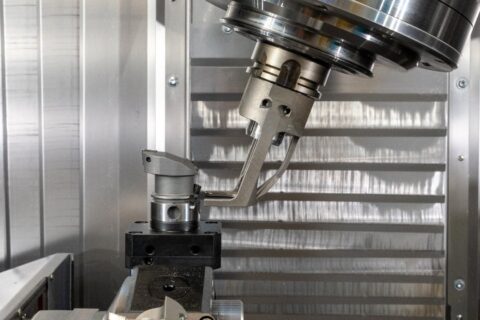
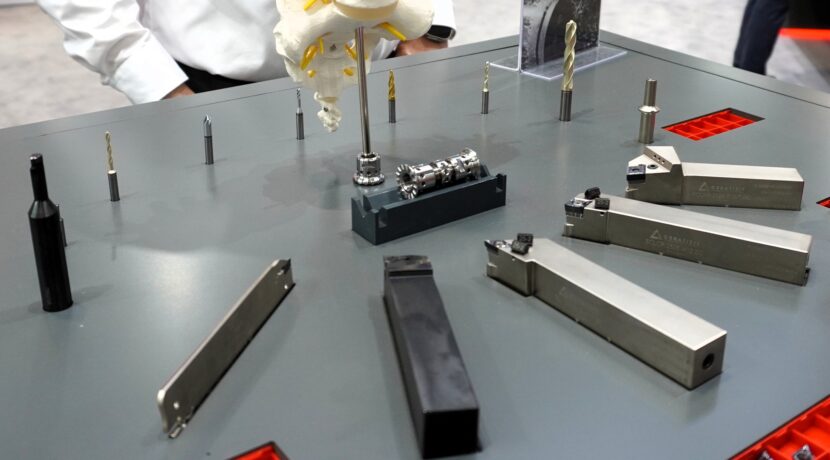
Different contours and turning directions can call for several tools in conventional turning. With High Dynamic Turning, the machine repositions a slender FreeTurn holder relative to the rotating workpiece, changing the cutting edge’s approach angle during machining. The edge can follow contours, radii and transition surfaces from different positions. According to CERATIZIT, varying the angle gives the operator a way to influence cutting-edge load, chip formation and surface quality.
The indexable insert at the head of the FreeTurn holder can combine different cutting edges, for example, for roughing and finishing. The same tool concept can cover rough and finish turning, contouring, facing and longitudinal turning. CERATIZIT says this can cut the number of tool changes and free up tool positions in the machine. For the spinal implant demonstration, the company used a TRAUB TNX220 with a B-axis, two tool turrets, a main spindle and a counter spindle.