
Researchers at Fraunhofer IPMS and the University of Antwerp’s Cosys-Lab have developed PiCASo, an ultrasonic sensor that helps robots map their surroundings and pinpoint sources of sound. In separate tests, the PiCASo sensor produced acoustic images at distances of up to 6 metres indoors and distinguished three compressed-air leaks, the smallest just 0.3 millimetres across.
PiCASo combines both functions in a housing that measures 35 × 38 × 15 millimetres, giving compact robots a way to carry out environmental sensing and condition monitoring with the same device. Inside is a 4 × 4 millimetre micromachined ultrasonic transducer, known as an L-CMUT, developed at Fraunhofer IPMS. It covers a frequency range of approximately 20 to 80 kilohertz and is paired with 16 miniature digital microphones arranged in a circle.
“Our priority is to pack as much sensing capability as possible into the smallest possible space,” says Dr Sandro Koch, head of the Acoustic Sensors and Systems business unit at Fraunhofer IPMS. The difference between the sensor’s two operating modes is where the sound comes from: PiCASo either sends out a signal of its own or listens for ultrasound already present in the environment.
Mapping rooms with ultrasonic echoes
In active mode, PiCASo’s transducer emits ultrasonic signals and the system uses the returning echoes to map the positions of objects and structures. This gives robots a way to supplement cameras and LiDAR, which maps surroundings with laser light. Dust, smoke and fog can limit optical sensing, and poor lighting can make it harder for cameras to see.
The team tested the active mode indoors, where PiCASo turned reflected signals into acoustic images at distances of up to 6 metres. The images allowed the researchers to identify not only the walls but also a passageway and objects such as radiators and to locate them within the space. The reported distance comes from those indoor tests, where the sensor was listening for reflections of its own signal.
Listening for compressed-air leaks
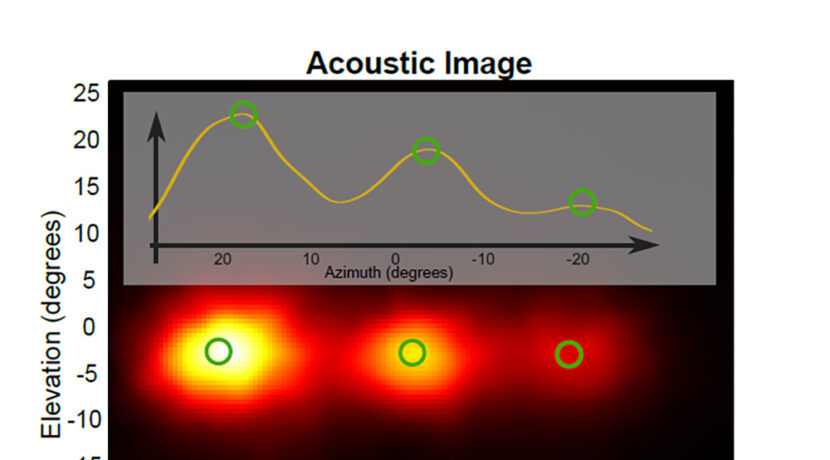
In passive mode, PiCASo does not emit a signal. Instead, its 16 microphones pick up ultrasound from the surroundings and the system uses those measurements to locate the source. In a compressed-air system, that lets the sensor do more than register the sound of a leak: it can indicate where the air is escaping.
To test that function, the researchers used a compressed-air conduit with three defined leak sites. PiCASo was able to distinguish the three locations rather than registering them as a single source. That included the smallest leak site the team tested, which measured 0.3 millimetres in diameter.