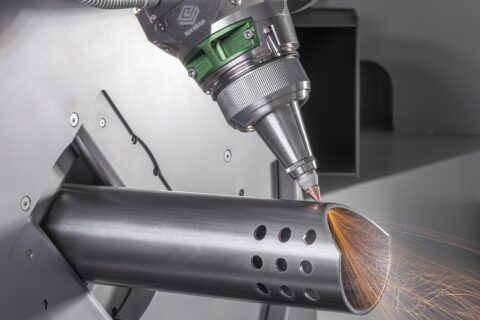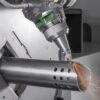


BLM GROUP has developed the LT-FREE 3015, a 3D laser cutting cell for larger metal components and complex bent tubes. It can also process multiple parts in one setup. Its enlarged working volume and 750 mm Z-axis travel address a recurring limitation in three-dimensional machining. Workpiece size and fixture space can restrict access and flexibility.
The development builds on BLM GROUP’s experience with five-axis laser cutting of straight and bent tubes. It also applies to other three-dimensional components. In bent-tube production, cutting before bending can be affected by forming-related deformation. Cutting the finished bent component directly avoids this issue. It also helps ensure conformity with the intended design. Since 2015, the technology has supported applications such as automotive production. It can cut high-strength materials without contact. The LT-FREE 3015 extends this approach to larger profiles, frames, stamped parts and deep-drawn components. The machine is available in two configurations. It provides a working area of up to 3,000 × 1,500 mm and 750 mm of Z-axis travel.
Greater height for complex setups
In three-dimensional laser cutting, usable Z-axis height can be as important as the working area footprint. The machine must accommodate the component and the fixtures needed to hold it securely during machining. With 750 mm of travel, the LT-FREE 3015 is intended for parts that are difficult to position in a restricted cell. The additional height allows the processing of large components, complex bent tubes, frames and large stamped or deep-drawn parts. It also creates space to machine multiple components simultaneously. Parts can be positioned at an angle when this makes better use of the available volume. As a result, the range of possible setups expands without changing the fundamental five-axis cutting approach.
This flexibility is relevant in sectors where part geometry varies substantially between projects. BLM GROUP identifies applications in the automotive and aerospace sectors. Other sectors include household appliances, construction and earthmoving machinery, industrial installations, HVAC and ventilation systems. The list also includes professional kitchens, stainless-steel components, light metal construction and three-dimensional sheet-metal processing. Across these applications, the larger cell is intended to accommodate the component. It also addresses the practical requirements of clamping and access.

Rigidity and dynamics in a larger cell
Increasing the working volume can affect machine dynamics. This is particularly relevant when high acceleration and accurate toolpaths are required. BLM GROUP states that maintaining performance despite the larger dimensions was a central objective of the LT-FREE project. The cell uses an extremely rigid structure. It has a natural frequency of nearly 30 Hz. According to the company, this supports high acceleration and trajectory accuracy at high speed. These characteristics are particularly relevant for intensive production processes. In these processes, cycle time is a key parameter alongside cut quality.
The machine is also designed to be compatible with existing installations on the market. This includes retrofit projects and the replacement of existing systems. It can therefore suit manufacturers seeking to increase machining volume without changing their broader production approach. Alongside the mechanical design, the LT-FREE 3015 uses BLM GROUP’s ArGo software. It can also integrate with third-party software. BLM GROUP links the process stability of its 3D cutting technology to application data. This data covers materials, thicknesses, geometries and cutting conditions. The experience is particularly applicable to bent tubes. These combine forming-related variation with complex three-dimensional geometry. In aerospace applications, the company sees opportunities involving special alloys and advanced materials. These applications require a small heat-affected zone and the ability to cut complex geometries.