
The SIMAROUTE research project is developing a demonstrator for generating and testing route networks for mobile transport robots. It uses plant layouts and material flow data. The project addresses a planning task that is still largely completed manually. Factory layout changes can also require further updates.
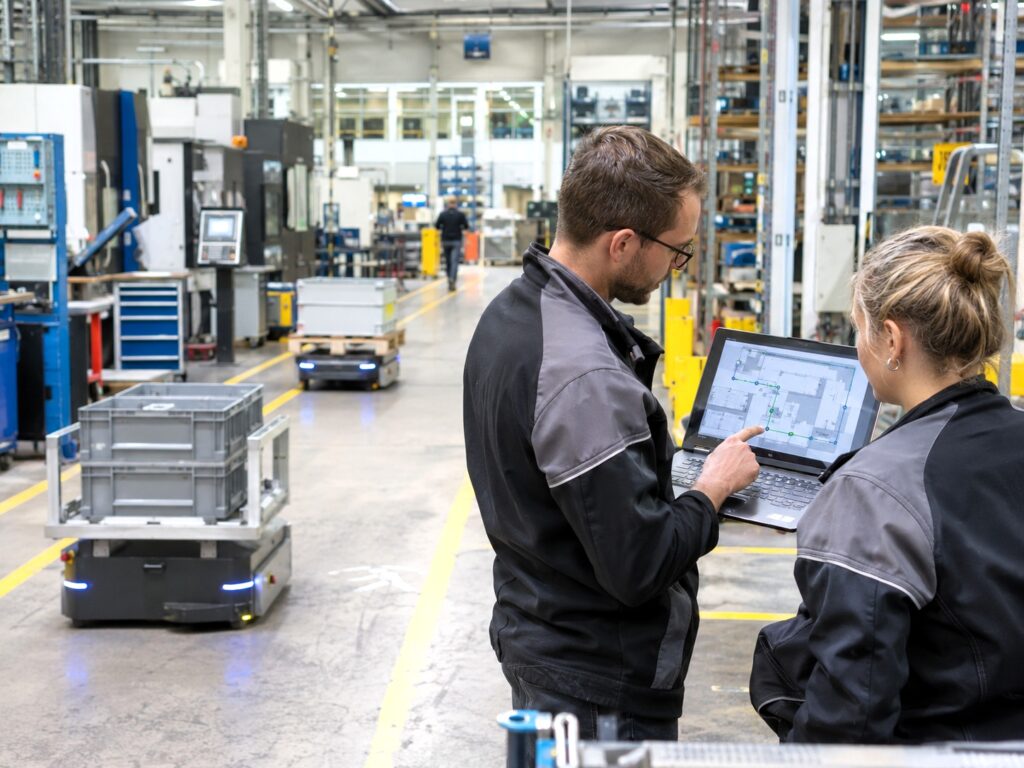
Mobile transport robots already move materials from warehouses to production and assembly lines in many plants. Before a fleet can operate, planners must define its permitted routes. According to project manager Tobias Bornemann of Frankfurt University of Applied Sciences, planners still draw these routes largely by hand. They create them in simulation models and fleet management systems. The project team will assess how much of this work can be automated. It will also compare automatically generated networks with manually planned routes. SIMAROUTE began in October 2026 and runs for 15 months. Frankfurt University of Applied Sciences leads the project with its Research Lab for Urban Transport and simulation services provider SimPlan. Automotive supplier AUMOVIO is an associated partner.
From plant data to route networks
The demonstrator will generate route networks from real plant layouts and material flow data. It will then test and improve these networks through simulation. This approach targets a task that can otherwise take considerable time and simulation expertise. It is also relevant when plant layout changes require an existing network to be updated. The resulting networks will be provided as node-edge graphs in the open Layout Interchange Format, or LIF. This exchange format prevents the results from being tied to one simulation program. Moreover, the project aims to make route planning manageable for companies without their own simulation specialists. This could lower a barrier to automation for smaller manufacturers. The team will assess the automatically generated networks against the existing manual approach. The project builds on SIMOBOT, an earlier collaboration between Frankfurt University of Applied Sciences and SimPlan AG. SIMOBOT focused on simulating transport robot fleets.
Testing against an existing approach
The team is collecting infrastructure data and material flow route data at AUMOVIO production plants. This information will support the demonstrator’s staged development. It will ultimately enable a comparison with manual route planning. The comparison will show whether automated route generation can shorten planning cycles. This is one of the project’s aims. The team also wants to improve the efficiency of robot fleet use. However, the source material does not yet report results from the demonstrator. At a kick-off meeting at HOLM in Frankfurt am Main, the consortium coordinated the next steps. These include initial plant analyses and demonstrator development. The project receives support through the Hessen Innovation Support Program. Funding comes from the State of Hesse and HOLM funding under the Hessian Ministry’s Innovations in Logistics and Mobility initiative.