
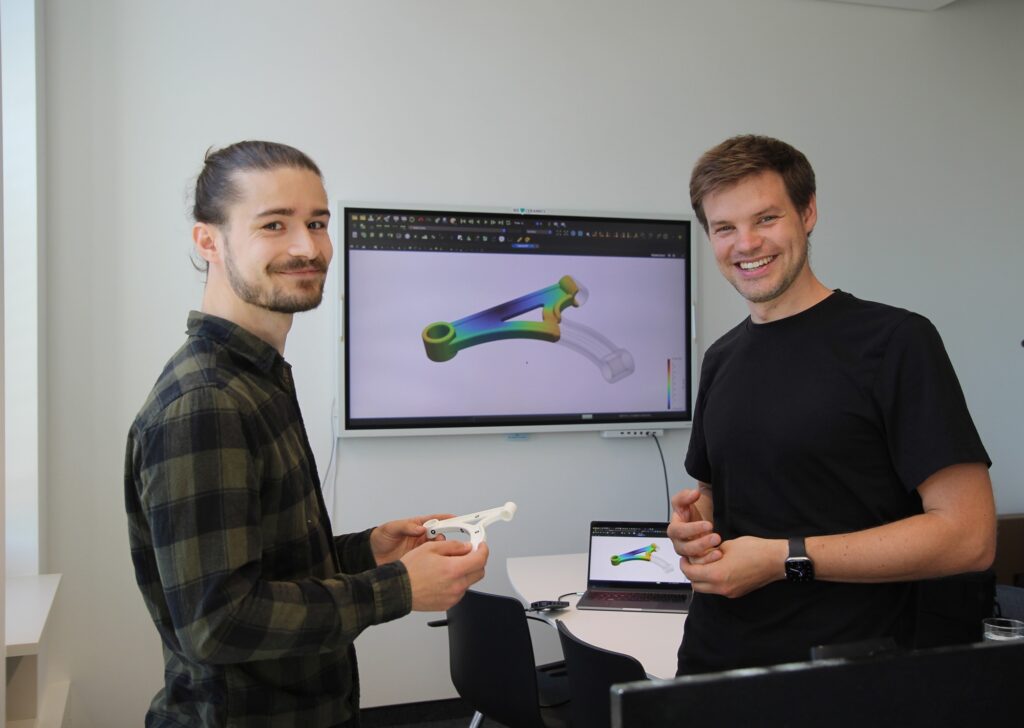
A research team at the University of Augsburg has developed software that combines physical models with artificial intelligence to assess injection moulding processes within seconds. The approach supports early product development. At this stage, engineers must compare many design and process variants before committing to a mould design. According to the team, calculations can be completed up to 100 times faster than with established simulation software.
Injection moulding involves more than defining component geometry. Before producing a new mould, manufacturers must determine where plastic should enter the cavity. They must also assess how the material will fill the mould and how cooling will affect the finished part.
Flow simulations based on physical models provide highly accurate results. However, their computational demands can mean that individual calculations take several hours. This limits the number of alternatives that engineers can examine during early development.
The Augsburg researchers therefore see a role for their faster model before detailed physical simulation. It is designed to assess possible configurations quickly. Users can then narrow down the options before validating the final component and mould with established methods.
AI model incorporates physical knowledge
The central challenge was to develop an AI-supported model that can process arbitrary component geometries without requiring extensive training data. Instead of relying solely on data, the research group incorporated established physical relationships into the model.
One example concerns the relationship between the injection point and filling time. Areas farther from the point where molten plastic enters the mould will generally fill later than nearby regions. Because this relationship is already known, the AI does not need to derive it from a large dataset.
According to Professor Nils Meyer, who leads the work at the Centre for Future Production, this approach enabled the model to be trained with only a few hundred examples. It can still make predictions for other components.
The shorter calculation time is particularly relevant during the initial design phase. Engineers can assess numerous alternatives, including different injection locations, within seconds. As a result, the approach can reduce staff time and computing time. It can also lower the energy consumption associated with repeated simulations.
Detailed physical methods remain necessary for the final assessment. However, the AI-based tool is intended to make the process leading to that stage more flexible.
Finite element method extends AI learning
The research group is also developing AI-compatible finite element software. Finite element methods divide a complex system into many smaller, simpler elements. These elements can then be analysed computationally.
In injection moulding, the method can estimate how a component is likely to deform as it cools and solidifies.
The distinguishing feature of the Augsburg approach is that the finite element software can further train the AI model. Measured deformation data from production can be incorporated into the learning process. This allows the model to improve its predictions over time.
The approach therefore links simulation with observed component behaviour. It does not treat the initial model as fixed.
At its current stage, the software supports the optimisation of components that have already been designed. The longer-term objective is to provide broader support for component development.
Meyer describes a future system in which users specify the requirements for a component. The AI would then generate a design suitable for injection moulding. Such a tool could help designers assess many possible geometries more quickly. It could also leave more time to consider product requirements and creative design decisions.