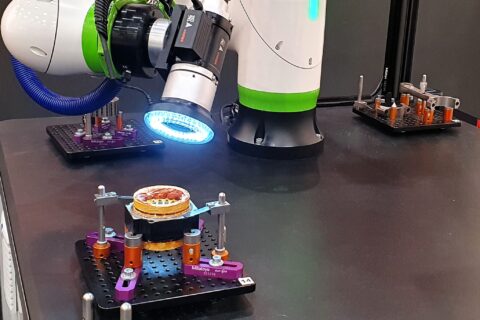
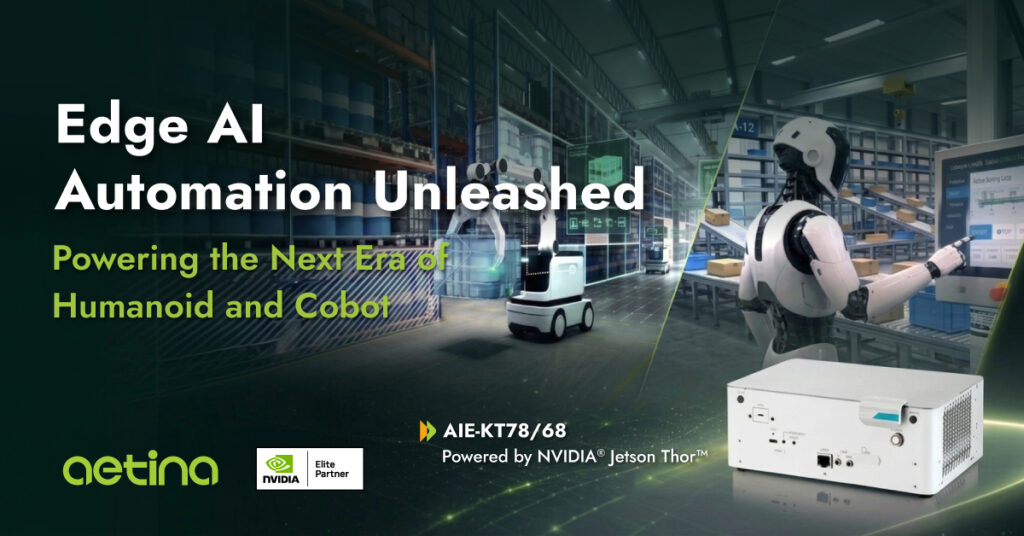
Aetina has introduced the AIE-KT78 and AIE-KT68 edge AI systems for robots. They combine sensor processing, AI inference and deterministic motion control locally. Built around NVIDIA Jetson Thor modules, the systems target cobots, humanoid robots and autonomous machines. These platforms interpret their surroundings and control actuators within the same hardware system. Robotics systems are moving beyond fixed routines. They must now respond to changing environments. This requires simultaneous processing of data from cameras, LiDAR, radar, depth sensors and inertial measurement units. AI models interpret this data, understand context and generate actions.
At the same time, motors, joints and actuators require predictable control timing. Aetina’s new systems combine these functions in a compact edge computer. As a result, they can reduce the number of separate controllers and interfaces needed in a robotic installation. Both platforms support local execution of multimodal generative AI, large language models, vision-language models and vision-language-action models. Running these workloads on the device is intended to limit cloud latency. It also keeps data under local control.
Local AI computing for multimodal robotics
The AIE-KT78 uses the NVIDIA Jetson T5000 module. It provides 128 GB of 256-bit LPDDR5X memory and AI performance of up to 2,070 FP4 TFLOPS. The AIE-KT68 is based on the Jetson T4000 module. It provides 64 GB of 256-bit LPDDR5X memory and up to 1,200 FP4 TFLOPS. According to Aetina, the two variants offer different balances of compute capability, power consumption and system cost. Their purpose is to run sensor-intensive AI workloads at the edge. Vision-language-action models, for example, combine visual input, language understanding and action generation in one pipeline. In robotics, this allows the system to connect environmental observations with a generated response. The full workload does not need to move to an external server.
The systems provide several high-bandwidth interfaces for this task. QSFP28 connectivity supports up to four 25 Gbps links, depending on the configuration. The platforms also include two RJ45 10GbE ports and support up to eight GMSL2 camera inputs. This interface combination accommodates simultaneous streams from high-resolution cameras and other sensors. Therefore, it provides the data throughput needed for multi-view perception and spatial awareness.
EtherCAT connects AI inference with motion control
A separate RJ45 1GbE port operates as an EtherCAT master. Aetina states that it provides microsecond-level synchronisation between AI inference and motors, joints, sensors and external actuators. Separating this control connection from the high-bandwidth sensor interfaces is relevant for systems that process large data volumes. It also supports deterministic motion control. For cobots, the architecture is intended to support faster changes between tasks and operation alongside people. In humanoid robots, the combination of sensor processing and actuator control supports continuous motion decisions based on spatial awareness.
The same approach can also be applied to industrial robot arms and other autonomous machines. Moreover, it connects perception, decision-making and control within one system. Aetina positions the platform as a way to consolidate these functions. In practice, this can reduce the need for additional control hardware and cross-platform integration. For developers and system integrators, the main implication is a more contained system architecture. This is particularly relevant where sensor fusion, local AI models and EtherCAT-based control must operate together.
Compact format with industrial interfaces
Both systems are 80 mm thick and accept a 9 to 48 VDC input. Their specified operating temperature range extends from minus 25°C to plus 55°C. The hardware includes USB 3.2, isolated digital I/O and M.2 expansion slots. These features allow interfaces and storage to be adapted to the application. The AIE-KT78 and AIE-KT68 run Linux. They support NVIDIA JetPack 7, CUDA, TensorRT, DeepStream, Holoscan and Isaac ROS. These software components support the deployment and optimisation of multimodal inference, computer vision, sensor fusion and robotics workloads.
The systems are available in two compute configurations. However, they share the same basic approach to high-bandwidth sensor data acquisition and local AI model execution. They also provide an EtherCAT connection for deterministic control. This addresses a growing integration challenge in advanced robotics. The performance of an AI model alone is insufficient when sensing, inference and physical motion depend on disconnected hardware layers.