
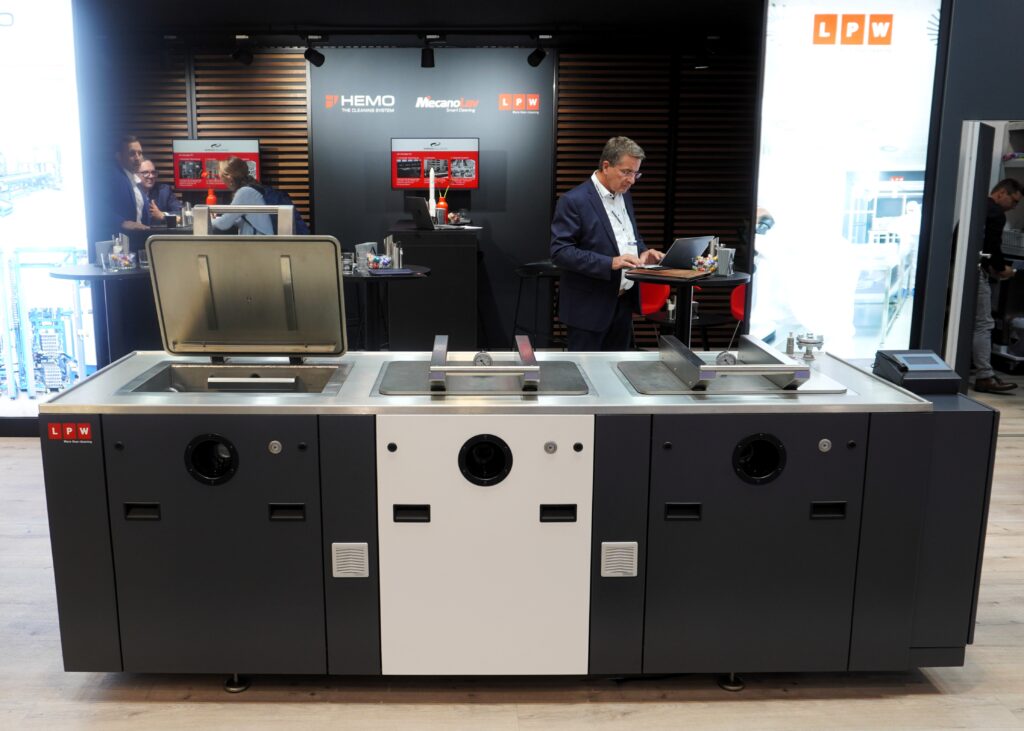
Subcontractors are increasingly asked to deliver components with stricter cleanliness requirements. This also applies when only a limited share of production needs this treatment. LPW Reinigungssysteme has developed the PowerPulse CNp for such applications. The compact, semi-automatic system is designed for small batches. When the complete process is configured accordingly, it can support Grade 2 cleaning. The PowerPulse CNp was presented at AMB in Stuttgart. It will also be shown at a trade fair on 18 and 19 November. The system is intended for companies that want to bring industrial cleaning in-house without investing in a large automated line.
The operator transfers batches manually between three cleaning and rinsing chambers and a drying chamber. The system has a footprint of approximately 2.3 m² and a usable volume of 55 litres. It is therefore aimed at applications where not every workpiece requires the same cleanliness level. Rob Rebel of Ertec describes the system as an option between basic cleaning and a fully automated installation. This distinction is particularly relevant to SMEs. Their demand for higher cleanliness may apply to selected components rather than the entire production flow.
Cleaning complex internal geometries
Internal geometries are a critical factor when cleaning machined parts. Contamination can remain in deep bores, narrow channels and blind holes. Cleaning fluid is difficult to refresh in these areas. Effective cleaning therefore requires more than removing contamination from exposed surfaces. The process must also renew the fluid inside restricted areas. It must then carry loosened particles away. The PowerPulse CNp combines ultrasonic cleaning with cyclic nucleation, or CNp. Both technologies can be used separately or together. During the CNp process, repeated pressure changes create bubbles in a liquid-filled chamber. These bubbles grow and collapse.
At the same time, pulsed flow renews the cleaning liquid in narrow openings. According to LPW, this approach complements ultrasonic cleaning for components with complex internal geometries. The system has an ultrasonic power of approximately 9 W/l and a heating power of 5 kW. Full-flow filtration removes loosened contamination from the process fluid. After cleaning and rinsing, the parts are dried using vacuum and infrared radiation. The combination of these stages is intended to support small-batch production with demanding cleanliness requirements.
The wider process determines cleanliness
Rebel stresses that the cleaning machine alone does not determine whether Grade 2 cleanliness is achieved. The result also depends on conditions before and after cleaning. The selected chemistry, clamping material and contamination on incoming workpieces can influence the final condition. Handling between process steps also affects the result. Industrial cleaning is therefore a specialist discipline alongside machining. It is not simply a downstream operation. A component can be cleaned in a controlled process, but subsequent handling may introduce new contamination.
Contamination retained in fixtures can also affect the result. The same applies to contamination carried into the system on supplied workpieces. Companies introducing in-house cleaning must therefore consider the complete chain. This includes machining, clamping, cleaning, drying and further handling. Ertec has built a 150 m² cleanroom in Beek en Donk for testing and pilot production runs. Rebel expects cleanliness requirements to continue increasing. Grade 4 was previously common. However, demand is shifting towards Grade 2. Grade 1 cleaning is also being requested more often.