
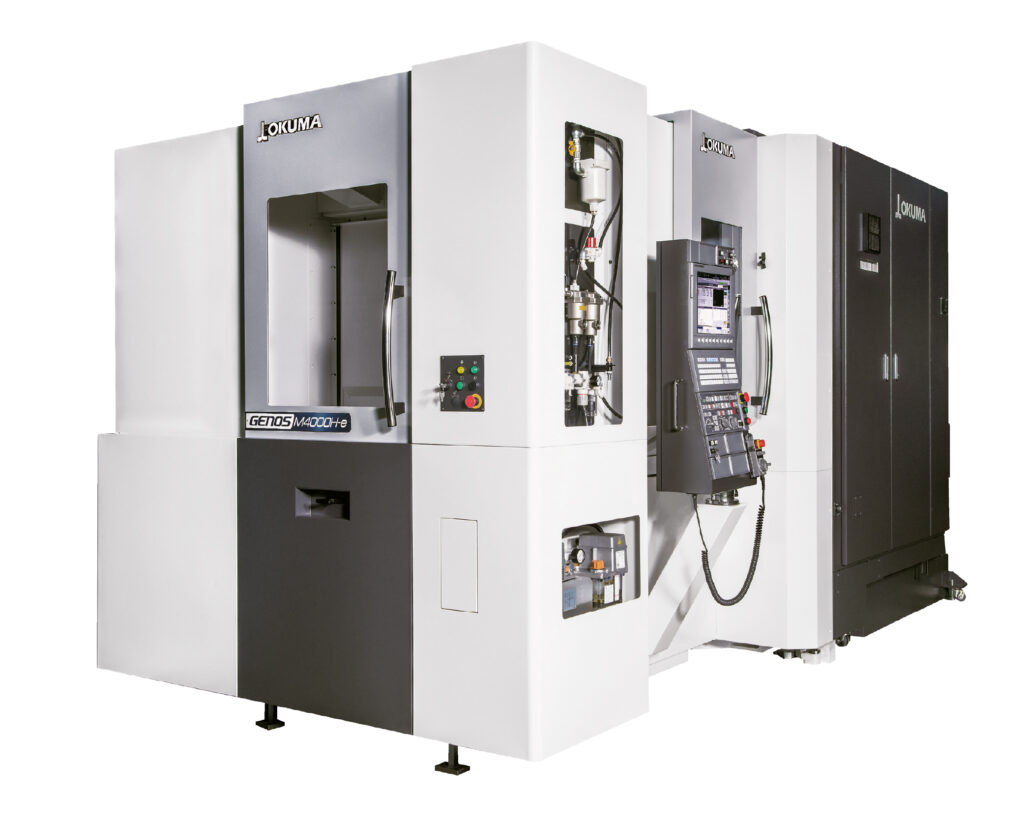
Okuma has introduced the GENOS M4000H-e, a 4-axis horizontal machining centre for cost-effective NC machining in a compact footprint. The machine combines a 400 x 400 mm table, four-sided machining capability, fast tool and pallet handling, and thermal compensation features intended to support stable accuracy during continuous production.
The new model expands Okuma’s GENOS range with an entry-level horizontal machining centre based on the company’s MB-H series. Its positioning is clear, provide the core functions needed for productive horizontal machining without turning the machine into a highly specialised configuration.
For manufacturers, the practical relevance lies in the balance between machine size, workpiece capacity and process continuity. The GENOS M4000H-e can machine workpieces up to 600 mm in diameter and 900 mm in height, while maintaining a relatively small floor space requirement. This makes it suitable for production environments where available space is limited, but access to four-sided machining and automated pallet exchange remains important.
Okuma points to applications in sectors such as automotive, agricultural machinery and construction machinery, where a single machine often needs to handle different materials and varying workpiece sizes.
Stability for continuous machining
Machine rigidity is a central part of the GENOS M4000H-e concept. The machine bed is made from cast iron, chosen for its vibration damping behaviour during heavy-duty and high-speed machining. In practice, this is relevant when cutting forces vary across different materials or when machining conditions place higher dynamic loads on the structure.
Dimensional stability is also supported by Okuma’s Thermo-Friendly Concept. According to the company, the system compensates for temperature fluctuations to maintain consistent accuracy during long periods of operation. For shops running extended shifts or continuous production, thermal behaviour can have a direct impact on part quality, especially when parts are machined over many hours without frequent intervention.
The machine offers X, Y and Z axis travels of 560, 560 and 625 mm. Combined with the 400 x 400 mm table and B-axis capability, it allows four-sided machining in one setup. Reducing the number of setups can support repeatability, shorten handling time and limit the risk of errors caused by repositioning the workpiece between operations.
Spindle and axis data for varied materials
The GENOS M4000H-e is equipped with a spindle rated at 15,000 rpm and 199 Nm of torque. This combination gives the machine the range needed to work across different cutting conditions, from higher-speed machining to operations that require more torque. Okuma states that the machine can process all types of materials for the named target industries.
Axis speed is another part of the productivity package. The maximum rapid traverse is 60 m/min, helping to reduce non-cutting time during positioning moves. On a horizontal machining centre, this can be particularly relevant when several faces of a component are machined in one cycle and the machine must move repeatedly between features, tools and pallet positions.
The B-axis enables access to multiple sides of the workpiece in a single clamping. For production teams, that can mean fewer manual handling steps and a more controlled machining sequence. It also supports a more compact process layout, since operations that might otherwise require additional setups can be consolidated on one machine.
Tool handling and chip management for uptime
The machine includes an automatic tool changer with a chain magazine for 64 tools. This capacity supports machining processes that require a broader tool set, while also reducing the need for frequent manual tool changes. The stated tool-to-tool time is 1.0 seconds, with a chip-to-chip time of 2.6 seconds.
Accessibility of the automatic tool changer is highlighted as part of the machine’s operating concept. In daily production, access for tool loading, checking and maintenance can influence how easily operators keep the process running. The two-station pallet changer adds another element of continuity by allowing workpiece handling to be separated from cutting time.
Chip management is addressed through high-volume flushing of chip deposits and through-spindle coolant supply. This is especially relevant in horizontal machining, where chip evacuation affects process reliability, tool life and surface quality. Keeping chips away from the cutting zone and machine interior helps reduce interruptions and supports stable operation over longer runs.
The machine is operated with Okuma’s OSP control. According to the company, the control is designed to simplify operation and reduce setup times, which is important for shops that need to switch between jobs while keeping machine utilisation high.