
Voestalpine Böhler Bleche has shortened the turning of titanium plates from up to 15 minutes to 10 seconds by placing a Teqram EasyFlipper next to its wide-belt grinder. The change addresses a critical handling step in plate grinding, where surface integrity, operator safety, and process continuity are closely linked.
In titanium plate production, handling is not a secondary operation. At elevated temperatures, titanium absorbs oxygen into the surface, creating a hard and brittle layer that differs from the tough base material. For applications including aerospace and medical technology, this layer is unacceptable and must be removed from both sides.
Voestalpine Böhler Bleche removes the layer with a wide-belt grinder. Therefore, turning the plate between grinding passes is an important part of the process. The plates can measure up to 6,000 x 2,000 mm, with thicknesses up to 75 mm. Before the new setup was introduced, they were tilted with an overhead crane and clamps. According to the company, this took time, created safety risks, and increased the chance of damaging the material.
A bottleneck next to the grinder
The turning operation was previously dependent on crane availability and additional handling. For a process that requires both sides of the plate to be ground, that created interruptions around the wide-belt grinder. Waiting time, crane movements, and manual clamping all added complexity to a step that had to be carried out repeatedly and without surface damage.
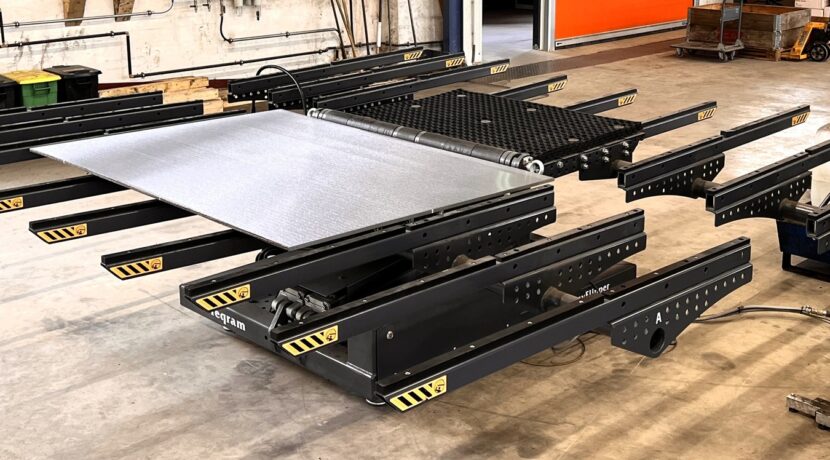
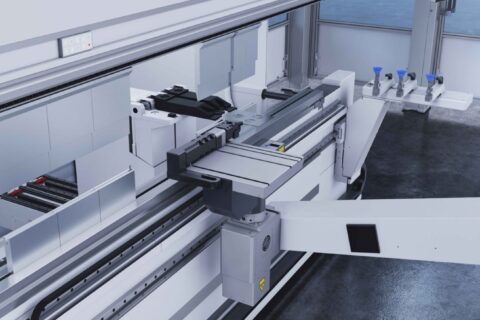
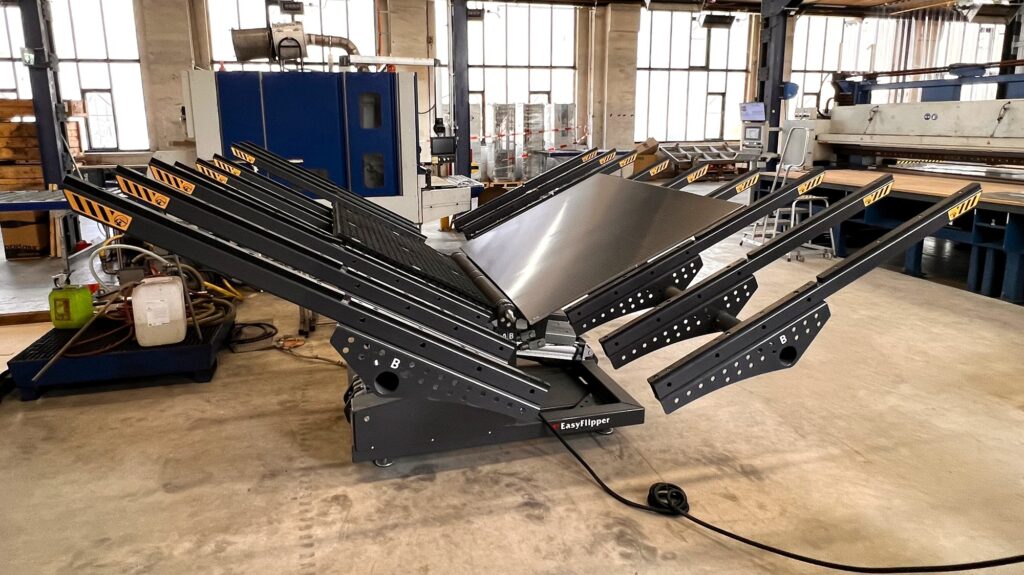
Since 2025, Voestalpine has been using a pneumatic Teqram EasyFlipper for this operation. The unit is positioned directly next to the grinder, so the plate can be turned within the same process flow. The grinder operator also operates the EasyFlipper, which removes the need for separate crane handling during this step.
The time difference is substantial. A turning process that previously took up to 15 minutes is now completed in around 10 seconds. In practice, this means the grinding process can continue with fewer interruptions and less dependency on other equipment or personnel. Matthias Illmeier, Product and Process Technician at Voestalpine, describes the former procedure as “time-consuming and risky” and says it now takes only seconds, safely and without interruptions.
Controlled turning for large plates
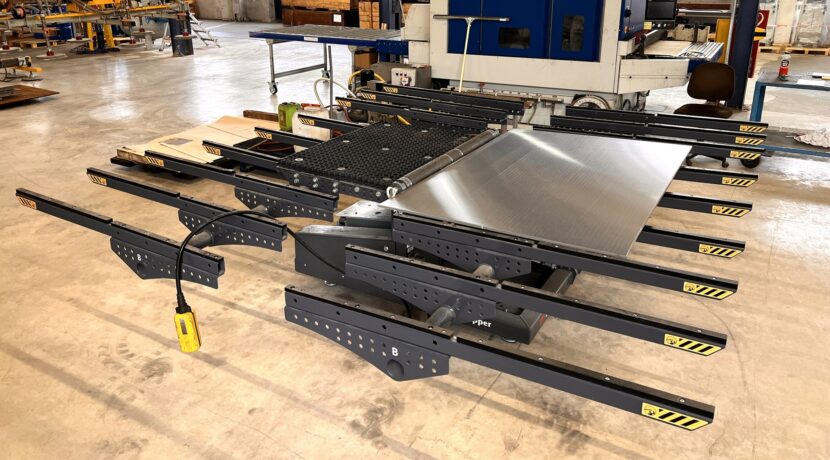
The EasyFlipper used by Voestalpine is equipped with extension arms to handle large titanium plates in a controlled way. With these additions, the standard EasyFlipper size of 1,200 x 800 mm is expanded to 3,640 x 1,637 mm. The setup can turn plates measuring 6 x 2 meters and weighing up to 750 kg.
For plate processing, the practical value lies in the controlled movement and the reduced contact risk during turning. The press release notes that the modular concept allows the use of brushes, plastic strips, or mats to help prevent damage. This is relevant in a process where surface condition directly affects the next production step and where damaged material can lead to rework or loss.
By moving the turning step from crane-assisted tilting to a dedicated device beside the grinder, the handling sequence becomes shorter and more predictable. The operator no longer has to wait for crane availability, and the plate does not need to be repositioned through a separate lifting operation. As a result, process stability around the grinder improves, and the number of interventions during production is reduced.
Reliability in daily production
According to Voestalpine, damage during turning has not occurred since the EasyFlipper was commissioned. The company also reports that the system operates robustly and without failures under intensive industrial conditions. For a production environment working with high-quality stainless steel plates and special materials, such reliability is important because a handling device becomes part of the main process rather than an occasional aid.
Voestalpine Böhler Bleche, based in Mürzzuschlag, Austria, employs around 450 people and is part of the Voestalpine Group. The company supplies stainless steel plates and special materials for sectors including aerospace, oil and gas, toolmaking, industrial high-temperature applications, and medical technology. These markets place strict demands on material condition and process safety, which explains why plate handling around grinding receives close attention.
Illmeier says the EasyFlipper has “fundamentally simplified” the work. Stripped of promotional language, the case shows a clear production effect: a slow and crane-dependent turning operation has been replaced by an integrated handling step with shorter cycle time, fewer interruptions, and lower risk of material damage.