
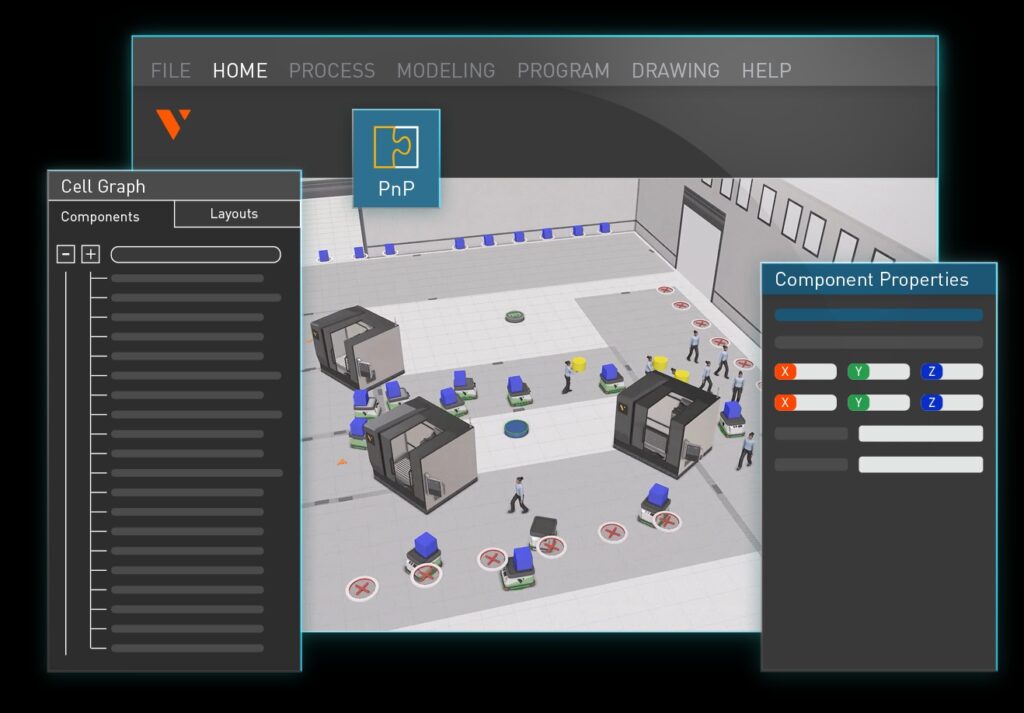
Visual Components has released version 5.1 of its factory simulation and robot offline programming platform. The update addresses a growing challenge in manufacturing, how to validate complex autonomous operations before they reach the shop floor. It enables large fleets of AMRs and AGVs, robots, products, people, and control logic to be simulated together in one factory environment.
Manufacturers moving toward more autonomous and connected production face a practical challenge. The more mobile robots, fixed robots, material flows, and human operations are combined, the harder it becomes to predict how the system will behave in operation. Traffic bottlenecks, collision risks, programming errors, and layout inefficiencies can appear late in a project. As a result, changes are more expensive, and commissioning schedules are already under pressure.
Visual Components 5.1 is focused on earlier validation of these interactions. The release adds scalable robot orchestration, faster simulation performance, and updated PhysX technology for more realistic physics simulation. It also extends connectivity to production control systems and robot brands. For production leaders, factory planners, and automation engineers, the main value lies in testing more of the actual operating logic and movement behavior before committing equipment, layouts, or programs on the factory floor.
Simulating mobile fleets at factory scale
A central update in Visual Components 5.1 is the ability to simulate hundreds of autonomous mobile robots and AGVs within a single environment. The platform now supports dynamic collision avoidance and delivers up to 10x faster performance compared with previous versions. That performance gain is important because mobile robot projects are rarely limited to one isolated vehicle. In full factory environments, vehicles interact continuously with each other, with fixed automation, products, operators, and changing material flows.
By making larger scenarios practical to model, the software helps users identify where mobile traffic may become unstable or inefficient. Routes, crossings, shared work areas, and high-activity zones can be evaluated before deployment. This is especially relevant where mobile fleets are used alongside traditional robot automation, because the system behavior depends on many moving resources rather than a single machine cycle.
The release is aimed at environments where manufacturers need to understand not only whether each robot can complete its task, but also whether the overall operation remains workable when many resources are active at the same time. Therefore, simulation shifts from isolated equipment checks toward validation of the wider production system.
More realistic physics for earlier validation
Visual Components 5.1 also includes updated PhysX technology, intended to make physics simulation faster and more realistic. In factory planning, this affects how users evaluate interactions between moving objects, products, vehicles, robots, and people. More accurate behavior in the virtual model can reduce the gap between what is planned and what later happens during commissioning.
The practical relevance is clear in projects where movement, contact, timing, and spacing determine whether the layout works. If a simulation cannot represent these interactions convincingly, teams may still rely on assumptions or manual adjustments during installation. By improving physics simulation, the new version gives engineers a stronger basis for assessing dynamic factory operations earlier in the process.
This does not remove the need for commissioning, however, it can help reduce avoidable changes once equipment is installed. Potential collision hazards, unstable flows, and layout constraints can be examined in the simulation environment first. For manufacturers dealing with large or fast-changing automation systems, that earlier feedback can support better decisions before physical changes are made.
Bringing control logic into the simulation loop
The 5.1 release also expands connectivity. Visual Components has added support for Allen-Bradley PLCs and introduced new virtual commissioning plugins for Nachi and Epson robots. This brings more of the real production system into the simulation environment earlier in a project, including controller logic and robot behavior.
For automation engineers, this matters because many commissioning issues are not caused by mechanical layout alone. They often come from the way control systems, robot programs, and material flows interact under real operating conditions. By validating controller logic in the simulation loop, teams can detect errors and conflicts before equipment is installed or modified on the factory floor.
The wider benefit is collaboration. Factory planners, automation engineers, operations teams, and management can work from a shared model that represents more than a layout concept. It can include mobile fleets, fixed robots, control behavior, products, and human operations. That makes discussions about capacity, routing, safety risks, and commissioning readiness more concrete, because the effects of changes can be tested rather than debated only in theory.
Python 3 support for robot offline programming
For teams using Visual Components for robot offline programming, version 5.1 upgrades the scripting environment to Python 3. The company describes this as a replacement for a legacy environment that had become a constraint for developers building and maintaining robot programs.
The change is technical, but its practical impact is straightforward. Robot programs are often adjusted and maintained over time as products, layouts, and processes change. A modern scripting environment can make that work easier for developers and automation teams, particularly when robot programming is part of a broader virtual commissioning or factory simulation workflow.
Together with the new connectivity and large-scale simulation capabilities, the Python 3 upgrade supports a more integrated approach to automation planning. Robot programs, mobile robot behavior, PLC logic, and factory flows can be considered in the same digital environment. For sectors such as automotive, electronics, logistics, and healthcare manufacturing, where mobile fleets and connected production systems are increasingly combined, that broader validation can help reduce commissioning risk and support a faster path from planning to production.