
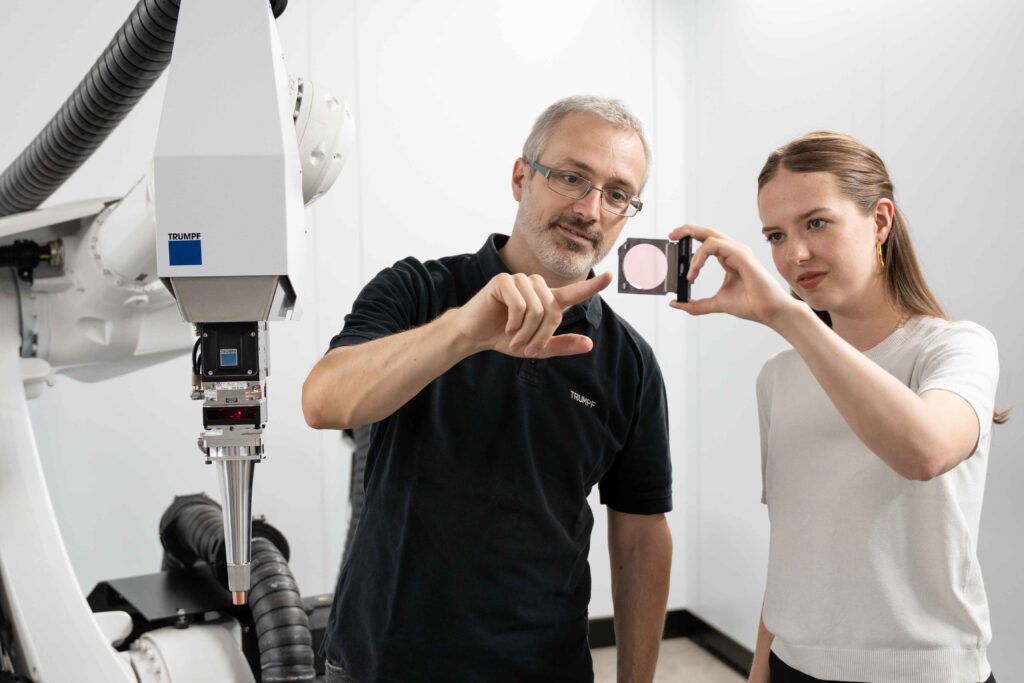
TRUMPF will present the TruLaser Weld 3000 at EuroBLECH 2026. The compact robotic laser welding cell is designed for high-variant, small-batch production. Its main development is AI-assisted programming. This function is intended to reduce the time required to create and adjust welding programs. Smaller welding optics and a reduced footprint also support automated laser welding in confined production areas and for complex component geometries.
Manufacturers of sheet-metal assemblies often manage changing orders, limited floor space and a shortage of experienced personnel. Programming and setting up a welding cell can therefore represent a significant part of overall throughput time. This is particularly relevant for smaller production series.
The TruLaser Weld 3000 combines offline programming from CAD data with functions for correcting deviations at the machine. The cell is aimed at applications in equipment and plant engineering, data-center sheet-metal production, medical technology, and kitchen and food-production equipment. With laser power options of three or four kilowatts, it can weld stainless steel and mild steel up to eight millimetres thick. It can also weld aluminium up to six millimetres thick.
Faster program creation and correction
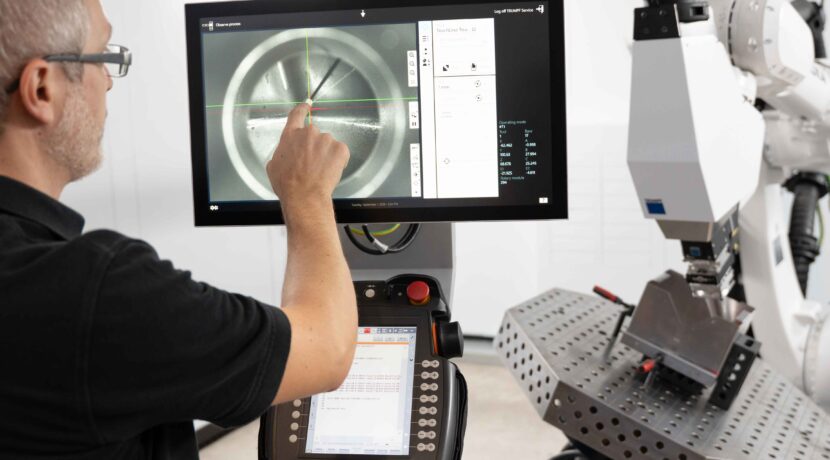
Programs for the TruLaser Weld 3000 can be created at the machine or offline with TruTops Weld software. Offline programming allows operators to prepare programs for upcoming parts while the cell continues producing existing workpieces. For companies handling frequent component changes, this separation can reduce machine downtime caused by programming work. TRUMPF states that CAD-based program generation, combined with the TeachLine Touch function, can reduce programming and setup time by up to 50 percent. TeachLine Touch is intended for small corrections after a component has been positioned in the cell. Operators can move welding points to their required locations by selecting them on the machine screen.
The optional TeachLine AI extension takes this adjustment further. The system detects deviations in the actual positions of welding points. It then adapts the robot path accordingly. This is intended to shorten setup work for new components. It can also reduce manual intervention when actual component conditions differ from the programmed CAD model. According to TRUMPF, the approach enables less experienced employees to operate the cell. However, the value of these programming functions will depend on how often parts change. It will also depend on how closely supplied components match their nominal geometry.
Compact optics for deeper components
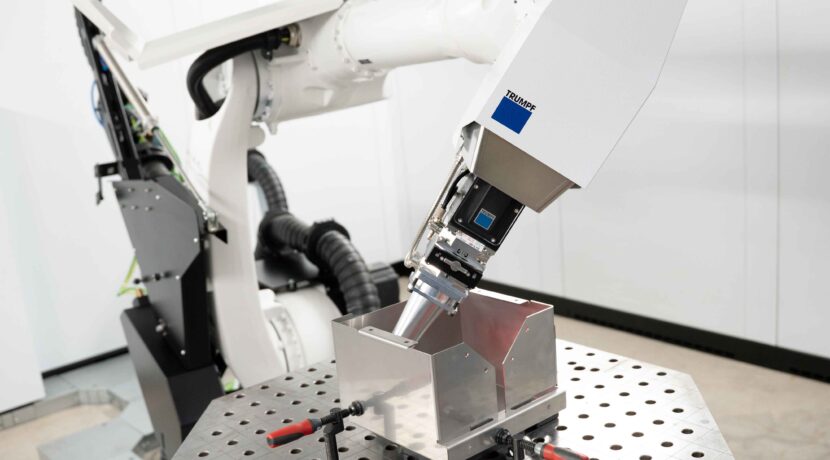
A newly developed welding optic is approximately 40 percent smaller than the previous version. Its reduced dimensions are intended to give the robot access to welding locations that are difficult to reach with larger optics. These include areas inside deep enclosures, crates and boxes. As a result, the optic can expand the range of components suitable for automated welding. It can also reduce the need for manual rework on inaccessible seams.
The cell uses several laser welding functions for different joint conditions. BrightLine Scan combines a high-frequency scanner with motorised focus adjustment. It provides gap-bridging capability of up to 0.4 millimetres. The function also creates wider weld seams to compensate for component tolerances. BrightLine Weld distributes laser power between an inner core and an outer core in the laser light cable. TRUMPF specifies that this reduces spatter, particularly during deep penetration welding. For joints with larger gaps or materials that require filler material, FusionLine combines laser welding with filler wire. The process deposits material in a targeted way. It is specified for gaps of up to about 1.5 millimetres. Together, these functions are intended to support stable welding where part fit-up varies between workpieces.
Footprint addresses limited production space
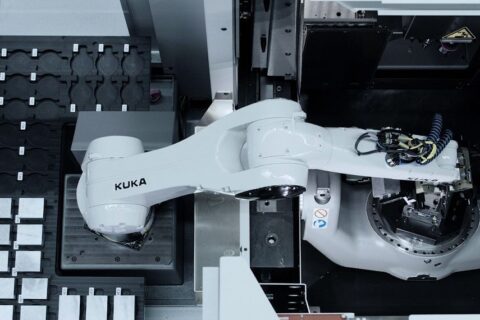
The protective enclosure measures 3.65 by 3.65 metres. According to TRUMPF, the TruLaser Weld 3000 is approximately 24 percent smaller than the smallest version of the TruLaser Weld 5000. This smaller footprint is relevant where limited floor space restricts the addition of dedicated automation. Despite its compact enclosure, the cell is designed to process components up to pallet size. A KUKA Iontec robot provides a reach of 2,100 millimetres. Users can select a conventional welding table, a rotary-tilt positioner or a compact rotary changer. The rotary changer allows loading and unloading to take place in parallel with the main production time. It therefore supports a continuous workflow where part handling would otherwise interrupt the welding process.