
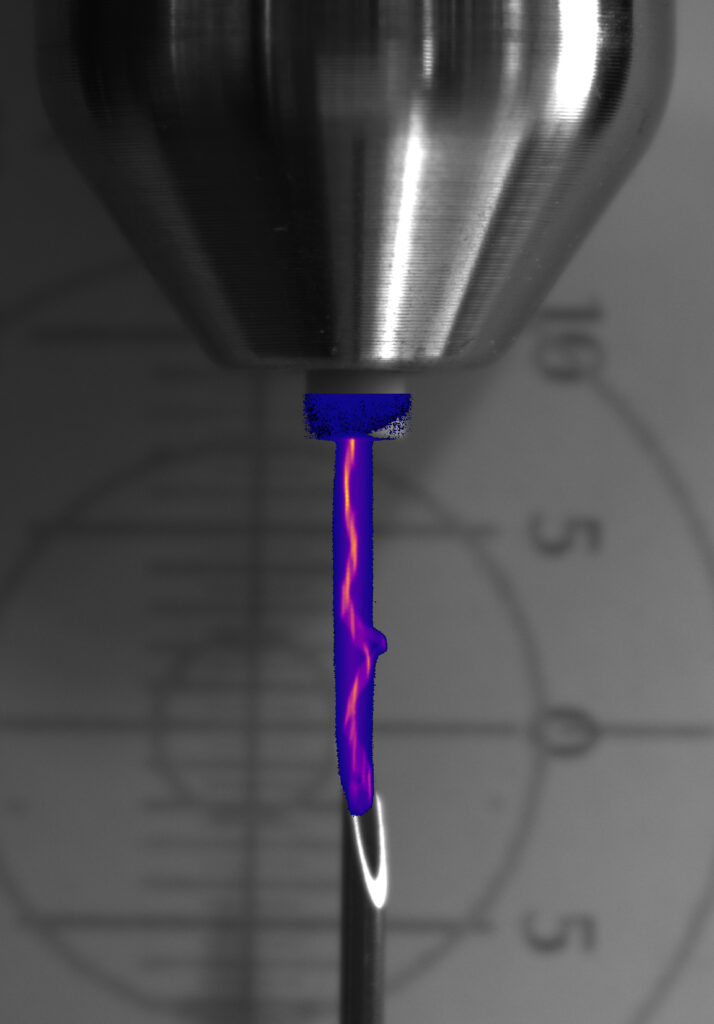
Researchers at the Leibniz Institute for Plasma Science and Technology are using synchronized IDS industrial cameras to reconstruct plasma jet discharges in three dimensions. The work gives researchers an experimental basis for analyzing the spatial behavior of highly dynamic plasma filaments, which change within microseconds and are difficult to capture with conventional single-view imaging.
Plasma jets are used in technological and medical applications, including materials processing and plasma medicine. They consist of ionized gas emitted as a focused, self-luminous structure. Their behavior is relevant, however, it is difficult to study because the discharge is small, fast, and erratic.
At INP in Greifswald, the Medical Plasma Source Systems research group led by Dr. Torsten Gerling is investigating plasma sources used in medicine. One focus is the kINPen plasma jet, an atmospheric-pressure cold plasma source developed at the institute. Its discharge leaves the device as an effluent and forms a highly dynamic filament with a period of about 1 microsecond, a diameter of around 0.1 mm, and a length of about 10 mm. That combination of speed and scale makes it a suitable reference system for studying how individual plasma jet discharges propagate in space.
Capturing a microsecond plasma structure
The central challenge is not only to image the plasma, but also to record the same discharge features from several directions at the same moment. Exposure times between 9.35 and 30.03 microseconds are used, with monochrome 8-bit single-frame images. Such short exposures are needed to make individual discharge channels visible without losing their shape through motion.
Two-dimensional images can show the discharge with high spatial detail, but they cannot reliably describe its three-dimensional form. For self-luminous and highly dynamic objects such as plasma filaments, the real spatial distribution remains uncertain when only one viewing direction is available. Curvature, coiling, and lateral deflection can be assessed more reliably when the discharge is captured from multiple angles at the same time.
“All the cameras must operate in perfect synchronisation, as this is the only way to capture the same features within a very short timeframe,” explains Artur Wittig, research fellow at INP. Dr. Torsten Gerling adds that the setup also depends on repeatability in relation to the plasma source.
Why the discharge path can be reconstructed
The plasma behavior itself provides an important condition for measurement. A single measurement without a surface may produce several filaments, known as guided streamers. These are short-lived, thread-like discharge channels in the plasma. When a surface is involved, however, the measurements usually show one clearly dominant discharge path.
This behavior is linked to the derivative mode. A guided streamer forms a conductive channel to the surface, after which a transient glow discharge flashes erratically along that channel. Due to the memory effect, metastable particles from earlier discharges make it easier for further guided streamers to re-ignite. These streamers largely follow the same path, although the gas flow can shift them slightly.
For high-frequency excitation of the kINPen, this results in a visible plasma structure that forms in a spatially reproducible way across multiple discharges. That repeatability is essential for systematic image-based measurement. It allows researchers to move beyond isolated images and build a more stable experimental picture of how the discharge path behaves in space.
Five synchronized views for 3D point clouds
INP uses a multi-view stereo approach with five IDS cameras operating in synchrony. The cameras capture the plasma discharge simultaneously from different viewing angles. After calibration of the camera system, distinctive structures in the discharge are identified and used as point correspondences across the images. From these correspondences, the three-dimensional structure is reconstructed as a point cloud.
The optical setup is demanding because the visible structure is both small and weakly luminous at the observation distance. The discharge has an axial length of less than 10 mm and a width of less than 1 mm. High-aperture 75 mm IDS lenses are used, with a 1.2-inch image circle and an f/2.8 aperture.
“At an observation distance of around 500 mm, the plasma filament is hardly self-luminous, its brightness is almost comparable to that of a firefly,” says Dr. Ing. Philipp Mattern, supervisor and examiner of the master’s thesis carried out at INP. The combination of sensor and optics makes it possible to capture usable images despite exposure times of only a few microseconds.
“The point clouds obtained in this way provide, for the first time, a reliable basis for investigating the discharge paths,” says Wittig. “This allows us not only to visualize the plasma structure, but also to analyze it systematically.”
Camera control and repeatable measurements
The multi-camera setup uses five IDS uEye CP U3-31J0CP Rev. 2.2 industrial cameras. The selection was based mainly on hardware triggering, exact synchronization, and reliable control of very short exposure times. These factors are critical because each camera must record the same short-lived plasma feature under reproducible conditions.
The cameras use a square Sony Pregius S CMOS sensor, IMX546, with a resolution of 8.13 megapixels. The global shutter sensor supports distortion-free imaging of the short-lived plasma structure. Backside illumination helps when working with low light levels, which is important for self-luminous plasma filaments captured with microsecond exposure times.
Integration is handled through the IDS peak SDK. The setup is controlled and automated with the IDS peak API for Python, enabling parallel camera operation, triggering, and image storage. The ability to save and reuse camera settings is also relevant for the research workflow, because measurement series can be carried out under consistent conditions and compared with one another.
Wittig notes that the documentation and technical support were useful when designing and validating the simultaneous image capture and the stable multi-camera configuration.
Beyond visualization of plasma jets
The method developed at INP is intended as more than a visual demonstration. It shows that the highly dynamic discharge of a kINPen plasma jet can be reconstructed as a three-dimensional point cloud and then examined structurally. This gives researchers a practical experimental basis for studying the spatial propagation of plasma jet discharges.
The approach is not limited to the kINPen system. According to the source material, it can also be applied to other small discharge structures with relatively little effort. Current work continues to examine plasma jet discharges under changed operating parameters, including gas flow and discharge mode.
Further imaging methods are also being investigated. Schlieren and Background Oriented Schlieren techniques do not capture the object itself, but changes in the surrounding fluid, such as air or working gas. In future experiments, these methods could complement the 3D reconstruction by visualizing flows and density differences around the plasma discharge.