
OPEN MIND Technologies will present updates to hyperMILL and Hummingbird MES at AMB 2026 in Stuttgart. The focus is on practical manufacturing tasks, including surface finishing, deburring, turning simulation, automation and tool management. For machining companies, the relevance lies in more consistent programming, fewer manual steps and a better connection between CAM and shopfloor execution.
At Booth 2B21 in Hall 2, OPEN MIND will show the latest enhancements to its hyperMILL CAD/CAM suite alongside the Hummingbird Manufacturing Execution System. The exhibition program reflects a broader shift in production environments, where CAM programming, machine data, tool logistics and execution planning increasingly need to work as one connected process.
The updates cover both individual machining functions and the digital workflow around them. On the CAM side, OPEN MIND is adding strategies for contour planing, deburring, turning and collision checking. On the MES side, Hummingbird brings planning and control, machine data acquisition, CAM/CNC integration and tool logistics into a modular structure. The combination is intended to reduce friction between programming and production, especially where tool data, machining knowledge and process stability have a direct impact on daily output.
Contour planing for sensitive surfaces
One of the new hyperMILL functions is 2D hale machining, also described as contour planing. The process is supported by machining strategies and simulation, with the aim of producing scratch-free surface finishes. OPEN MIND cites sealing surfaces in battery manufacturing as an example of where this can be relevant.
For production teams, the practical point is not only the surface result itself, but also the ability to plan and verify the operation in CAM before it reaches the machine. Surfaces that must seal reliably leave little room for uncontrolled tool marks or unnecessary rework. By combining the machining strategy with simulation, programmers can assess the operation digitally and reduce uncertainty before machining starts.
This type of function fits into applications where the finishing operation is closely tied to part function. A surface may look simple in geometric terms, but still carry strict requirements in use. Bringing contour planing into the CAM environment gives programmers a defined method for handling this task, rather than relying only on manual adjustment or downstream correction.
Deburring directly on the machine
OPEN MIND is also highlighting a deburring feature package for areas that are difficult to reach and have often required manual post-processing. The package includes three strategies: hole brushing, hole deburring and component edge deburring. Each can be run as 3-axis or 5-axis machining.
The value for manufacturers is clear where burr removal affects throughput, handling time and consistency. Manual deburring can be labor-intensive, especially when features are hard to access or when parts contain many edges and holes. Moving more of this work into the programmed machining process can help produce burr-free part edges directly on the machine.
The 3-axis and 5-axis options are important because deburring requirements vary with part geometry and machine setup. Simpler features may be handled with 3-axis motion, while more complex access conditions can require 5-axis capability. By covering holes, edges and brushing operations within the CAM strategy, the package gives programmers a structured approach to a task that is often treated as a secondary operation but can strongly influence part quality and production time.
Turning support for complex turret configurations
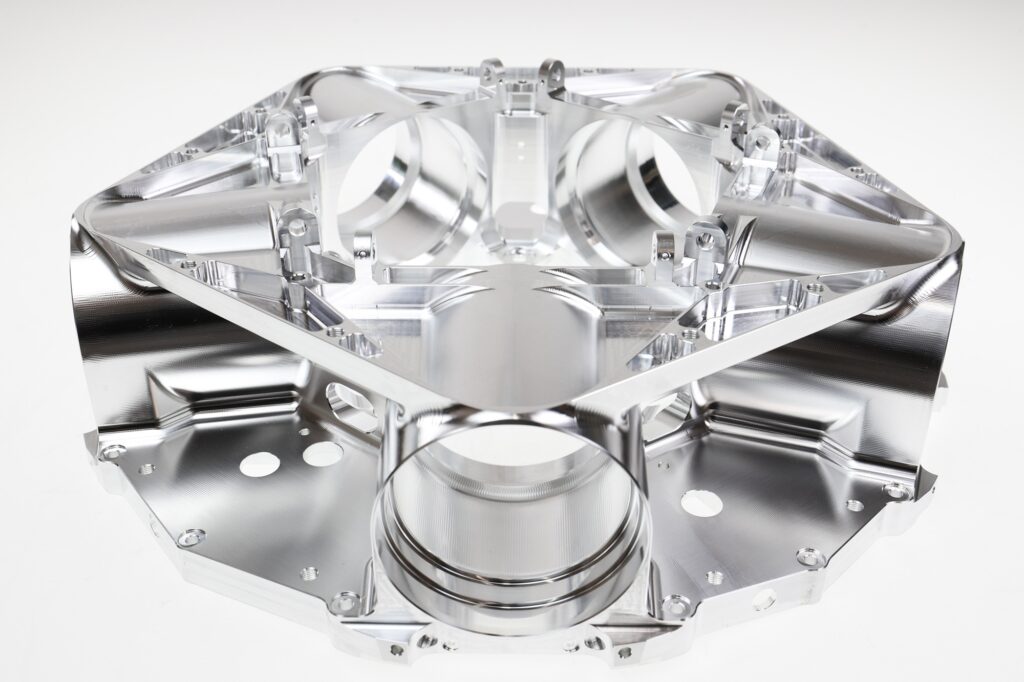
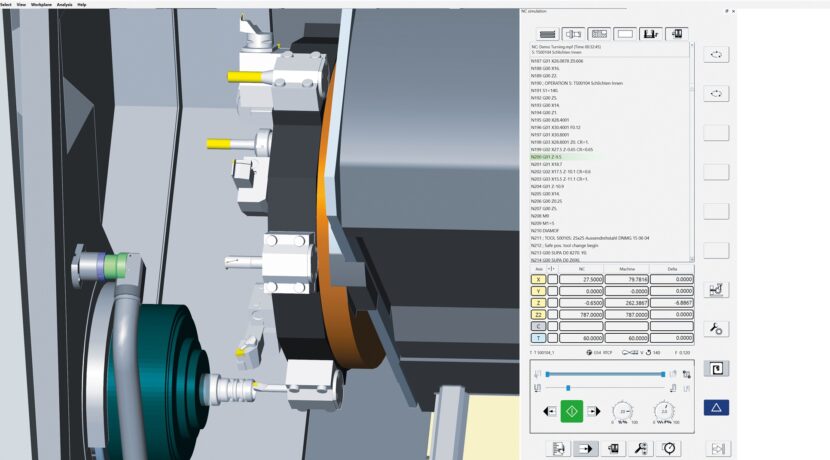
The enhancements to hyperMILL TURNING Solutions focus on simplifying the programming of turning programs and extending support for complex turret-type turning during collision checking. OPEN MIND will also show examples of machined workpieces from different industries, including a propeller hub produced using hyperMILL.
In turning and mill-turn environments, collision checking is a practical necessity, particularly where turrets, tools and workpiece geometries create limited space. More complex turret configurations increase the need for reliable simulation, because errors can lead to machine downtime, tool damage or scrapped parts. The press material specifically points to accurate simulation and reliable collision detection for these configurations.
Simpler programming is also relevant for everyday production work. Turning operations can involve multiple tools, setups and approach conditions. When the CAM system supports the configuration more directly, programmers spend less effort working around machine structure and more effort defining the machining process. That supports a more predictable transition from NC program to machine operation.
Automation and AI within CAM programming
Under the name hyperMILL INTELLIGENCE, OPEN MIND is presenting a concept that combines human expertise, smart automation, digital optimization and artificial intelligence. In CAM programming, the company emphasizes rule-based automation, proven logic and access to company-specific knowledge to deliver consistent and transparent results.
This is a notable distinction, because automation in manufacturing software has to remain understandable to the people who depend on it. Rule-based programming can help standardize recurring decisions, while company-specific knowledge allows existing methods and preferences to be reused. That can reduce variation between programmers and make results easier to trace.
OPEN MIND also states that it uses AI to analyze data, identify patterns and make existing expertise available more quickly. In practical terms, the focus is not on replacing programming knowledge, but on making it easier to apply. For manufacturers dealing with repeated part families, complex machining strategies or accumulated internal know-how, faster access to usable knowledge can support more consistent programming decisions.
Tool management connects CAM and MES
Hummingbird MES will be shown as a modular suite with four main components: planning and control, machine data acquisition, CAM/CNC integration and tool logistics. Its connection with hyperMILL is especially relevant in tool management, where centralized tool data can be made available across the company.
Tool information often sits at the boundary between engineering, programming, tool presetting and production. If the data is fragmented, time is lost searching, checking or correcting information. Centralized tool management addresses this by streamlining work and giving different users access to the same tool data. According to OPEN MIND, this can save time and money by improving how tool information is handled.
The link between MES and CAM is also significant for digital continuity. CAM defines how the part will be machined, while MES supports execution, data acquisition and logistics around the production process. When tool data is connected between these environments, the workflow becomes less dependent on separate manual steps. At AMB, OPEN MIND is positioning this integration as part of a broader move toward connected digitalized manufacturing technologies.