
Gear production depends on more than a stable machining process. Geometry must also be verified reliably, especially when deviations have to be traced back into production. With Gearpak, a module within the MCOSMOS control system, Mitutoyo enables gear measurement and analysis on a CMM. As a result, companies can reduce the need to invest immediately in a dedicated gear measuring machine.
In gear manufacturing, inspection is a direct part of process control. A gear can only be produced consistently when its geometry is measured in a way that makes deviations visible and understandable. For companies with continuous gear production, a specialized gear measuring machine may be a logical investment. However, for manufacturers that only produce or inspect gears occasionally, that step is less straightforward.
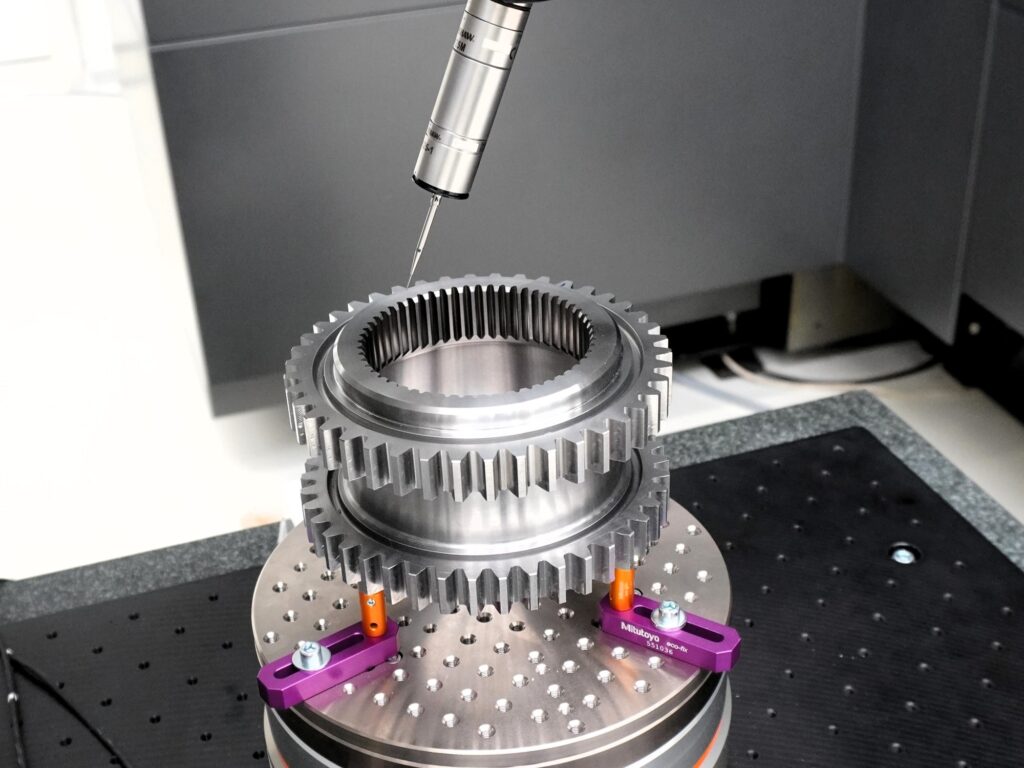
Mitutoyo addresses this situation by combining a CMM with a dedicated gear module in MCOSMOS. Gearpak allows gears to be measured and analyzed within an existing measurement environment. The practical value lies in the broader use of equipment that may already be available in the quality department. Instead of treating gear inspection as a separate capability that requires a separate machine, the measurement task can become part of the CMM workflow. Therefore, gear inspection becomes more accessible without removing the need for a carefully prepared measurement strategy.
Visual control of the measurement process
Gearpak uses a modern interface based on a 3D model of the gear. This gives the user a visual reference during preparation and measurement, making it easier to check whether the inspection is being carried out as intended. In gear measurement, that visual feedback is relevant because the result depends strongly on correct setup, the chosen measurement strategy, and the proper coordinate system.
The software also supports preparation through automatic program generation and on-screen guidance for setting up the coordinate system. These functions lower the entry threshold for users who need to inspect gears but do not work with dedicated gear measurement equipment every day. The measurement task itself remains technically demanding, especially because gear geometry must be assessed in a structured and repeatable way. Still, guided preparation helps reduce uncertainty in the setup phase and makes the process easier to integrate into an existing CMM environment. For companies expanding their inspection capabilities, this can be an important practical step.
More value from the CMM
In combination with a rotary table, Gearpak supports 4-axis measurement. This expands the possibilities for inspecting gears on a CMM and gives manufacturers a way to add gear measurement to their quality control without immediately moving to separate specialized equipment. The main benefit is not only the measurement function itself, but also the broader applicability of the measuring machine.
A CMM can be used for many inspection tasks, while a dedicated gear measuring machine is aimed at a more specific application. For companies that produce or inspect gears only occasionally, this difference matters. Gearpak allows them to use existing measurement capacity more flexibly and to bring gear inspection into the same environment as other dimensional checks.
That approach reflects a broader shift in production practice. Gear manufacturing and gear inspection are becoming easier to integrate into flexible manufacturing environments. When the CMM can also support gear analysis, quality control becomes less dependent on separate equipment for each specific component type. For users, the result is a more versatile inspection setup with a lower threshold for checking gear geometry.