
Méca-Précis has installed a robotic measurement cell to increase inspection capacity and reduce pressure on its quality department. The system combines a Mitutoyo MiSTAR coordinate measuring machine with robotic handling and automation from Engineering Data. For a workshop producing complex parts with demanding dimensional checks, the cell addresses a practical issue, inspection had become the limiting step in the production flow.
Founded in 1975 and based in Châtillon-sur-Indre, Méca-Précis has grown from a family-run machining business into a 45-person company operating 25 machine tools, 18 of them CNC-controlled. Its work covers prototype parts, one-off components, small and medium production runs, and welded mechanical assemblies. The company manufactures complex parts for aerospace and satellite applications. It has also supplied parts and complete sub-assemblies for carton packaging machinery for 48 years.
This mix of work places heavy demands on dimensional control. Méca-Précis already used a measuring machine on the shop floor and a coordinate measuring machine in a thermally controlled environment. Some aerospace and space-sector customers, however, require 100% inspection of all dimensions on every part, before and after surface treatment. As production volumes increased and palletized machining centers ran overnight, the inspection department could no longer keep pace with machining output.
Inspection capacity under pressure
The scale of the inspection workload varies widely. According to Nicolas Mériaudeau, dimensional inspection of a single pin may take only one minute, but there can be up to 300 pins to check. At the other end of the range, inspection of one complex satellite component can require up to 80 hours. Therefore, the company faced a clear imbalance between production capacity and control capacity.
The company’s two inspectors were faced with growing volumes and increasingly demanding inspection requirements. The bottleneck was not machining, but the ability to verify parts quickly enough while maintaining the required level of dimensional control. Bruno Mériaudeau says the company needed a way to automate and robotize inspection to maintain service levels, manufacturing quality, and reasonable lead times.
After the manufacturer of the existing coordinate measuring machine was unable to provide a suitable solution, Méca-Précis turned to Mitutoyo. The proposed answer was a robotic measurement cell built around a Mitutoyo MiSTAR coordinate measuring machine, developed in collaboration with Engineering Data, which specializes in fixturing solutions and automation for machining centers.
A robotic cell built around shop floor measurement
The measurement cell was installed less than a year after the first meeting between Mitutoyo, Engineering Data, and Méca-Précis. The company’s quality inspectors were closely involved throughout the project. After installation, further work was needed to develop inspection programs, commission the system, configure the cell, and complete technical adjustments. Six additional months passed before the system became fully operational.
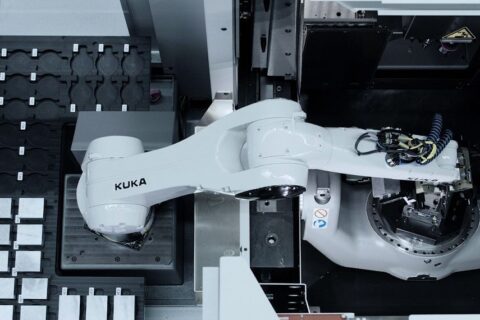
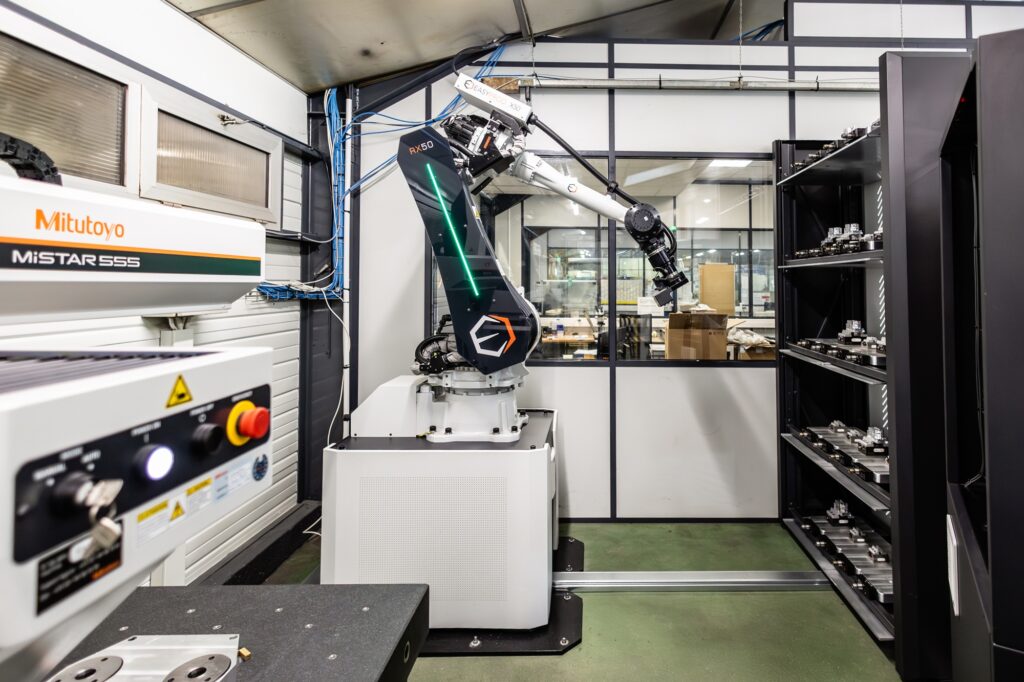
The cell is installed inside an enclosed structure with glass panels. This provides operator protection while keeping the process visible. Inside the cell are a multi-axis articulated robot, a Mitutoyo MiSTAR coordinate measuring machine, and an automated storage unit for up to 20 pallets. The MiSTAR 555 is designed for use in production environments. According to the supplied information, its accuracy is guaranteed across a wide temperature range, and its absolute encoder provides resistance to environmental conditions.
A loading station is accessible from outside the cell, allowing operators to interact with the system without interrupting its overall operation. This layout is important in daily use. It separates manual loading from automated inspection, so the measuring machine can continue working while operators prepare new parts for the cycle.
Pallet handling separates loading from measuring
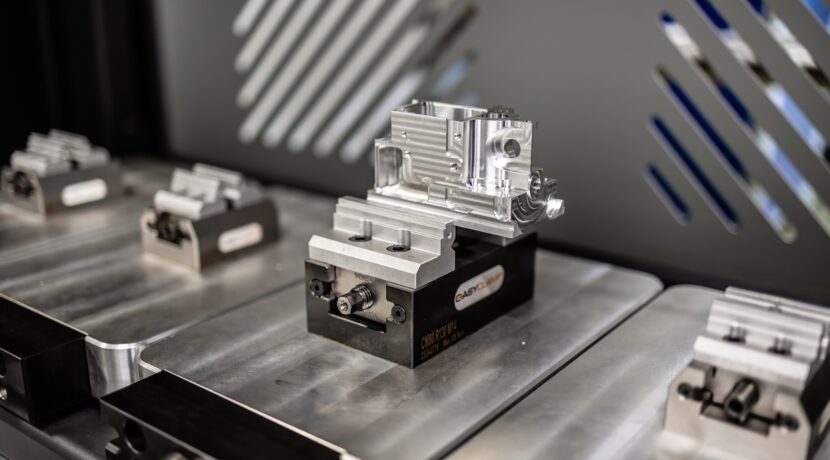
The inspection process begins with the operator placing a pallet carrying a part onto the loading station. The pallets are designed to hold the component in a position suitable for robotic handling and measurement. Through the Easyprod human-machine interface from Engineering Data, the operator selects the type of part being loaded. The control system then associates the part with the correct inspection program.
The robot picks up the pallet and transfers it to the storage unit. This can be repeated until the storage system is fully loaded. Once the operator starts the inspection cycle, the cell runs autonomously. The robot retrieves each pallet in sequence and places it on the surface plate of the coordinate measuring machine. A clamping device on the machine ensures positioning and stability during measurement.
The CMM then runs the associated inspection program. Measurement time depends on the number of dimensions to be checked and the complexity of the component. It can range from a few minutes to several hours. After inspection, the robot returns the pallet to the storage cabinet and continues with the next part. Results are recorded by the system and can be reviewed later by the metrology team.
More autonomous inspection during and after shifts
For Méca-Précis, the main gain is not only the use of a robot, but the ability to extend inspection activity beyond direct operator presence. Inspectors can load parts into the cell before leaving the workshop, after which the system continues carrying out measurements automatically. This is particularly relevant in a production environment where palletized machining centers may also run through the night.
The cell has reduced the workload on the two inspectors by taking over repetitive handling and enabling automated inspection during the day and overnight. Manual intervention is still needed for loading, selecting the part type, and reviewing measurement results, but the measurement equipment is used more continuously and with less waiting time between parts.
Bruno Mériaudeau says the company has removed the bottleneck that had formed in quality control. Nicolas Mériaudeau adds that without the robotic measurement cell, Méca-Précis would not be able to manage the growing production volumes of series-manufactured parts with demanding control requirements. The company now has two in-house measurement solutions available for the checks required by its customers, with the robotic cell carrying a significant part of the automated workload.