GrindingHub 2026 in Stuttgart made a clear shift visible: grinding technology is moving from standalone machines toward connected, automated, and data-driven process chains. For manufacturers, the relevance lies in greater process stability, better quality assurance, more efficient use of tools and coolants, and production systems that can be monitored and adjusted with less manual intervention.
Around 11,000 visitors from around the world attended the event, where 462 exhibitors from 28 countries presented developments in grinding machines, measurement technology, automation, tooling, coolant supply, and digital process solutions. More than half of the visitors came from outside Germany, underlining that these issues are shaping the grinding sector internationally.
The background is a difficult business environment, with declining production, weaker exports, higher energy and material costs, and volatile sales markets. Against that backdrop, the trade show focused less on isolated machine performance and more on robust process chains. Compared with GrindingHub 2024, the emphasis was stronger on the grinding process as a system made up of machine, tool, sensors, measurement technology, data management, automation, and maintenance.
Grinding becomes a networked manufacturing system
The main technical trend at GrindingHub 2026 was the functional integration of components that were previously often considered separately. Higher spindle power, more rigid structures, and finer grinding tools remain relevant. However, the central question is increasingly how process data, tool condition, machine behavior, and measurement results can be fed back into production.
This shifts innovation from process design alone toward process control. Wema Glauchau showed this with the Wotan Dynamic Rest, a dynamic steady rest that can actively compensate for positional deviations in long, flexible workpieces during machining. For external cylindrical grinding, this is significant because workpiece deflection, position, and roundness errors directly influence dimensional accuracy.
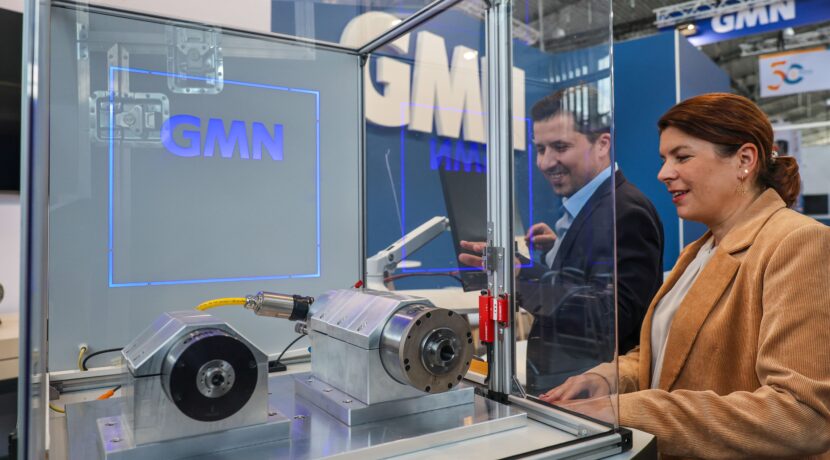
GMN’s Idea-4X illustrated a similar development from the spindle side. Vibration, rotational speed, temperature, shaft growth, and operating data are no longer treated as isolated values, but are combined into an interpretable picture of machine condition. The spindle becomes a network-capable process module that supports monitoring, maintenance, and digital documentation. In this context, artificial intelligence is used mainly as an assistance and analysis technology. It does not replace process knowledge, but helps consolidate data from machines, tools, sensors, and measurement systems into usable information.
Machine concepts shift toward flexibility
The machines shown in Stuttgart reflected a wider range of production requirements. Alongside systems for series production, flexible machine concepts are gaining importance for smaller batches, more workpiece variants, and easier operation. This responds both to the shortage of skilled workers and to the growing variety of components in user industries.
Kellenberger demonstrated the trend with the K8 and upgraded K10 cylindrical grinding machines. The K8 is positioned as a standardized CNC machine for entry-level applications and small to medium production runs. It uses a one-piece machine bed, friction-reducing coated V-flat guides on the Z-axis, and high-resolution Fagor measuring systems, but deliberately omits certain configuration options and does not include a loader interface.
The K10 is aimed at greater flexibility and process support. Its universal grinding head can accommodate two external grinding wheels and a directly driven high-frequency internal grinding spindle with a maximum wheel speed of 60,000 rpm. Longer X- and Z-axis travel, an automatic B-axis, structure-borne noise detection, semi-automatic balancing, quality measurement, and grinding time monitoring are intended to support guided operation, reduce setup time, and improve process visibility.
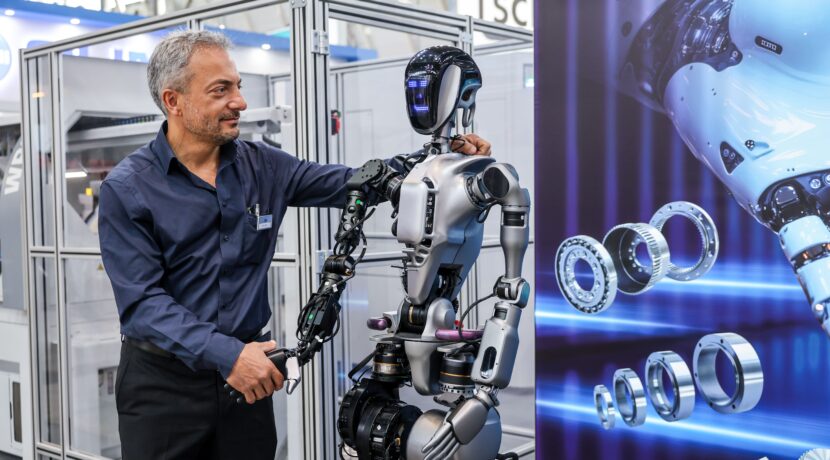
Emag placed the emphasis on coordinated process chains. Components are prepared in earlier manufacturing steps so that grinding removes only the material that is necessary. This can reduce machining time, tool wear, and process costs while maintaining dimensional, geometric, and surface quality. The company also linked this approach to components for humanoid robotics, including gear, shaft, screw, and actuator parts.
Clamping and automation support stable low-labor production
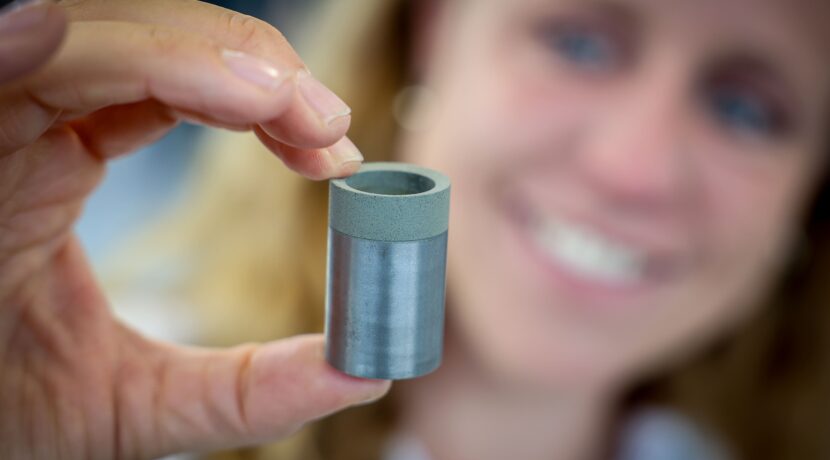
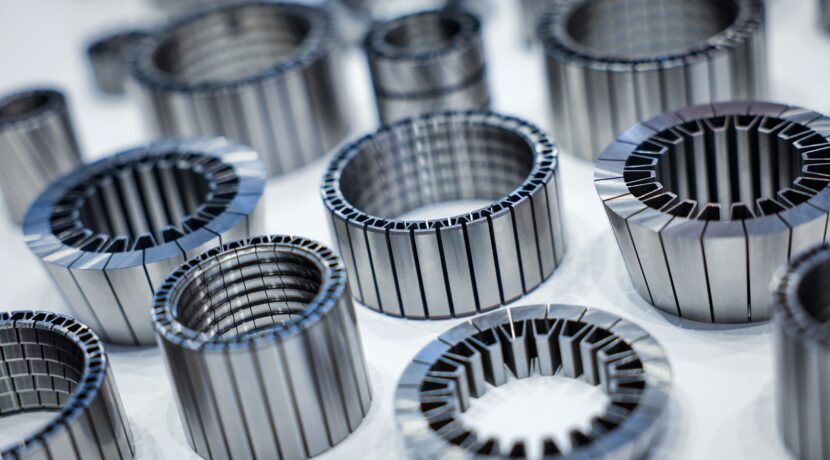
Flexible process chains also depend on chucking systems that can hold different geometries securely with minimal deformation. Emuge presented additively manufactured clamping sleeves produced by laser deposition welding. Their longitudinal, meandering clamping segments and honeycomb structures are designed using FEM to adjust radial expansion for internal clamping and radial contraction for external clamping.
Because the concept avoids separate rubber components used in many traditional clamping systems, it is intended for applications where uniform force distribution is important. Grinding remains essential in the post-processing of these clamping sleeves, since the required surface topography on the inner and outer surfaces is achieved only through machining. According to the information presented, the method is suitable for hardened workpieces with hardening distortion, thin-walled parts, and components with varying geometries.
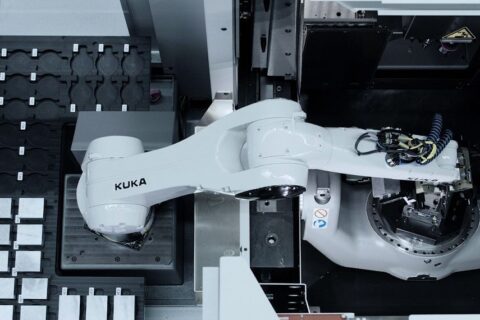
Automation was another strong theme, though the term autonomous manufacturing requires care. In this setting, it refers to cells that can run stably for long periods after setup, under supervision and with limited manual intervention. Rollomatic showed an automated tool grinding solution combining a grinding machine, robotic handling, and workpiece storage. Häberle, working with Fanuc Germany, presented an automated grinding wheel preparation process using spark-erosion dressing of conductive bonds, robotic handling, a setup station, and a digitally managed job sequence. Depending on tool dimensions, up to 100 tools can be prepared autonomously.
Measurement becomes part of process control
As machines become more connected, measurement technology is moving closer to production decisions. Zoller presented measurement, inspection, and automation solutions, including AI-based assessment of cutting tool wear. This allows tool condition to be evaluated in a more standardized, image-based way rather than relying only on the operator’s subjective judgment. The practical value lies in more reproducible documentation and better decisions on continued tool use.
Metubiq, a startup with ties to the University of Kassel, showed vibration-compensated inline optical measurement technology based on white-light interferometry. In addition to the measurement data, a separate sensor records vibrations as vertical distances. These vibration and distance components are then mathematically offset against the interferometry data, bringing optical measurement closer to production environments.
Surface lead analysis was also addressed. The Institute for Machine Elements at the University of Stuttgart presented IMA Microlead Analysis at the Grinding Solution Park Wissenschaft. The method translates the assessment of surface lead according to FVA Guideline 975 I into an industrial testing environment. This is relevant for sealing mating surfaces, where micro and macro leads can create an unwanted pumping effect in the sealing contact. According to the IMA, microlead analysis can be completed in about 2.5 minutes, while combined 3D macro lead and structure-based analysis takes about 3 minutes.
Coolant and extraction become process modules
Coolant supply is increasingly being treated as an independent technical lever rather than a peripheral function. In grinding, coolant delivery affects cooling, cleaning, thermal stability, avoidance of grinding burn, tool life, and energy consumption. This makes the design and monitoring of coolant systems directly relevant to both quality and operating cost.
Wirth Engineering applied CFD-based thinking to internal machine extraction. Instead of focusing only on exhaust air volume, the company considers the entire airflow pattern inside the machine room. Large, semipermeable air intake and exhaust elements are used to distribute airflow more evenly and capture aerosols more reliably. Simulation-based optimization of inlet and outlet elements, such as baffle plates or filter plates, can reduce local flow peaks and pressure losses. The intended result is higher extraction capacity at lower differential pressure and more homogeneous flow distribution.
Quaker Houghton and Grindaix addressed coolant supply through flow-optimized components and sensor-based monitoring of the coolant circuit. Additively manufactured parts allow internal geometries that are difficult to produce conventionally, while sensors measure parameters such as pressure, flow rate, temperature, and fluid condition. In this form, coolant technology becomes a monitored process module that influences quality, energy efficiency, and resource use.
Grinding tools focus on removal rate and material use
Tool developments at GrindingHub 2026 focused on higher material removal rates, bonding systems, and resource-efficient concepts. Meister Abrasives introduced Fusion, an organic bonding system for ultra-fine machining. The system is designed to combine higher removal rates with a high surface finish and can be used in medical technology and in machining components subjected to high loads.
MicroGrind presented a manufacturing concept for ceramic and resin-bonded grinding tools that increases grain-holding forces. The approach treats not only the binder, but also pre-treats the abrasive to improve initial grain adhesion. The company reported successful tests in surface grinding of connecting rods and in double-sided surface grinding.
Kapp Niles showed CBN-pro grinding tools made of cubic boron nitride with a positive electroplated coating, developed for applications such as grinding cast rotors. For roughing tools, the design focuses on higher machining performance through increased chip clearance volume and reduced grain agglomeration. For finishing operations, the aim is consistent surface quality even with coarser CBN grit sizes.
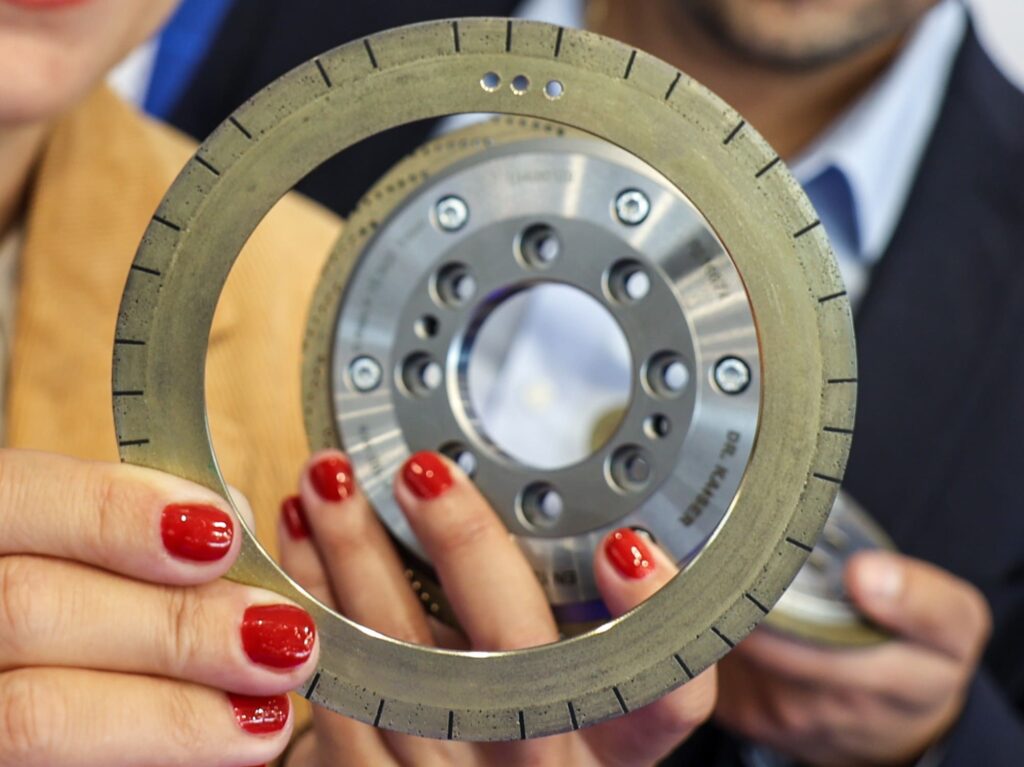
Dr. Kaiser presented the Eco-Wechselsystem, a modular dressing system in which the backing is reused and only the worn dressing layer is replaced. Users can keep replacement rings available and change them as required, either at the factory or with a tool set. For the grinding process, the important point is that re-machining must maintain the required tolerance and concentricity specifications while reducing material use in dressing ultra-hard abrasives.