
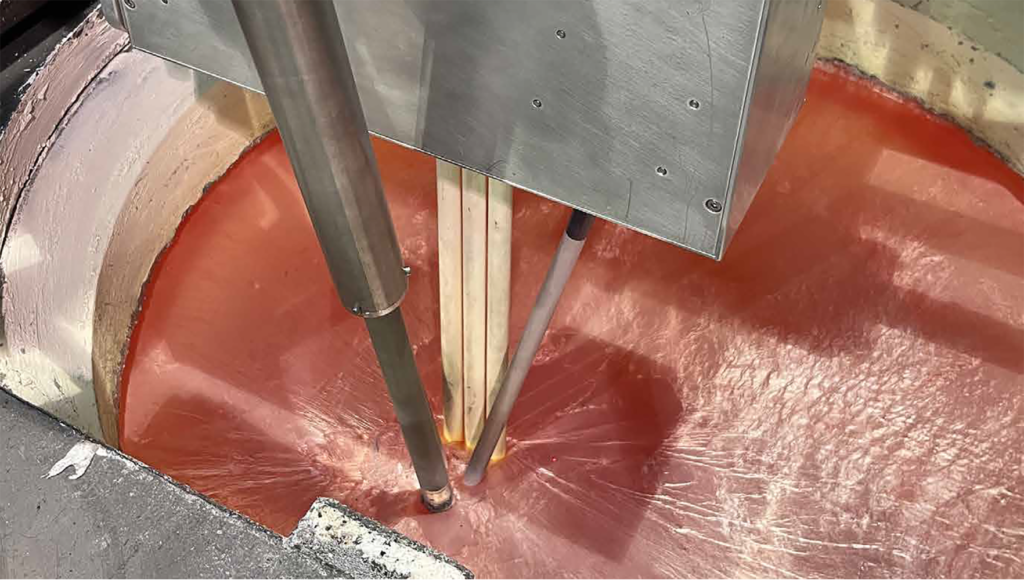
Fraunhofer IZFP will present its AloX measurement system at SENSOR+TEST 2026 in Nuremberg. The system uses ultrasound to determine the level of non-metallic inclusions in aluminum melts during production. For foundries, this is relevant because particles in the melt can reduce component quality. Early detection therefore supports more stable casting processes and better material use.
Aluminum is gaining importance in applications where low weight, good strength and recyclability are central requirements. The material can be recycled with low energy consumption and is widely used in lightweight construction. However, these advantages depend strongly on melt quality. Foreign particles in molten aluminum can remain in the final component and affect mechanical properties.
Non-metallic inclusions are particularly problematic because they can act like notches or cracks in the material. In demanding sectors such as automotive and aerospace, this can lead to serious consequences for component reliability. Detecting inclusions at an early stage is therefore an important part of quality control in aluminum casting. According to Fraunhofer IZFP, previous methods were often too slow, too expensive, insufficiently accurate, difficult to reproduce or dependent on specialist knowledge. AloX is intended to address these limitations with a continuous measurement approach that can be used directly in the foundry environment.
Ultrasonic backscattering in the melt
AloX is based on ultrasonic backscattering. Ultrasound is coupled into the aluminum melt, after which the reflected ultrasound components are detected and evaluated. From these reflections, the system can quantify the number of inclusions, their size and their distribution. This gives foundries a way to assess melt cleanliness while production is ongoing, rather than relying only on later checks or methods that require more time and expertise.
The practical value lies in bringing measurement closer to the process. If inclusions are identified while the aluminum is still in the molten state, the information is available early enough to support decisions before particles become part of a cast component. This is especially relevant where material quality has a direct influence on mechanical performance. Fraunhofer IZFP describes the method as fast, reliable and cost-effective. The aim is to make inclusion monitoring more accessible for industrial use.
The system has been adapted to the conditions of molten aluminum, which is a demanding measurement environment. By using reflected ultrasound signals, AloX makes it possible to detect impurities without interrupting the process. This continuous view of melt quality can support more consistent production and reduce dependence on slower or less reproducible inspection approaches.
Designed for foundry use
AloX can be used both in the channel and in the crucible. This flexibility is important because foundries do not all have the same process layout, and measurement points are not always easy to access. Fraunhofer IZFP states that the system can also be used in difficult measurement positions, enabling more complete monitoring of melt quality across different production situations.
Another practical aspect is operation. The system does not require expert knowledge, so measurements can be carried out by employees in the foundry. This lowers the barrier to routine use and makes the technology more suitable for production environments where quality checks must fit into existing workflows. A measurement system that depends heavily on a small number of specialists can become a bottleneck. AloX is positioned as a tool that can be integrated more directly into daily foundry practice.
The ability to measure continuously also changes how melt quality can be followed. Instead of treating inclusion detection as a separate laboratory-oriented task, the measurement becomes part of the process. For manufacturers of aluminum components, this can provide earlier insight into possible quality risks. As a result, non-metallic particles may be identified before they remain unnoticed until after casting.
Presentation at SENSOR+TEST
Fraunhofer IZFP will showcase AloX from June 9 to 11, 2026, at SENSOR+TEST in Nuremberg, in Hall 1, booth 1-317. The trade fair focuses on sensor, measurement and testing technology, making it a suitable setting for a system that connects nondestructive testing with foundry production.
Project leaders Dr. Thomas Waschkies and Andrea Mroß will present the measurement system on site. Visitors will be able to see the system and discuss its operation and possible applications directly with the researchers. The presentation is intended to show how ultrasound can be used for rapid, continuous and accurate determination of inclusion levels in aluminum melts.
Fraunhofer IZFP also sees potential beyond aluminum. As a next step, the researchers plan to expand the technology to other melts. Their current focus is on low-melting-point alloys, especially magnesium, tin and zinc, all with melting points below 600°C. In the longer term, steel is also mentioned as a possible target melt.