
Fraunhofer IGCV is developing additive manufacturing processes that combine multiple metals within a single rocket component. The goal is to reduce development time, lower material use, and cut manufacturing costs in propulsion and attitude control systems, which account for a significant share of launch vehicle cost. The work is part of a major EU research project focused on strengthening more independent European access to space.
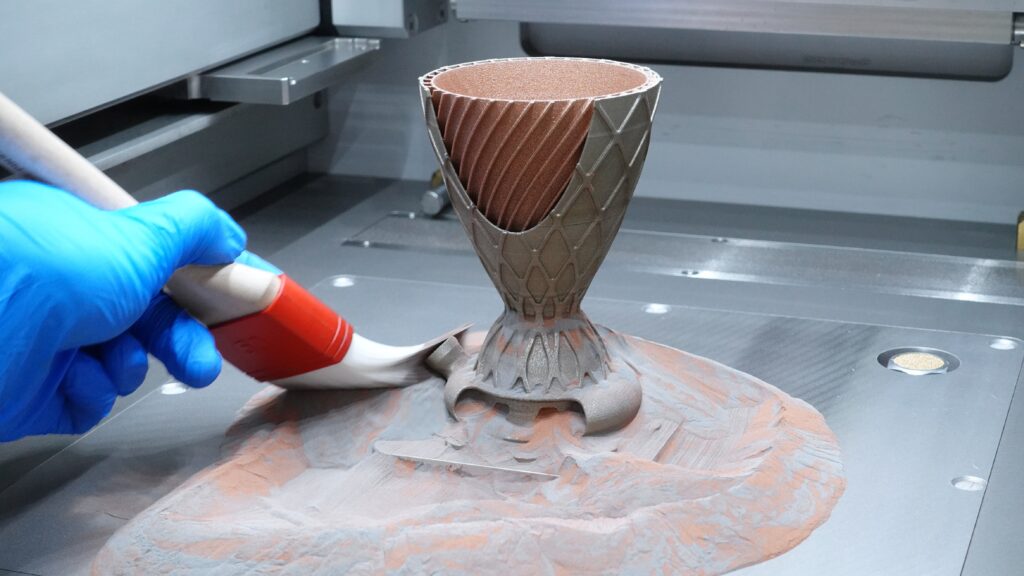
At the center of the research is multimaterial laser beam melting. In this process, two or more metal powders are selectively fused in one build, allowing local material properties to be tailored within the same part. That opens the door to components with different magnetic behavior, hardness, or corrosion resistance without having to assemble multiple pieces afterward. For rocket manufacturers, the practical appeal is clear. Design changes can be implemented directly in the digital model and produced without the long lead times associated with conventional machining and joining routes. According to Fraunhofer IGCV researcher Constantin Jugert, that flexibility can shorten development cycles by weeks when requirements change. In a sector where iteration speed and qualification effort strongly influence cost, that makes additive manufacturing relevant well beyond prototyping.
Material tailoring in a single build
Fraunhofer IGCV has already produced a multimaterial rocket demonstrator based on this approach. The component is a valve made from alternating magnetic and non-magnetic steel alloys, intended for use in systems that help keep a rocket stably aligned during flight. In laboratory testing, the part showed high density and a controlled material distribution, both important indicators for component performance.
What makes this notable is not only the use of additive manufacturing, but the degree of functional integration. Instead of manufacturing separate sections from different alloys and then joining them, the material layout is built directly into the part during production. That can simplify the production route and reduce the number of interfaces that would otherwise need to be machined, welded, or inspected. Fraunhofer IGCV is now comparing the printed prototype with conventionally milled and welded versions. The comparison is intended to show differences in function, efficiency, cost, and cycle time for the next generation of Ariane engines. That benchmarking step will be important, because the value of multimaterial printing ultimately depends on whether it can deliver not just design freedom, but measurable manufacturing and performance benefits.
Critical transitions between dissimilar alloys
The technical challenge in multimaterial printing lies less in depositing different powders than in controlling the transition zone between them. If incompatible materials come into direct contact, brittle phases and other defects can form, creating a weak point in the part. For aerospace components, where thermal and mechanical loads are high, that risk quickly becomes a limiting factor.
To better understand these limits, Fraunhofer IGCV worked with KU Leuven on the combination of titanium and nickel alloys in multimaterial laser beam melting. Initial trials without an intermediate layer produced defect-rich transitions and brittle structures. The researchers then used simulations and laboratory testing to evaluate a thin molybdenum interlayer. This interlayer prevented direct contact between the titanium and nickel alloy while still enabling a metallurgical bond on a laboratory scale.
That result is significant because it points to a more controlled route for combining materials that would otherwise be difficult to join. It also expands the design space for lightweight and functionally integrated parts, where different sections of a component may need to meet very different requirements. For rocket hardware, that could support more targeted material placement without forcing designers into conventional assemblies.
Powder recovery and process control
The economic case for multimaterial additive manufacturing depends not only on component design, but also on powder handling and quality assurance. During printing, powders can mix, which complicates reuse and can drive up material costs if not managed properly. Fraunhofer IGCV is addressing that with a magnetic separation system that automatically separates mixed powder after the process so it can be reused. That reduces both raw material consumption and associated emissions.
The institute also sees process monitoring as a key next step. In future setups, thermography and additional sensors could monitor every melt layer in real time and adjust process parameters automatically through a closed-loop system. For production environments, this matters because consistent part quality cannot rely solely on post-process inspection. Live monitoring would make it easier to detect deviations as they occur and stabilize the process across longer production runs.
That combination of powder recovery and in-process control reflects a broader reality in industrial additive manufacturing. The performance of the printed part is only one side of the equation. Scalability, repeatability, and material efficiency determine whether a promising laboratory process can move toward reliable series production.