
Researchers at FH Aachen have developed a plasma-based method that can shorten carbon fiber production and reduce its energy demand. The approach targets the stabilization of polyacrylonitrile fibers, one of the most time-intensive and energy-intensive steps in the process. By using free-standing microwave plasma, the researchers report faster heating, lower energy use, and a much shorter production line.
Carbon fiber materials are valued in applications where low weight and high load-bearing capacity are required, including bicycle frames, vehicle parts, protective clothing, and components for the automotive and aerospace industries. Rising demand puts pressure on production methods that are still slow, energy-intensive, and costly.
The conventional route starts with polyacrylonitrile, usually abbreviated as PAN. Before carbonization, the PAN fibers must be stabilized. Today, this is done by guiding the fibers through a large industrial furnace, around 30 meters long, where they are heated to about 300 degrees Celsius for approximately 60 minutes. According to the researchers, this step consumes a large amount of energy and also requires a building large enough to house the furnace. The work at the Institute for Microwave and Plasma Technology focuses on replacing this long thermal treatment with a more compact plasma-based process.
Free-standing plasma prevents local overheating
Earlier attempts to use plasma for treating PAN fibers ran into a basic process problem. In experiments with a plasma jet, the researchers were able to generate enough heat. However, that heat entered the material too locally. “The fibers simply burned through,” says Dr. Christoph Schopp, research associate at the Institute for Microwave and Plasma Technology.
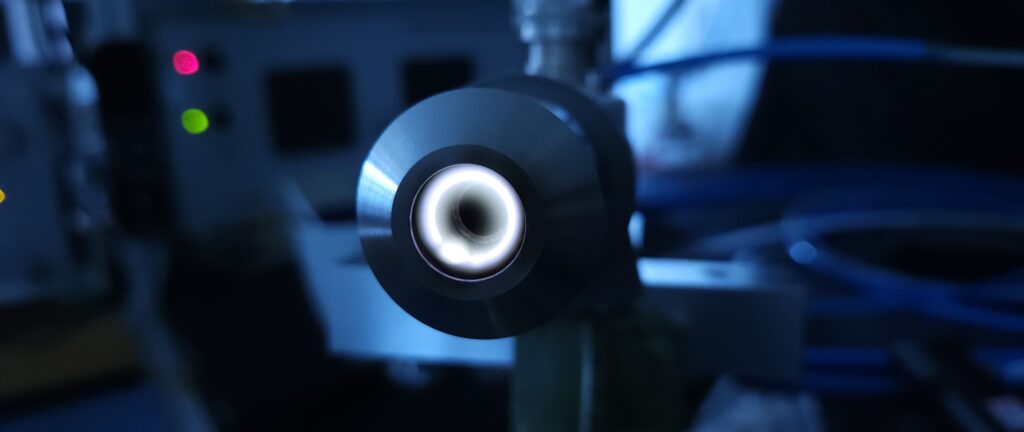
The decisive change came when Prof. Dr. Holger Heuermann and Schopp succeeded in decoupling the plasma from the electrode. Until now, artificially generated plasma was tied to a component such as an electrode. In the new setup, the plasma can stand detached from the plasma-forming elements and can be shaped according to the process requirement. The result is a cylindrical plasma field through which the PAN fibers can be guided without direct contact.
This changes the heat transfer in the stabilization step. Instead of forcing energy into a small area, the free-standing plasma radiates heat more uniformly onto the fibers. That allows controlled stabilization without burning through the material. In practical terms, the method addresses both process stability and throughput, because the fibers can be exposed to the required thermal effect without the same localized damage risk seen with a plasma jet.
Residence time falls from 60 to seven minutes
The reported process figures show why the development is relevant for industrial carbon fiber production. With the new method, the PAN fibers pass through the furnace at a speed of one millimeter per second. This gives a total residence time of seven minutes for complete stabilization, compared with 60 minutes in the conventional process described by the researchers.
The effect on energy use is also substantial. In the stabilization phase, energy consumption is reduced by 80 percent. The required production line length falls from around 30 meters to about four meters. For manufacturers, those two changes are closely linked. A shorter process not only reduces treatment time, it also changes the physical scale of the equipment needed for stabilization.
Schopp describes the optimization of the process parameters as remarkable. The main technical point is not simply that the plasma is hot, but that the plasma geometry and non-contact treatment make the heat usable for PAN stabilization. A process that previously needed a long furnace and an hour of residence time can, in the reported setup, be compressed into a much shorter and less energy-intensive stage.
Parallel plasma units point toward industrial scaling
The researchers are already working on a setup intended to move the method closer to industrial use. In this version, 16 plasma apparatuses are arranged in parallel in a 4×4 matrix. This arrangement further reduces the residence time in the furnace to six minutes. The researchers also consider further optimization to a minimum of four minutes possible.
The parallel configuration is important because carbon fiber production depends on continuous processing. A single laboratory-scale plasma field can demonstrate the principle, but industrial relevance depends on whether the treatment can be organized in a way that matches production requirements. By arranging multiple plasma units in a matrix, the concept moves from a single treatment zone toward a more scalable furnace design.
Across the complete manufacturing route, including stabilization and subsequent carbonization, the researchers report a potential energy reduction of 60 percent. They also see a possible role for the technology in supporting carbon fiber production in Europe. Schopp states that large-scale implementation of the new plasma technology could bring carbon production back to Europe. The next technical step is the construction of a production-ready furnace using the new plasma process, so that an industrial pilot phase can begin.
Microwave plasma brings high energy density into the process
The development is based on microwave plasma, generated and maintained by electromagnetic waves in the gigahertz range, around two billion invisible oscillations per second. Plasma is often described as a fourth state of matter. When sufficient energy is supplied to a gas, it can enter this state, as seen naturally in the sun and in lightning. Controlled plasma is already used in areas such as surface treatment, neon tubes, and welding processes.
For the stabilization of PAN fibers, the relevant feature is the high energy density of plasma. Prof. Heuermann notes that plasma still occupies a niche in research, although it offers considerable potential for industrial use. In this project, that potential is applied to a specific bottleneck in carbon fiber production, where long residence times and high energy demand directly affect production cost.
The research was carried out at FH Aachen’s Institute for Microwave and Plasma Technology in cooperation with the University of Ulm, DIENES Apparatebau GmbH, and Fricke und Mallah Microwave Technology GmbH. The project was funded by the German Federal Environmental Foundation. Further work with the project partners will focus on process optimization and the production-ready furnace needed for the industrial pilot phase.